
Sign up to save your podcasts
Or



Based on Podcast App listening data
AI – the end of humanity or the next evolutionary step?
Computers are becoming more powerful. Much more powerful. Last week, Gordon Moore, the co-founder of Intel Corporation died. A computer industry billionaire, he came up with ‘Moore’s Law’ which observed that the power of computers doubles every couple of years. Today a microchip can contain 50 billion transistors, each narrower than a strand of human DNA.
The war of the robots has begun. Microsoft’s ‘ChatGPT’ and its rival, Google’s ‘Bard’ allow you to have a conversation with a computer, much as you would with another person. But it’s not just talk. As well as writing essays, presentations, legal documents and sermons, artificial intelligence can also produce art. We’ve accepted that machines can beat us at chess, but might they soon also beat us at poetry, painting and music? Could they make Shakespeare look second rate? Or will art without human input always be worthless?
Some people are impressed by the quality of what AI can create, but others are scared. It’s one thing for computers to process our knowledge, but quite another when a machine starts to teach itself. If it behaves just like a real person, will we trust it more than we should? Can machines display morality and if not, is it safe to allow them to make decisions for us? We worry that AI might take over our jobs, but should we really be worrying that it might replace humanity altogether?
Some see AI as the next evolutionary step, the latest development by mankind, with potential to transform lives for the better. But what are the risks in asking technology, however impressive, to solve human problems? Should we be excited by AI, or could artificial intelligence mark the start of the end of humanity?
Producer: Jonathan Hallewell
Is Growth a False God?
Last week’s budget was, according to the Chancellor, about growth. Whenever politicians talk about their plans these days, it’s always about growth. The arguments are clear: Until we generate more growth, we can’t get any richer and wages can’t increase either. It’s urgent too: The UK will be the only major economy apart from Russia to shrink this year, according to forecasts from the OECD. But not everyone is convinced that increasing growth makes us happier, or even that it’s sustainable.
Some believe the pursuit of growth attaches too little value to wellbeing, that it neglects what should be the real priority, people’s contentment and happiness. Government policies lead us, they claim, to work harder and for longer than we want to. They suggest it creates a culture that values our economic activity, earning money and spending it, over other important roles such as caring for children and elderly relatives, maintaining our community, or charitable work. Some ecological economists believe that endless growth is unachievable without climate breakdown, that it simply can’t be sustained without irreversible damage to the planet.
What is the moral case for the pursuit of growth? The political orthodoxy is that a growing economy is good for everyone. Growth drives up pay; welfare payments depend on tax revenues; pension providers rely on stock market growth for their returns. So don’t we all have an interest in continuous growth? Or have we created a world where our leaders care more about GDP than our happiness? Has growth become a false God?
Producer: Jonathan Hallewell
Is pacifism virtuous, admirable, impractical, immoral or stupid?
War and militarism are in the news every day. In the Budget, the Chancellor announced an extra £11bn in defence spending over the next five years, to counter threats from hostile states. It comes alongside news of a new defence pact with the US and Australia in response to Chinese military power. The war in Ukraine has seen advanced weapons rushed in by Western countries to support the fight against Russia. But alongside the talk of battles and territory won and lost, there is also talk of the horrors of war. There are renewed demands for peace, and some say it should be peace at any price. In Germany, protest marchers assert that sending more weapons to Ukraine pours fuel on the fire, causing more death, misery and destruction. They claim to detect a change of mood and point out that the latest film adaptation of “All Quiet on the Western Front”, a 1929 novel by the German pacifist, Erich Maria Remarque, has just picked up four Oscars to add to its 14 Baftas.
Producer: Jonathan Hallewell
Breach of Trust
When the journalist Isabel Oakeshott broke her promise and passed Matt Hancock's personal WhatsApp messages to the Daily Telegraph, was she morally justified in doing so? She didn't just go back on her word to the former health secretary, but broke a legally-binding Non Disclosure Agreement. She claims that "no journalist worth their salt" would have acted otherwise and insists her obligations to Mr Hancock were outweighed by the public interest served by releasing the messages. But others see it differently. It was, they claim, a decision aimed at promoting her own view that government lockdown measures during the pandemic were excessive. Journalists often cite the "public interest" when it can seem that their actions are more about advancing a particular cause, or about selling their story because the "public are interested".
Aside from journalism, when is a breach of trust justified in any human relationship? For many professionals, there's an understanding that confidentiality does sometimes have to be broken. The police, social workers, doctors, teachers and even the clergy grapple with often difficult judgements about the morality of betraying trust. At times, promises are broken with the justification that it's for "the greater good". But is there really no such a thing as a truly solemn "never to be broken" promise? Or are all our confidences, our shared stories and discreet conversations rather loose arrangements, conditional on other loyalties and pressures? In our personal relationships, should we be less ready to make promises we can't keep, and also avoid asking others to do the same? What are the moral limits to our obligation to keep a secret, and how can we know when it's right to breach someone's trust?
Producer: Jonathan Hallewell
Leaders with Faith
The first hustings in the election of the new leader of the Scottish National Party were held this week. The winner will become Scotland’s first minister. But so far the coverage of the campaign has been more about religion than policy. One of the three candidates, Kate Forbes is a member of the Free Church of Scotland and has faced criticism from within her party for saying that she would have voted against gay marriage, had she been an MSP in 2014. She also said that according to her religious beliefs, having a child outside of marriage was wrong. Several of her backers have withdrawn their support and others have questioned whether such views make her an appropriate choice to lead the country.
But why should traditional religious beliefs like this be a barrier to achieving high office? Forbes insists that it’s possible to be a person of faith, while still supporting the rights of others. Although she would have opposed the legalisation of same sex marriage, she says that as a “servant of democracy” she would now defend the legal right to gay marriage “to the hilt”.
Religious belief used to be seen by most people as a private matter. It was also generally regarded as a positive attribute in a senior politician, evidence perhaps of a strong moral compass. So what has changed in our attitudes to faith and should it affect how we choose our leaders?
Producer: Jonathan Hallewell
How should Britain make amends for its colonial past?
Should museums in the UK return historic artefacts to their countries of origin? Many items displayed in museums were looted in colonial times and now there are campaigns for them to be returned. There's a related question of whether Britain should pay reparations for its role in the slave trade. Attitudes to both of these questions have shifted in recent years. Some of the Benin Bronzes, looted by the British Army in 1897 have been returned to Nigeria. The British Museum is now in talks over how the Elgin Marbles, removed from the Parthenon Temple in Greece in the 19th century, might be displayed in Athens.
Producer: Jonathan Hallewell
Why does God allow natural disasters to happen?
Producer: Jonathan Hallewell
In her first public comments since leaving office, the Ex-PM Liz Truss has argued that her plans to boost economic growth were brought down by "the left-wing economic establishment". Losing the confidence of the financial markets at a time of global uncertainty has made us all more aware of our income and expenditure. If the news accurately reflected our lives, it would be hard to escape the conclusion that life is all about money - inflation, interest rates, pay demands and profits. The overriding objective of measuring economic growth is to help as many people as possible to have more money. But how have we become so pre-occupied with what is, after all, an artificial construct that is intrinsically valueless – paper and numbers in themselves morally neutral?
The love of money may be the root of all evil, but its use demands trust and co-operation, its possession brings freedom and agency. Money may have given much of humanity richer lives, in every way, but it’s made us into transactional, rather than relational beings, and it corrupts as much as it enables; a tool that so often seems our master. It’s impossible for us to judge when we have enough of it.
If the best things in life are free, can we imagine a world without money – and would it be better?
With Charlie Mullins, Darren McGarvey, Tomáš Sedláček and Anitra Nelson
Producer: Dan Tierney.
Boris Johnson has described a chilling phone call in which Vladimir Putin threatened him with a missile strike in the run-up to Russia's invasion of Ukraine. Almost a year on from the start of the war, it’s tempting to see it as a clear-cut conflict between good and evil; Putin the malign aggressor bent on destruction and conquest, Zelensky the courageous defender of liberty and his country. It may be true, or at least substantially so, but is it helpful?
Seeing events through the prism of good and evil enables us to make moral judgements and define what we value. But it can also brush aside the ambiguities of complex situations and de-humanise both those we deem evil, and those we regard as good. Plato and St Augustine thought they were not opposites; that evil was the absence of good, a lack of moral imagination. Psychologists might prefer to dispense with the term ‘evil’ altogether, seeing it as human behaviour to be explained and understood.
Does evil exist? If so, what is it? And how should we deal with it?
With Ed Condon, Professor Scott Atran, Professor Lars Svendsen and Professor Tony Maden
Producer Dan Tierney
Nicola Sturgeon has argued for a wider debate on teenagers' rights, as she defended plans to allow 16-year-olds to change their legal gender in Scotland. Each society settles on its own thresholds to determine when a person is old enough to make informed decisions about matters including voting, having sex or drinking alcohol. This is a collective agreement about the legal point at which human beings reach maturity. But what is human maturity in moral terms?
Aristotle warned against trusting the judgments of the young, saying, “they have exalted notions, because they have not been humbled by life or learned its necessary limitations”. Meanwhile, psychological studies suggest that the period of adolescence among Gen Z has extended – ‘25 is the new 18’ – which means that ‘adult’ roles and responsibilities now occur later than in they once did. All this is evidence, according to some, that teenagers’ judgments are less likely to be sound than their elders, and rather than expecting them to be political beings, we should allow them to be kids. Conversely, there are those who argue that younger generations have been failed by a system that is rigged to favour the interests of older people; that they should play more of an active role in our democracy because their concerns are the concerns of the future; and that they are more likely to make better judgements about society because they are far more connected to the world and aware of their own values than previous generations.
Should we trust children and teenagers to make good judgments about the future? Or, if active citizenship is the preserve of adulthood, what is an adult?
Producer: Dan Tierney.
From the publisher's feed
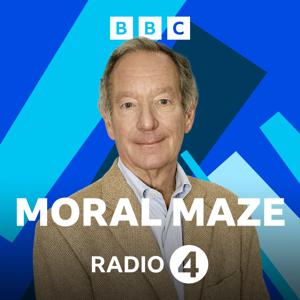
Combative, provocative and engaging live debate examining the moral issues behind one of the week's news stories. #moralmaze
Ranked by our users in the last 21 days

7,626 Listeners
874 Listeners

1,046 Listeners
157 Listeners

5,482 Listeners
1,798 Listeners

1,808 Listeners
1,031 Listeners
2,108 Listeners
1,904 Listeners
28 Listeners
35 Listeners

369 Listeners
161 Listeners
41 Listeners
59 Listeners
107 Listeners
693 Listeners

3,221 Listeners
725 Listeners
1,004 Listeners

3,021 Listeners

1,114 Listeners
773 Listeners
30 Listeners