
Sign up to save your podcasts
Or



Based on Podcast App listening data
School’s out for summer. For many, holidays are a chance to rest, unwind and empty the mind of work. For others, the long break brings additional pressures and stresses, such as childcare. It’s a period when inaction and inactivity are to be celebrated and envied.
What does that reveal about our priorities? During the pandemic, many people got a glimpse of what it was like to live more simply. Aristotle writes that the greatest possible human good is contemplation, a life lived remote from endless activity. Economics has taught us that our time is money, which is a necessity. But for some it has turned human beings into ‘human doings’ – units of productivity. The philosopher Bertrand Russell wrote “In Praise of Idleness” in 1932, at the height of the Great Depression, in which he called for nothing less than a total re-evaluation of work – and of leisure.
Throughout history, however, idleness has, more often than not, had a bad press. St Benedict described it as “the enemy of the soul”. Sloth is one of the seven deadly sins – a failure to do what should be done. The greatest danger of idleness, some believe, is that it can slide from a state of inaction to a state of purposelessness. That’s why Christianity has long seen the positive moral value, the character-building nature, of hard work.
Is idleness good for us?
Producer: Dan Tierney.
Wimbledon, the Ashes, the Proms and George Osborne’s wedding have all been interrupted by ‘Just Stop Oil’ protesters in recent days. Several areas of London have been brought to a standstill, provoking the ire of motorists and leading to multiple arrests. ‘Just Stop Oil’ describes itself as a “nonviolent civil resistance group demanding the UK Government stop licensing all new oil, gas and coal projects”. The Prime Minister Rishi Sunak said he wouldn't be “giving in to eco-zealots” disrupting the British summer.
The group’s supporters believe that blocking traffic, interrupting sporting events and vandalising artwork, are entirely proportionate in the face of an existential crisis bequeathed to our children and grandchildren. Right now, they argue, parts of Europe are literally on fire, and there is no more time left to wait for those in power to do the right thing. Their critics object to the fact that the targets of the protests are often ordinary people, who have more immediate concerns like the rising cost of living. Moreover, some believe the use of apocalyptic language is less likely to elicit a change in behaviour, since despair, like indifference, is not a good motivator.
How might our descendants judge today’s climate activists? Successful movements for social change, like the Suffragettes, have historically been disrupters who, in the face of inaction, adopt increasingly radical tactics. For some, the spirit they embody is irrepressible and necessary, which means that their methods cannot always be peaceful. For others, social progress can only be fully achieved through conventional democratic means.
Are acts of civil disobedience and sabotage by climate activists morally justifiable?
Producer: Dan Tierney.
As NATO meets this week, the US is seeking to calm its critics over sending cluster bombs to Ukraine. Cluster munitions are banned by many countries – including the UK and most EU members. They are more indiscriminate and can leave unexploded bomblets scattered over a wide area, posing a lethal threat to civilians years after a conflict has ended. The US, which is not a signatory to the 2008 Convention on Cluster Munitions, argues that supplying these weapons is justified in the defence of Ukraine, that civilian areas would be avoided and that records would be kept to facilitate a clean-up operation after the war.
While some see this as a clear concession of the moral high ground, others disagree. As one US congressman put it, “the only way it erodes the moral high ground is if either you're an idiot, or you're rooting for Russia in this conflict."
What should be the ethical rules of conduct in warfare, when the goal of opposing armies is to perpetrate, and sometimes maximise, death and destruction? For some, the tragedy of war is the suspension of ethical norms. And yet, certain fundamental principles, such as proportionality of violence and discrimination between enemy combatants and non-combatants, have existed for centuries to prevent the ends being justified by any means necessary in battle. But what if the enemy has no regard for these rules? How should they be interpreted outside a philosophy seminar and in the chaos of war?
Producer: Dan Tierney.
Thames Water, which serves a quarter of the UK population, is billions of pounds in debt and on the brink of insolvency. The company has received heavy criticism, and calls for it to be nationalised, following a series of sewage discharges and leaks. The energy sector, railway companies, and the Royal Mail have faced a similar outcry in recent months.
When it comes to the provision of services which are essential for our national life, the calculation is often utilitarian: which form of ownership, public or private, leads to the greater social good? Many believe that the private water, rail and energy companies are simply failing to serve the public. Meanwhile, although polling suggests most people want to keep the NHS under public ownership, many of the health outcomes of patients compare less favourably to other European countries.
The privatisation versus nationalisation debate is about more than outcomes: it highlights competing visions of the good society. For some, the private sector gives us more freedom of choice as moral agents. For others, a ‘market mentality’ has crept into more and more aspects of our social and communal life, including education, and the result has been the erosion of our own moral obligations towards each other.
Can the motivation for profit co-exist alongside a vision of the common good? What moral responsibilities should private companies have to society? And what are the moral limits of markets?
Producer: Dan Tierney.
Comparisons have been made between the news coverage of two tragedies at sea. The first was the capsizing of a boat off the coast of Greece, in which more than 500 migrants from the Middle East and Africa are thought to have drowned. The second is the catastrophic implosion of the Titan submersible carrying five people, including a billionaire explorer, who paid a huge amount of money to see the wreck of the Titanic. While the first story made the news, the second story was rolling news.
Moral Maze panellist Ash Sarkar faced a backlash when she tweeted about what she saw as the “grotesque inequality of sympathy, attention and aid... Migrants are “meant” to die at sea; billionaires aren’t.”
This raises the question of the moral purpose of the news – particularly when it comes to public service broadcasting – and the difference between reporting what people want to know and what they need to know. For some, the ‘ticking clock’ coverage of the Titan tragedy was ghoulish and sensationalist. For others it was merely a reflection of the trajectory of the story: the hope, the endeavour and the jeopardy. Then there is a question of scale – does a larger body count have a greater moral claim to be covered by the news? Or is it natural for British media to reflect a greater sense of empathy for British citizens?
What makes the news, what is left out, and how it is covered, is a decision made by editorial teams and individuals with their own view of what is 'newsworthy'. But what about our responsibilities as consumers of news? Does the demand for immediate clickbait sensationalism over thoughtful analysis from the other side of the world create a news environment which is out of kilter with what matters? Is this simply human nature or something we should seek to redress?
What news stories should make a moral claim on our attention?
Producer: Dan Tierney.
Scientists have created the first synthetic human embryos using stem cells. The breakthrough could help research into genetic disorders, but it raises ethical questions about the creation of life without the need for eggs or sperm. While nobody is currently suggesting growing these embryos into a baby, the rapid progress has outpaced the law.
This prompts a wider question: instead of society having to play catch up with science, should we be having a more frank conversation about the moral responsibilities of science itself? Some believe that scientists need their own version of the Hippocratic Oath, a regulatory system of ethical standards, similar to doctors. Others think that will stifle creativity, enthusiasm and academic freedom.
The human drive for discovery is the engine of progress – and we have demonstrably never had it so good. But are there things we should not want to discover? Are we capable of making a conscious decision to say “no further” if the potential consequences of pursuing knowledge are both good and bad? For some, science is morally-neutral, its advancement is inevitable, and it’s down to society to set the rules about what to do with the findings of scientific research. For others, simply relying on the moral-neutrality of science could be humanity’s fatal flaw, and there should be more democratically-accountable oversight of the research. If that’s the case, where should the ethical lines be drawn? As well as the consequentialist arguments, some make the distinction between science as a means of discovering the natural world and ruling it; in religious terms, between seeking to understand God and ‘playing God’.
When, if ever, should we apply the brakes on science?
Producer: Dan Tierney.
It’s almost impossible to imagine why anyone would risk a perilous crossing over cold, dark waters in an inflatable dinghy. This is a story of humankind: the despair – or ambition – that drove them, the wickedness of the traffickers who exploited them, and the moral dilemma of those of us already living where they want to go. History is all about borders.
Two cross-party reports out this week have sought to inform the political and moral response to the ‘Illegal Migration Bill’, currently making its way through Parliament, which proposes that people who come to the UK “illegally” will be detained and permanently removed. The Commons Joint Committee on Human Rights concludes that the bill, “breaches a number of the UK’s international human rights obligations”. Meanwhile, a Home Affairs select committee report states there is "little evidence" Albanians are at risk in their country and need asylum in the UK.
Migration brings into focus the competing worldviews of universalism and localism. Universalists argue that the world is shrinking, and that pandemics and climate change reveal our interdependence as one global community. It is neither moral nor in the national interest, they argue, to erect bigger borders out of a sense of protectionism. Their opponents see borders as not just territorial or political, but intrinsically moral. Borders, in their view, create moral communities in which people feel rooted and valued.
How much should a country be willing to compromise the integrity of its boundaries out of compassion for non-citizens? Is it unjust to see people differently, based on where lines are drawn on a map? Would a world without borders be a better place?
Producer: Dan Tierney.
Try telling the hordes of Manchester City fans heading to the Champions League final this weekend that the beautiful game has an ugly side. The team is on the verge of sealing an historic first Treble and glory awaits. Rival fans, however, claim they’ve bought success, with the wealth of their Abu Dhabi owners.
The eye-watering sums of money invested in top-flight football raises moral questions for all fans, some of whom may feel they are entering into a Faustian pact. Newcastle United’s recent takeover by an investment fund with strong links to the Saudi state, has prompted concerns about ‘sportswashing’ – a means by which ethically dubious regimes direct attention away from their poor human rights records. Some worry that the commercialisation and uneven distribution of wealth in the game has priced hardworking fans out of watching their team, while leaving some community clubs on the brink of insolvency. There is unease not just about the institution of football but about its culture. Across Europe, high-profile black players are targets of racist abuse, there are hardly any openly gay footballers and female officials are subjected to misogyny.
Others see football, on balance, as a moral force for good. Our society, they say, would be worse off without it. Far from encouraging a toxic tribalism, enthusiasts believe football brings communities together. They cite grassroots projects, funded by footballing authorities, clubs and individual players, which often go under the radar and transform people’s lives. For many fans, football is a language that knows no borders, and their home ground is a cathedral of collective transcendence. Football could be seen as a microcosm of life – the agony, the extasy, the drama, the messiness, the humanity – just ask the people of Wrexham, whose Hollywood owners, they believe, have not just injected money into their club, but meaning into their town.
Producer: Dan Tierney.
The gender-critical philosopher Kathleen Stock’s address to the Oxford Union this week has divided academics at the university. One group has signed a letter expressing concern that student opposition to her invite goes against free speech. A second group has written an open letter supporting the students and stating that revoking an invite is not the same as preventing someone from speaking.
This case is seen by many as an example of so-called ‘cancel culture’. ‘Cancel culture’ has become such a common term that it is not always easy to understand what precisely it means and what its implications are for society. Media organisations have always made judgements about who should and should not receive a platform. What some view as censorship, others see as curating their own experience of who and what they interact with.
Cancel culture on the left is often characterised as a form of secular puritanism denouncing the ‘sins’ of the age, while, as perceived on the right, it can have an overtly religious justification in the defence of so-called traditional liberal values. Those who view cancel culture as a threat to Western liberal democracy point to dramatic historic parallels: witch hunts, inquisitions, book banning. Others reflect that ostracization and social shunning have always existed as a form of accountability for an individual’s actions. Is there a difference between a person being accountable for their behaviour and being accountable for their ideas? If not, who decides what are ‘unacceptable’ ideas?
The tragic death of primary headteacher Ruth Perry, who took her own life when her school was set to be downgraded to “inadequate”, has prompted widespread anger from teachers and calls to reform or abolish Ofsted. Ruth Perry’s family believes that the stress of the inspection led to her suicide, and this week an article in the British Medical Journal argued that “every work-related suicide” should be investigated by the Health and Safety Executive.
While some see this as an important intervention in seeking to understand and prevent further suicides, others are concerned that speculation about direct causal 'triggers' can oversimplify a complex issue. The Samaritans’ media guidelines state: “vulnerable people experiencing similar issues are more likely to over-identify with the deceased when a single reason is given”. Moreover, others are worried about the ‘weaponisation’ of individual cases of suicide by campaign groups seeking to advance wider political aims.
Suicide is a highly sensitive issue and the way we talk about it matters. Across different times and cultures it has been seen as both honourable and sinful. Today, most responses start from a place of compassion, based on a better understanding of mental health. While it is vital to understand, prevent and treat suicidal thoughts, should we ever seek to rationalise or explain suicide? That question is also pertinent in the debate around assisted dying. For some, choosing to end one’s life in this way is a rational decision we should be allowed to make in certain circumstances, for others, that social acceptance would have a far-reaching impact on people's perception of the worthwhileness of their life.
How should we talk about suicide?
Producer: Dan Tierney.
If you are suffering distress or despair and need support, including urgent support, a list of organisations that can help is available at www.bbc.co.uk/actionline
From the publisher's feed
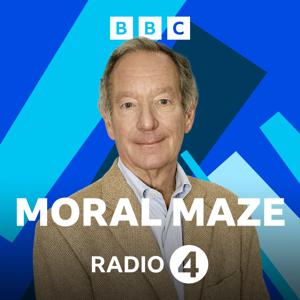
Combative, provocative and engaging live debate examining the moral issues behind one of the week's news stories. #moralmaze
Ranked by our users in the last 21 days

7,626 Listeners
874 Listeners
1,046 Listeners
157 Listeners

5,482 Listeners
1,798 Listeners
1,808 Listeners
1,031 Listeners
2,108 Listeners

1,904 Listeners
28 Listeners
35 Listeners

369 Listeners
161 Listeners
41 Listeners
59 Listeners
107 Listeners
693 Listeners
3,221 Listeners
725 Listeners
1,004 Listeners
3,021 Listeners

1,114 Listeners
773 Listeners
30 Listeners