
Sign up to save your podcasts
Or

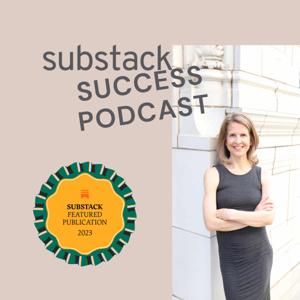


Maya C. Popa and I talk about self-promotion for the self-promotion averse.
Find out why self-promotion is all about bravely falling backward into a ball pit and why we can blame our dislike of it on the Modernists, Roland Barthes, and the Iowa Writers Workshop.
Welcome to the Substack Live Podcast!
Conversations with the best Substack early adopters who created amazing newsletters and continue to bring their good work to the world and make the world a better place in doing so. Plus, get updates and expert guidance on the platform as it changes and changes again and again, so you can use it to fuel your creative, professional, and financial life.
Brought to you by Substack Writers at Work Founder and Director and former Paris Review interviewer, Sarah Fay.
Over 300 people showed up to this live recording of the Substack Live Podcast to hear Emily Farra and Jessica DeFino talk about how they built newsletters that became something bigger than the platform itself, including:
* Why having tens and hundreds of thousands of subscribers doesn’t mean the Substack writer has it easy—far from it
* How to create your own platform and not to be platform-dependent
* Why it’s ill-advised to try to write a “genius essay” every week on demand and it’s better to create a framework you can apply consistently
* Why consistency is everything—unless it’s not
* And so much more…
Jessica DeFino is an award-winning beauty reporter and critic (the New York Times, the Sunday Times, Vice). She’s also written for Vogue, Allure, and more. She now writes the Guardian’s beauty advice column, Ask Ugly, a position that arose out of her Substack. Adweek named her one of their Creative 100 for 2023. She’s smart and sharp and funny and wry. FLESH WORLD by Jessica DeFino is “the newsletter the beauty industry fears.” She’s a Substack icon who showed what’s possible beyond the platform. And her CTAs are the best, e.g., “Subscribe now. (Because retinol won’t work in the face of your mortality.)”
Emily Kirkpatrick is the Roland Barthes of fashion writing—with a little bit of Stephen Wright and Tig Notaro mixed in. She’s written for People, i-D, The New York Times, and Vanity Fair, among many others. Her newsletter I <3 Mess is essential reading, whether you care about fashion or not.
Thank you, Helen Roy, Amy Gabrielle, Lynn Jericho, Brad Wetzler, Morgan Strehlow, and many others for tuning into my live video with Emily Kirkpatrick and Jessica DeFino!
It was so fun to talk about the importance of mindset when you're a writer and a Substack writer.
It’s everything.
Substack Writers at Work is the only expert guide to Substack.
* We’re one of the Top 10 Substacks, globally—a bestselling Substack featured by Substack and trusted by writers and creators since 2022.
In case you don’t know me, I’m the leading Substack Strategist. I’ve been on this platform for over five years and over a thousand writers and creators 1:1 and tens of thousands on Substack Writers at Work.
Everything you get on Substack Writers at Work is based on real results: clients who’ve doubled, tripled, and 10x’d their subscribers; grown their revenue; produced their best work; and built deep engagement.
Join us.
www.substackwritersatwork.com
Welcome to the Substack Live Podcast!
Conversations with the best Substack early adopters who created amazing newsletters and continue to bring their good work to the world and make the world a better place in doing so. Plus, get updates and expert guidance on the platform as it changes and changes again and again, so you can use it to fuel your creative, professional, and financial life.
Brought to you by Substack Writers at Work Founder and Director and former Paris Review interviewer, Sarah Fay.
You can also listen on your favorite podcast platform →
Over 700 people showed up to this live recording of the Substack Live Podcast to hear Austin Kleon give some of the best advice on how to have a newsletter/Substack that means something to you and your readers, including:
* making what you want to see in the world,
* taking time to process in a world that wants us to just move on and scroll,
* writing the newspaper column you’ve always wanted to write,
* the So what? test,
and so much more…
The Atlantic called Austin Kleon “positively one of the most interesting people on the Internet,” which is why his Substack is so damn good.
To have a Substack newsletter that people are interested in, it helps to be interesting, which typically comes when the writer of said Substack is interested in the world and specifically, the part of the world he writes about in a way no one else can.
Austin was Substack before there was Substack, having started his newsletter in 2013, before Substack existed. He came to Substack in 2021 because, he said, he liked the simple interface.
He’s the New York Times bestselling author of a trilogy of illustrated books about creativity in the digital age—Steal Like An Artist, Show Your Work!, and Keep Going—and of Newspaper Blackout, a collection of poems made by redacting the newspaper with a permanent marker.
I love how he describes his trilogy, which is a masterclass in creativity and living a creative life:
* Steal Like an Artist is the book you give to somebody who’s just starting out and needs a kickstart or a boost.
* Show Your Work is for the person that has found their thing but they haven’t been found themselves yet — people who need to self promote or need to get their work out there.
* Keep Going is really the book for people who are trying to make a career out of creative work — people who are trying to be in it for the long haul
***
About the Substack Live Podcast
Join me for conversations with Substack early adopters who created amazing newsletters and continue to bring their good work to the world and make the world a better place in doing so.
I also bring you updates and expert guidance on the platform as it changes and changes again and again, so you can use it to fuel your creative, professional, and financial life.
Subscribe to receive every episode»
Thank you Tom Sykes, Beth Spencer, Jason Chatfield, Petya K. Grady, Emilie Friedlander, and many others for joining us.
Nearly 400 people showed up to listen to Maya C. Popa and I talk about:
- The realities of pitching, publishing, and rejection
- Mindset, motivation, and the myth of “having it all together”
- Substack strategies, authenticity, and audience growth
- The dopamine loop, validation, and the writing process
and more…
Maya is a poet, prose writer, exceptional human, and someone I’m so lucky to call a dear friend. She’s the author of three books of poetry: Wound is the Origin of Wonder (W.W. Norton 2022; Picador 2023), named one of the Guardian’s Best Books of Poetry; American Faith (Sarabande 2019); and her third collection coming in 2026, which we’re all going to make sure it gets on the bestseller list. She’s also the Poetry Reviews Editor at Publishers Weekly. She’s been teaching for thirteen years at NYU and is just such an exceptional human. Her poems have been published in The New Yorker, The Paris Review, Poetry, Granta, the Nation, and elsewhere.
What I love most is Maya’s Conscious Writers Collective (CWC), her online school and writing community that offers a rigorous, MFA-level education for writers without forcing them to take on the debt an MFA program would. Having taught at NYU and elsewhere at the graduate and post-grad level, she’s created a not-to-be-missed-out-on mentorship and training for writers at all levels, those who already have an MFA, those who might go on to receive one with the training they need to make the most of it, and those who may get enough to produce a body of work ready for publication without it.
Thank you Jonas Ellison, Lulu Pearl Trevena, Andō, Sarah Brennan, Eric K. Carr, and many others for tuning into my live video with Maya C. Popa! Join me for my next live video in the app.
In this episode, I tell you what no one tells you about the Substack Bestseller badge, what it really means, and why your Substack DNA is all that matters.
As people scramble onto Substack, it’s easy to overlook why it’s the platform to be on right now: Certain early adopters spent years creating Substack newsletters so good people would actually read and paid to read them. Which is why I’ve created an entire podcast to share them with you.
My conversation with Mason Currey contains some of the best advice on how to stop feeling like you have to chase the algorithm and can set about owning your platform and doing your best work.
Nearly 300 people showed up for the live recording.
If you don’t know Mason, he’s the author of the Daily Rituals books and writes the Substack newsletter Subtle Maneuvers about how creative people get work done.
Cal Newport called him “the undisputed master of finding, in the messy lives of great artists and thinkers throughout time, deeply human lessons about cultivating meaning in our current age.”
* This is some of the best advice on how to build a Substack that people will spend their time and money reading.
* + How to stop chasing the algorithm and own your platform.
6 Ways to Build a Substack People Will Actually Spend Their Time and Money Reading
1. Don’t call it your Substack
Mason doesn’t say “my Substack.” He says “my newsletter.” The distinction keeps him focused on the writing, not the platform dynamics.
“When you think ‘my Substack,’ you start thinking about Notes, recommendations, leaderboards, what other Substacks are doing. When you think ‘my newsletter,’ you think about your readers and your work.”
2. His writing process
When writing, Mason doesn’t necessarily think about what will get subscribers. He’s thinking about what hits him and what will hit his readers.
“I’m always really thrilled when I read something or hear something in a podcast. I have my feelers out for that thing that makes me kind of sit up in my chair. When my spidey sense kind of tingles, I think okay, that could be a good newsletter. That’s something that I feel like really hit me and maybe it’ll hit my readers too.”
3. You don’t have to be confessional to connect with your readers
Many people aren’t comfortable with or don’t want to divulge every aspect of their personal lives on their Substacks. Mason doesn’t overshare but it still feels he’s talking to you. You experience his mind through what interests him, what he struggles with, what he finds in other people’s stories.
“You don’t know a ton about me but I think it somehow influences when I’m writing about somebody else’s process—you can believe that there’s a lot of me hidden in there.”
4. When to go paid
Mason started his newsletter in February 2020 with 74 subscribers. For two years, he built something good before going paid.
When Substack introduced recommendations, his growth spiked because (that’s right) his Substack was really good.
When I asked what made him decide to turn on paid subscriptions, he said: “I guess I just saw all these people making like six and seven figure incomes. And I was like, maybe I’ll just turn it on. I said, you know, it’s the same thing. But if you feel like you want to chip in to support it, feel free. And people did. It was wonderful.”
Over time, he’s added community features—a morning co-working Zoom at 6 AM (which is wild), a book club. But the newsletter itself stays free.
Mason said: “I’ve thought a lot about different things I could do and this is one that I feel good about. I don’t feel like I’m out there trying to sell, sell, sell. It feels sustainable and true to the spirit of the newsletter. Even if it’s not maybe as profitable as it could be.”
You don’t have to wait two years or even two months, but don’t rush to it until you have something worth paying for.
5. Go analog
Mason’s research process is tactile. He reads physical books from a physical library, marks pages with acutal sticky notes, scans those pages, prints them, then goes back through with a pen and makes notes.
He said: “That way I feel like I get to sort of run it through my brain at least twice.”
I know someone who does this with Kindle, where they print all their highlights and review them. You’ll only remember 20 percent of what you read if you don’t review it, but if you do review, you’ll remember 80 percent.
Mason’s process can’t be rushed. It produces original thinking because it’s been filtered through his brain twice, processed through his hands, connected to his interests and the way only he sees the world.
6. His advice for anyone just starting or who feels stalled
When I asked Mason what advice he’d give someone starting out or feeling very frustrated, he said:
“I would just figure out what writing you want to do that you would do for yourself or for your friends. Or if someone whose writing you like were to read it, what would you be happy for them to read of yours? I would just leave out the subscriber numbers and the money thing and just try to produce something you’re proud of that you can build up a collection of over time.”
Mason’s new book is Making Art and Making a Living, coming out in March 2026. My passion is to help Substack writers reach the bestseller lists by leveraging the Substack network, so please pre-order now. » Pre-ordering a book is quite possibly the most important way you can support a writer.
My interview with Mason is part of The Substack Live Podcast: Conversations with the best Substack early adopters who created amazing newsletters and continue to bring their good work to the world and make the world a better place in doing so. Plus updates and expert guidance on the platform as it changes and changes again and again, so you can use it to fuel your creative, professional, and financial life.
For paid subscribers:
For the only expert guide to Substack, join Substack Writers at Work with the leading Substack Strategist Sarah Fay: https://www.substackwritersatwork.com/
Substack has fundamentally changed—and that's actually the best thing that could happen to us. While everyone's panicking about algorithm changes, trolls, and platform noise, we need to see why Substack 5.0 is our opportunity to build something bigger.
In this episode, we break down why treating Substack like social media will hurt your growth.
We keep growing, we keep earning, but we stop being "on" Substack like it's Instagram. We use it as a launchpad for books, speaking, media opportunities—not another hamster wheel.
Every single one of my 42,000 subscribers has been hard-earned through deep work, not tricks. This isn't about growing less—it's about growing smarter while everyone else burns out chasing the algorithm.
Rufus Griscom’s Substack Author Insider is one of the Substacks I read or listen to/watch every single week. We’re so inundated with AI-generated slop about creativity, writing, and publishing. Author Insider is all about integrity and brings us real cutting-edge ideas and glimpses into the future of writing and publishing.
This was such a fun conversation. We talked about AI and the future of books, Rufus’s beginnings at Nerve.com and Babble, the changing landscape for writers, including the decline of general nonfiction sales, the importance of building email audiences over social media followers, the evolution of podcasting economics, and all the incredible interviews and insights Author Insider brings.
I highly, highly recommend subscribing. Substack Writers at Work get 25% off through the end of the month with this link.
Enjoy!
I mention his headshot.
Bring all your thoughts and questions to our Substack Writers at Work community chat. Don’t do Substack alone…
From the publisher's feed
Ranked by our users in the last 21 days

37,863 Listeners

16,036 Listeners

576 Listeners

14,908 Listeners

39 Listeners
3,301 Listeners
2,607 Listeners

269 Listeners
782 Listeners
678 Listeners

1,634 Listeners

18,838 Listeners
17 Listeners

6,157 Listeners

5 Listeners