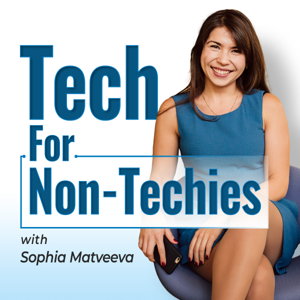
Tech for Non-Techies

Tech for Non-Techies

Download on the App Store

Tech for Non-Techies episodes

  • 87. How to commercialise innovation

    Success in tech consists of two parts: making great products and using them to build a business. No matter how brilliant an app or algorithm is, if people do not want to pay for it, it is unlikely to live for long.

    This is why all tech innovators need to learn the core skills of commercialising innovation.

    Listen to this episode to learn how Salesforce, Starbucks and Xero commercialise their tech products, and so you can apply their lessons too.

    The top 3 questions you need to answer to ensure your tech product has business success are:

    1. How will this product help people make more money?
    2. How will this product improve customer experience?
    3. How will this product improve efficiency?

    Always focus on the benefits that the product will bring customers, not its features.

    Tell Sophia what you're working on and submit your questions to her on [email protected]

    Or reach her on Facebook, Instagram and LinkedIn and Twitter.

    22 min
  • 86. What is coding? The quick guide for non-coders

    The terms coding and programming are ubiquitous, yet many non-technical professionals do not know what they mean in practice. Why are there different coding languages? What do developers actually do?

    This is what you'll learn in this episode.

    Learning notes:

    • Data is information that you can use to do something with. For example, your shopping list is information that you use to remember what food to buy when you go to the supermarket.
    • Technology is what you use to create, store or communicate that data. In our shopping list example, it could be pen and paper, or the notes app on your phone.
    • In order to make software, you have to tell a computer what to do. You do this via a programming language. All digital technologies are created by using specific coding languages to turn data into useful outcomes.
    • Python Java, C++ and Ruby are the most popular languages today. But, there are 256 coding languages in use today.
    • Binary code, also known as Machine Language, is what computers understand and are made up of 0 and 1, and nothing else. Coding languages like Python turn into binary language, so the computer can turn the commands into action. Most developers do not use binary language when writing code.

    Sign up to Sophia's mailing list here to get invited to events and get free learning in your inbox.

    Sign up to the mailing list

    Join the Tech for Non-Techies membership community. As a community member, you'll get:

    • ALL of our courses (Tech for Non-Technical Founders, How To Speak Tech For Leaders and more)
    • Monthly coaching with Sophia Matveeva
    • Live masterclasses with global experts
    • Supportive Online Community
    • Library of masterclasses
    • Exclusive Resources & Perks

    Learn more and sign up at https://www.techfornontechies.co/membership

    Say hi to Sophia on Twitter.

    Following us on Facebook and Instagram will make you smarter.

    21 min
  • 85. "Don't be afraid of the tech," lessons from a non-technical founder
    Nasi Rwigema doesn't have a background in software, but that didn't stop him from building his tech platform: Umwuga, a social network for blue collar workers in South Africa. To his surprise, he found that figuring out what people want is much harder than learning about tech.

    Nasi is one of Sophia's students from London Business School. He took her course three years ago, and used his knowledge, network and resilience to build his platform.

    If you have an idea for a tech venture, as a founder or a corporate innovator, or you want to invest in tech businesses, but don't have a tech background, this episode is for you.

    Learning notes from this episode:

    • "Don't be afraid of the tech and don't let not having a tech person hold you back," says Nasi. "Instead, focus on the customer and the problem you are solving."
    • Show traction from the start. This doesn't necessarily mean revenue or explosive user growth. It means doing whatever you can to solve the problem for the customer.
    • Outsourcing is a great way to build your product. Your needs will change as you grow, and a good product studio will be able to help you scale up your team. For advice on how to hire great product teams, get Sophia's e-book: How To Hire Your Product Team & Go From Idea To App: The Non-Technical Founder's Guide

    To learn the core concepts Nasi learnt from Sophia to build his business, join this FREE class:

    Break Into Tech: Masterclass For Non-Technical Founders

    Join the Tech for Non-Techies membership community. As a community member, you'll get:

    • Monthly coaching with Sophia Matveeva
    • Live masterclasses with global experts
    • Supportive Online Community
    • Library of masterclasses
    • Exclusive Resources & Perks

    Learn more and sign up at https://www.techfornontechies.co/membership

    Say hi to Sophia on Twitter.

    Following us on Facebook and Instagram will make you smarter.

    1 hr 9 min
  • 84. What UX designers do and how to work with them
    "Most people make the mistake of thinking design is what it looks like. People think it's this veneer — that the designers are told, 'Make it look good!' That's not what design is. It's not just what it looks like and feels like. Design is how it works," - Steve Jobs

    In this episode, you''ll hear from Sarah Doody, a UX designer who has worked for the likes of Vice Media and Dow Jones. Today Sarah runs Career Strategy Lab, a school for UX designers.

    Learning notes from this episode:

    • "User experience design is how you interact with a product, whether it's digital, physical or a mix of both," Sarah Doody.
    • When hiring a UX designer, think about the outcome that you want, rather than the process. E.g. Do you want a prototype to test an idea? Then you don't need the same level of attention to graphics as you would for a design you would give to developers.
    • If you want to transition into a career in UX design, your experience in another field can be the perfect way in. E.g. if you're a journalist and want to work in UX, you could begin by designing products for journalists.

    Check out Sarah's Career Strategy Lab and say hi to her on Twitter.

    Join the Tech for Non-Techies membership community. As a community member, you'll get:

    • Monthly coaching with Sophia Matveeva
    • Live masterclasses with global experts
    • Supportive Online Community
    • Library of masterclasses
    • Exclusive Resources & Perks

    Learn more and sign up at https://www.techfornontechies.co/membership

    Say hi to Sophia on Twitter.

    Following us on Facebook and Instagram will make you smarter.

    35 min
  • 83. How tech companies bring new ideas to life
    If you have an idea for a new product in a traditional business, you will probably have to work on an extensive plan before you do anything else.

    This is not how it works in tech companies. When the likes of Airbnb and Slack bring new apps or features to market, they use the Sprint Method. It is a methodology developed by Google Ventures to bring new ideas to life and test them quickly and cheaply.

    Learn how this works in this podcast.

    Learning notes from this episode:

    • The aim of a sprint is to test an idea for a new product to find out whether it is worth investing more money in. For example, you can use a sprint to test an idea for an app by creating a prototype. If users like what you've made, only then should you hire developers.
    • Each sprint should focus on one idea to test. Do not try to test multiple ideas in one sprint.
    • To figure out where the biggest risks in a new idea lie, ask yourself: if this time in a year, this project failed, why would it have done so?
    • A sprint team contains 5 – 7 people with different backgrounds. Only one should be an engineer, the rest should come from marketing, finance, design and more. This is because the sprint is about testing whether the product needs to exist, not how to build it.
    • Get the Google Ventures book Sprint: How To Solve Big Problems and Test New Ideas in Just Five Days

    To learn the core concepts you need to succeed in tech as a non-techie, sign up for:

    FREE TRAINING: How To Speak Tech For Leaders

    Live training and Q&A on 26 & 27 January. Places are limited.

    Join the Tech for Non-Techies membership community. As a community member, you'll get:

    • Monthly coaching with Sophia Matveeva
    • Live masterclasses with global experts
    • Supportive Online Community
    • Library of masterclasses
    • Exclusive Resources & Perks

    Learn more and sign up at https://www.techfornontechies.co/membership

    Say hi to Sophia on Twitter.

    Following us on Facebook and Instagram will make you smarter.

    22 min
  • 82. Intro to agile for non-techies

    Agile is now a ubiquitous management term, but few people understand what it means in practice.

    For some products, agile is THE BEST system, for others, it is THE WORST.

    Listen to this week's episode to find out what it is, how it works in practice, when to use it and when to avoid it.

    You'll hear how WhatsApp used this methodology to release its first product, and learn how to use it yourself.

    Learning notes from this episode:

    • There are two methodologies to make things: waterfall and agile.
    • Waterfall came from manufacturing and construction and emphasises planning in order to release a perfect product. For example, if you're building a house, you need to plan ahead and only let people move in to live in it when it is complete.
    • Agile methodology is an iterative process, used by software developers. Simple changes get released frequently, in response to user needs or technological changes. The product is by definition never complete, because it is always changing.

    To learn the core concepts you need to succeed in tech as a non-techie, sign up for:

    FREE TRAINING: How To Speak Tech For Leaders

    Live training and Q&A on 26 & 27 January. Places are limited.

    Join the Tech for Non-Techies membership community. As a community member, you'll get:

    • Monthly coaching with Sophia Matveeva
    • Live masterclasses with global experts
    • Supportive Online Community
    • Library of masterclasses
    • Exclusive Resources & Perks

    Learn more and sign up at https://www.techfornontechies.co/membership

    Say hi to Sophia on Twitter.

    Following us on Facebook and Instagram will make you smarter.

    18 min
  • 81. Technology is just another business tool. Don't put it on a pedestal.

    It's easy to put the tech sector on a pedestal, as we're constantly bombarded with its power and profits. But "technology is just a tool to affect business outcomes," says prop tech entrepreneur Sebastian Rivas.

    Sebastian runs Andes STR, a which uses machine learning algorithms to find property investments for short term rentals. If you want to invest in a property and rent it out on Airbnb, Andes STR will find the investment and manage the rental.

    Sebastian started his career in finance, and created a smart plan to break into tech. Listen to this episode to learn how he did it.

    Learning notes from this episode:

    • Technology is a tool used in business to improve efficiency, user experience and productivity, but it is not an end in itself.
    • Being tech savvy and understanding how technology influences business outcomes is a must have in today's working environment, almost no matter where you work. Even your coffee shop has an app!
    • "The biggest difference between entrepreneurship and tech entrepreneurship is that in a tech company the speed at which you're disrupting, innovating, and developing products is significantly higher," says Sebastian.

    To learn the core concepts you need to succeed in tech as a non-techie, sign up for:

    FREE TRAINING: How To Speak Tech For Leaders

    Live training and Q&A on 26 & 27 January. Places are limited.

    Join the Tech for Non-Techies membership community. As a community member, you'll get:

    • Monthly coaching with Sophia Matveeva
    • Live masterclasses with global experts
    • Supportive Online Community
    • Library of masterclasses
    • Exclusive Resources & Perks

    Learn more and sign up at https://www.techfornontechies.co/membership

    Say hi to Sophia on Twitter.

    Following us on Facebook and Instagram will make you smarter.

    33 min
  • 80. Why 2022 brings even MORE opportunity to non-techies in tech

    The tech sector is massive and is set to get even bigger in 2022. As it matures, the number of non-technical roles increases.

    Listen to this episode to prepare for the non-techie jobs boom.

    Learning notes from this episode:

    • According to research by Glassdoor, 54% of all jobs in tech companies are for non-technical roles.
    • As the tech sector matures, it becomes more open to non-techies. When a tech start-up grows into a business, it needs the human infrastructure of a business: marketing departments, legal expertise, procurement help and so on.
    • Peloton is a great example of a tech company, whose non-technical component makes it truly special. The bikes and treadmills are great, but the instructors, the community aspect and the branding is what makes consumers buy and love the products.

    To learn the core concepts you need to succeed in tech as a non-techie, sign up for:

    FREE TRAINING: How To Speak Tech For Leaders

    Live training and Q&A on 26 & 27 January. Places are limited.

    Listen here on Apple Podcasts. Listen here on Spotify.

    Join the Tech for Non-Techies membership community. As a community member, you'll get:

    • Monthly coaching with Sophia Matveeva
    • Live masterclasses with global experts
    • Supportive Online Community
    • Library of masterclasses
    • Exclusive Resources & Perks

    Learn more and sign up at https://www.techfornontechies.co/membership

    Say hi to Sophia on Twitter.

    Following us on Facebook and Instagram will make you smarter.

    14 min
  • 79. Why human insight will drive success in tech in 2022

    No code apps and outsourced product studios mean that there is more opportunity than ever for non-technical founders and traditional businesses to get into tech and succeed.

    But, as more companies enter the market, they'll be competing for a finite resource: our attention.

    Listen to this episode how to make the most of this opportunity and avoid costly mistakes.

    Learning notes:

    • The prevalence of No Code apps and outsourced product studios is driving down the cost of building apps, sites and algorithms.
    • As more tech products enter the market, marketing costs will increase. This means a boon for Facebook and Google, and also for professionals who know how to attract and engage new users.
    • Jobs that will benefit from this boom include User Experience designers, who know how to make habit forming products, Community Managers and Strategic Partnerships experts. None of these roles require coding, but they all require an understanding of how tech products get built and who does what on a tech team.

    To learn the core concepts you need to succeed in tech as a non-techie, sign up for:

    FREE TRAINING: How To Speak Tech For Leaders

    Live training and Q&A on 26 & 27 January. Places are limited.

    ....

    Join the Tech for Non-Techies membership community. As a community member, you'll get:

    • Monthly coaching with Sophia Matveeva
    • Live masterclasses with global experts
    • Supportive Online Community
    • Library of masterclasses
    • Exclusive Resources & Perks

    Learn more and sign up at https://www.techfornontechies.co/membership

    Say hi to Sophia on Twitter.

    Following us on Facebook and Instagram will make you smarter.

    20 min
  • 78. How to review your year with UX Designer Sang Valte

    "Follow effective action with quiet reflection. From the quiet reflection will come even more effective action" - Peter Drucker.

    As 2021 comes to a close, it's useful to reflect on what worked, what didn't and how your industry evolved.

    In this episode, you'll hear from Sang Valte, Senior UX Director at international design agency Jellyfish, and Design Standards Board Member at General Assembly, about how he reviews his year and how the UX changed in 2021.

    Questions to ask yourself for your end of year review:

    • What have you gained in your health & wealth? Where have you lost? Sang thinks of wealth in relationships, friendships and knowledge, and health in terms of financial health, mental health and physical health.
    • What have you done to further your skills in your career this year? Good UX designers must work to remove bias from their thinking to truly understand the users they make products for, says Sang. To sharpen critical thinking and dull bias, his recommended reads are Noise by Daniel Kahnemann and Think Again by Adam Grant.
    • What have you done to build relationships for your career? Build relationships before you need them. When the pandemic hit in early 2020, Sang had a job offer, which suddenly fell through. He spent 5 months applying for jobs fruitlessly, and landed a dream opportunity when he reached out to someone he met at a design conference.
    • How has your industry changed in 2021? In your end of year review, think beyond your experience and think about how the sector evolved. Reflecting on the trends will help you capitalise on them in future. For example, Sang says that the UX field now has more senior women in it than ever before, and that there is a new interest in diverse thought.

    If you want 2022 to be the year when you take your career to the next level, apply for Sophia's Break Into Tech Program.

    Sophia will teach you what you really need to know about tech to succeed as a non-technical professional, help you come up with a tailored career action plan and support you throughout your journey.

    APPLY HERE

    Join the Tech for Non-Techies membership community. As a community member, you'll get:

    • Monthly coaching with Sophia Matveeva
    • Live masterclasses with global experts
    • Supportive Online Community
    • Library of masterclasses
    • Exclusive Resources & Perks

    Learn more and sign up at https://www.techfornontechies.co/membership

    Say hi to Sophia on Twitter.

    Following us on Facebook and Instagram will make you smarter.

    32 min

About Tech for Non-Techies

From the publisher's feed

If you want to build new things and be known as the innovator in the room — this is your show.

More shows like Tech for Non-Techies

The Twenty Minute VC (20VC): Venture Capital | Startup Funding | The Pitch by Harry Stebbings

The Twenty Minute VC (20VC): Venture Capital | Startup Funding | The Pitch

541 Listeners

The McKinsey Podcast by McKinsey & Company

The McKinsey Podcast

388 Listeners

The Knowledge Project by Shane Parrish

The Knowledge Project

2,698 Listeners

The a16z Show by Andreessen Horowitz

The a16z Show

1,087 Listeners

Super Data Science: ML & AI Podcast with Jon Krohn by Jon Krohn

Super Data Science: ML & AI Podcast with Jon Krohn

305 Listeners

Founders by David Senra

Founders

2,208 Listeners

Masters of Scale by WaitWhat

Masters of Scale

3,979 Listeners

The Diary Of A CEO with Steven Bartlett by DOAC

The Diary Of A CEO with Steven Bartlett

8,527 Listeners

Inside the Strategy Room by McKinsey & Company

Inside the Strategy Room

175 Listeners

Coaching Real Leaders by Muriel Wilkins

Coaching Real Leaders

671 Listeners

Business Breakdowns by Colossus | Investing & Business Podcasts

Business Breakdowns

349 Listeners

ACQ2 by Acquired by Ben Gilbert and David Rosenthal

ACQ2 by Acquired

290 Listeners

Marketing Against The Grain by Hubspot Media

Marketing Against The Grain

358 Listeners

The AI Daily Brief: Artificial Intelligence News and Analysis by Nathaniel Whittemore

The AI Daily Brief: Artificial Intelligence News and Analysis

684 Listeners

HBR On Leadership by Harvard Business Review

HBR On Leadership

156 Listeners