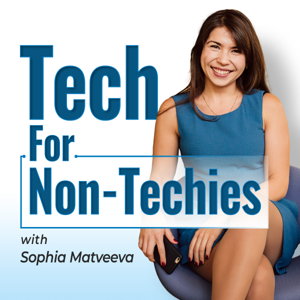
Tech for Non-Techies

Tech for Non-Techies

Download on the App Store

Tech for Non-Techies episodes

  • 67. What Product Managers do and how to become one

    Satya Nadella, the CEO of Microsoft, and Ben Horowitz, the co-founder of VC fund A16Z, both started their careers as Product Managers (PMs).

    PMs rise to leadership positions in the tech sector, because the job combines user perspectives, business needs and technological capabilities. Whatever you want to do in the tech sector, learning how product managers think will help you succeed.

    Learning notes:

    • A product is a solution to a problem somebody is experiencing. Good product managers always focus on the user and the problem.
    • Product Managers lead developers, marketers and designers, but rarely know how to do all those jobs themselves.
    • To lead the team successfully, product managers set product goals. This means telling the team where to go, not how to get there.
    • To get into product management, learn a bit, do a bit. Taking courses is useful, but make sure to also participate in making a product.
    • You can get involved in product management by volunteering with a start-up, helping a product team with user research or making a simple product using no-code apps.

    To download Sophia's guide on the top resources, books and podcasts on Product Management, click here.

    ... Do you have a brilliant app idea and no tech knowledge to build it? Get your FREE guide here.

    Join the Tech for Non-Techies membership community. As a community member, you'll get:

    • Monthly coaching with Sophia Matveeva
    • Live masterclasses with global experts
    • Mini-course on how to go from idea to live app
    • Supportive Online Community
    • Library of masterclasses
    • Exclusive Resources & Perks

    Learn more and sign up at https://www.techfornontechies.co/membership

    Say hi to Sophia on Twitter.

    Following us on Facebook and Instagram will make you smarter.

    Photo by Leon on Unsplash

    18 min
  • 66. Why cloud computing isn't just for techies

    You've probably heard the term cloud computing, but like most non-techies, you're not sure what it means. In this episode, you'll learn what it is and how businesses use it to solve problems.

    You'll learn from DJ Johnson, who works at Microsoft Azure. DJ started his career as an NBA player and transitioned into a career in tech.

    Learning notes from this episode:

    • Cloud computing allows businesses to rent space to store data. Previously, companies had to store data on their own servers, which was much more expensive.
    • The two biggest players in cloud computing are Amazon Web Services and Microsoft Azure.
    • As a non-techie, first identify business problems and then see if technology can fix them.
    • For example, during Covid when suddenly many people ended up working from home, one of DJ's clients suffered from major time lags in their communications. Their internal messenger service was taking 3 days to deliver a message! This was making customers and employees frustrated and unhappy. The business and user facing side identified the problem, and then the product and technology side fixed it.

    Get in touch with DJ Johnson here.

    If you want to build a tech business, but don't have a technical background, then join Break Into Tech: Masterclass For Non-Technical Founders here.

    ... Do you have a brilliant app idea and no tech knowledge to build it? Get your FREE guide here.

    To watch the full session on video and access learning notes, join the Tech for Non-Techies membership community. As a community member, you'll get:

    • Weekly live masterclasses with global experts
    • Mini-course on how to go from idea to live app
    • Supportive Online Community
    • Library of masterclasses
    • Monthly live coaching with Sophia Matveeva, tech entrepreneur & Chicago Booth MBA
    • Exclusive Resources & Perks

    Learn more and sign up at https://www.techfornontechies.co/membership

    Say hi to Sophia on Twitter.

    Following us on Facebook and Instagram will make you smarter.

    24 min
  • 65. Fundraising For Non-Technical Founders

    Many investors view non-technical founders as more risky. Sometimes this is plain silly, but there are legitimate investor concerns that non-techie founders will make costly mistakes that technical founders will not.

    The answer is not to learn to build the product with your bare hands, but to know enough about tech to have a product strategy and relate it to business goals.

    Learning notes from this episode:

    • "You can be the ripest juiciest peach in the world, and there's still going to be somebody who hates peaches," - Dita von Teese. Some investors don't invest in non-technical founders and they never will. There are plenty of those who do. Spend your time on them.
    • Learn how to connect product metrics to business metrics, for example how does user engagement relate to revenue or fundraising goals?
    • Understand key tech concepts to make the right hires and set the right goals, but you do not have to retrain to become a coder yourself.
    • Plenty of non-technical founders have raised millions and built successful tech businesses. You can hear them on this podcast. Learn from Alexandra Zubko, who has built a global SaaS business called Triptease with two other non-technical founders, and raised $28 million to date. Hear from Robyn Exton, a non-technical founder and Y Combinator alumna, who has built HER, a dating community for queer women.
    • Listen to Tech for Non-Techies episodes with non-technical founders who have built AI businesses, content platforms and marketplaces, and have been backed by VCs and angel investors.

    If you want to buid a tech business, but don't have a technical background, then join Break Into Tech: Masterclass For Non-Technical Founders here.

    Do you have a brilliant app idea and no tech knowledge to build it? Get your FREE guide here.

    To watch the full session on video and access learning notes, join the Tech for Non-Techies membership community. As a community member, you'll get:

    • Weekly live masterclasses with global experts
    • Mini-course on how to go from idea to live app
    • Supportive Online Community
    • Library of masterclasses
    • Monthly live coaching with Sophia Matveeva, tech entrepreneur & Chicago Booth MBA
    • Exclusive Resources & Perks

    Learn more and sign up at https://www.techfornontechies.co/membership

    Say hi to Sophia on Twitter.

    Following us on Facebook and Instagram will make you smarter.

    14 min
  • 64. Product Management at Apple vs Amazon

    Product managers combine user perspectives, business needs and technology capabilities in one job. But, what they do day to day varies widely. In this episode, you'll hear how what PMs do differs between Apple and Amazon from Souvik Bhattacharya, who has worked at both.

    This episode is for product managers, founders, investors and those who want to understand tech companies from the inside.

    Learning notes from this episode:

    • Founders play the product management role in their start-ups, and venture capital funds often employ former PMs as investors.
    • What Product Managers do day to day depends on the life cycle of the product. For example, in the launch phase the PM role also includes product marketing.
    • Software vs. Hardware Product Management is incredibly different. Hardware products, like those at Apple, take years to develop and incremental updates are typically not an easy option Software Product Management is much faster as changes can be made virtually and to certain groups of customers for A/B testing versus all at once as with hardware.
    • Engineers often work on problems set by the product managers.

    Get in touch with Souvik here.

    If you want to buid a tech business, but don't have a technical background, then join Break Into Tech: Masterclass For Non-Technical Founders here.

    ...

    Do you have a brilliant app idea and no tech knowledge to build it? Get your FREE guide here.

    To watch the full session on video and access learning notes, join the Tech for Non-Techies membership community. As a community member, you'll get:

    • Weekly live masterclasses with global experts
    • Mini-course on how to go from idea to live app
    • Supportive Online Community
    • Library of masterclasses
    • Monthly live coaching with Sophia Matveeva, tech entrepreneur & Chicago Booth MBA
    • Exclusive Resources & Perks

    Learn more and sign up at https://www.techfornontechies.co/membership

    Say hi to Sophia on Twitter.

    Following us on Facebook and Instagram will make you smarter.

    24 min
  • 63. There are no lone wolves in tech: all products are interconnected

    Every app and site is made up of lots of different tech tools and languages. Like a house, one part is built on top of another and they need each other to function. If one part of the structure breaks, the rest can fall down too.

    These are called dependencies. To keep a product working, all the dependencies need to work together. This is part of the invisible work that software engineers do.

    Learning notes from this episode:

    • A tech stack describes all the tools and programming languages used to build an app or a site. Some of those tools are custom made, some are rented as licences and others plug you into a bigger ecosystem.
    • Examples of bigger eco-systems that many products depend on are the Apple App Store, Google Play and Amazon Web Services. If one of these ecosystems has a problem, the apps and sites they support will have issues too. An app on the Apple App Store depends on Apple, hence the term dependency.
    • Product teams have to update their products to keep up with the changes in the external tools that make up their product. If Apple has an update, all the apps on the Apple App Store have to keep up with the changes.
    If you want to learn the system Sophia used to raise $1 million for her tech venture as a non-technical founder, join the Fundraising For Non-Technical Founders Workshop on 19 September.

    Do you have a brilliant app idea and no tech knowledge to build it? Get your FREE guide here.

    To watch the full session on video and access learning notes, join the Tech for Non-Techies membership community. As a community member, you'll get:

    • Weekly live masterclasses with global experts
    • Mini-course on how to go from idea to live app
    • Supportive Online Community
    • Library of masterclasses
    • Monthly live coaching with Sophia Matveeva, tech entrepreneur & Chicago Booth MBA
    • Exclusive Resources & Perks

    Learn more and sign up at https://www.techfornontechies.co/membership

    Say hi to Sophia on Twitter.

    Following us on Facebook and Instagram will make you smarter.

    14 min
  • 62. How I used accelerators to build a tech business

    Andi Govindia has gone through three accelerators on her start-up journey. This helped her build a business model, find co-founders and get her first major clients.

    Andi leads Riviter, a visual search company that uses AI to predict fashion and beauty trends, and counts L'Oreal amongst its clients.

    If you're interested in entrepreneurship and how non-technical founders can succeed in tech, this one is for you.

    Learning notes from this episode:

    • Use Effectual Logic: ask yourself what the simplest and laziest way is for you to solve a problem. The simplest way is often imperfect, but results matter more than perfection.
    • If you are applying for accelerators, link their speciality to your current needs. Andi participated in Chicago Booth's New Venture Challenge, Plug & Play and Founders Factory. Each accelerator has different strengths, and Andi used them for different purposes.
    • Andi collaborated with her co-founders for a year before they made their agreement official. It is important to really get to know the people you are going to have a long term business partnership with.

    If you want to learn the system Sophia used to raise $1 million for her tech venture as a non-technical founder, join the Fundraising For Non-Technical Founders Workshop on 19 September.

    Do you have a brilliant app idea and no tech knowledge to build it? Get your FREE guide here.

    To watch the full session on video and access learning notes, join the Tech for Non-Techies membership community. As a community member, you'll get:

    • Weekly live masterclasses with global experts
    • Mini-course on how to go from idea to live app
    • Supportive Online Community
    • Library of masterclasses
    • Monthly live coaching with Sophia Matveeva, tech entrepreneur & Chicago Booth MBA
    • Exclusive Resources & Perks

    Learn more and sign up at https://www.techfornontechies.co/membership

    Say hi to Sophia on Twitter.

    Following us on Facebook and Instagram will make you smarter.

    28 min
  • 61. How To Hire Product Teams: Outsourcing vs In-House

    Hiring developers and designers to build your tech product is always risky, because as a non-techie, you're hiring people to do things you don't know how to do.

    Is outsourcing more risky because you're far away from the team? Or is in-house more risky, simply because it usually costs more?

    Listen to this episode to find out.

    Learning notes from this episode:

    • Always get employees and contractors working on your products to sign over the Intellectual Property to the company. If a person or a firm is refusing to sign an IP Agreement, this is a bright red flag.
    • In the early stages of product development, your job is to test ideas, get an MVP out there and get initial traction. The focus should be on doing this as quickly and cheaply as possible, which often means working with an outsourced product studio in a cheaper geography.
    • After you've proven market need, you can hire in-house to scale the product.
    • Right at the start of product development, you don't know what tech tools and languages you need to build it. Because you won't know what you need in your tech stack, you won't know what skills developers will need. This is why hiring a product studio which has different tech stack specialists will often be the best option at the start.

    If you want to delve deeper, then check out the ebook: How to Hire Your Product Team & Go From Idea To App: Guide For Non-Technical Founders.

    In the e-book you will get:

    • A list of product studios recommended by non-technical founders including a firm I've worked with
    • A guide on how to set your budget for prototypes, minimum viable product and market testing
    • What to do if you don't have a technical co-founder
    • What to look for when hiring a user experience designer
    • Difference between development shops, product studios and in-house development teams
    • Examples of successful non-technical founders
    Do you have a brilliant app idea and no tech knowledge to build it? Get your FREE guide here.

    To watch the full session on video and access learning notes, join the Tech for Non-Techies membership community. As a community member, you'll get:

    • Weekly live masterclasses with global experts
    • Mini-course on how to go from idea to live app
    • Supportive Online Community
    • Library of masterclasses
    • Monthly live coaching with Sophia Matveeva, tech entrepreneur & Chicago Booth MBA
    • Exclusive Resources & Perks

    Learn more and sign up at https://www.techfornontechies.co/membership

    Say hi to Sophia on Twitter.

    Following us on Facebook and Instagram will make you smarter.

    20 min
  • 60. Why the VC market is changing and how to succeed it

    More money is entering venture capital today than ever before. This means more career opportunities for investors, and funding options for founders.

    In this episode, you'll hear from Check Warner, parter at Ada's Ventures, and co-Founder of Diversity VC. Check talks about her career transition from advertising to VC, how the venture industry is changing and how that affects founders.

    Learning notes from this episode:

    • Networking is a key part of a VC's job. If this is a career you want, build your network with founders, other VCs and larger funds that invest in venture.
    • To be a successful tech VC, you do need to learn how to speak tech, but you definitely don't need to be a coder yourself.
    • More money is entering the VC market and more funds are being set up. VC funds are often small, unlike other firms in the financing market.
    • The widening VC market and the growth of no code tools means more opportunities for non-technical founders to succeed.

    Say hi to Check Warner here and check out Diversity VC here.

    31 min
  • 59. What on Earth is growth hacking?

    Why do some products go viral and others die a quiet death? The answer lies in growth hacking.

    Growth hacking is a type of marketing that combines working on the product, which is an inside job, and working on promotion, which is an outside job. It is a new discipline born with the tech sector, and growing in popularity today.

    Learning notes from this episode:

    • The Dropbox growth hacking case study is still seen as the Holy Grail in the sector. The team created a double referral program to grow 3900% in just 15 months.
    • A growth hacking effort is always done by a multi-disciplinary team, and will often involve a product manager, a designer, a community manager, engineers, someone with a marketing or PR background, and maybe a data scientist.

    • Traditional marketing is outside facing: billboards, TV ads and articles in the press. Growth hacking is different because it looks at the inside of the product, and adjusts it to grow users and revenue.

    • PR and growth hacking spur each other on: if something is going viral, journalists want to write about it. They write about it, which makes it go even more viral.
    • Products very rarely go viral by themselves. Viral growth is almost always the result of investment and experimentation by the growth hacking team.

    Get Sophia's Recommended Reading List of technology sector books you will actually understand and enjoy, click here.

    Listen here on Apple Podcasts. Listen here on Spotify. ... Do you have a brilliant app idea and no tech knowledge to build it? Get your FREE guide here.

    To go deeper, join the Tech for Non-Techies membership community. As a community member, you'll get:

    • Weekly live masterclasses with global experts
    • Mini-course on how to go from idea to live app
    • Supportive Online Community
    • Library of masterclasses
    • Monthly live coaching with Sophia Matveeva, tech entrepreneur & Chicago Booth MBA
    • Exclusive Resources & Perks

    Learn more and sign up at https://www.techfornontechies.co/membership

    Say hi to Sophia on Twitter.

    Following us on Facebook and Instagram will make you smarter.

    Photo by Markus Winkler on Unsplash

    14 min
  • 58. How to pivot your way to success

    Neither life nor business are linear. Startups often pivot their business models several times to find product market fit, just as we try out different careers.

    In this episode, you'll hear from Hannah Feldman, the CEO and co-founder of Kidadl, which helps families do fun and useful things with their kids. Hannah began her career as a corporate lawyer, then worked in banking, and then with Dragon Den's James Kaan before starting on her entrepreneurial journey.

    Her company, Kidadl also went through pivots before it found product market fit during the Covid shutdowns. Whether you want to build a business or transition into a career in tech, this is a great episode to learn from.

    Learning notes from this episode:

    • "The business strategies employed by highly successful start-ups and the career strategies employed by highly successful individuals are strikingly similar," Reid Hoffman.
    • Most startups have to pivot their business models several times to find product market fit.
    • Career transitions from corporate to tech usually have an interim step in a medium sized entrepreneurial organisation. Hannah learnt about entrepreneurship by working with James Kaan after leaving UBS, which helped her spot the right start-up opportunity when it came her way.

    Say hi to Hannah here and check out Kidadl here.

    Join our free masterclass on How To Transition Into A Career In Tech on 4 August 2021.

    ... Do you have a brilliant app idea and no tech knowledge to build it? Get your FREE guide here.

    To go deeper, join the Tech for Non-Techies membership community. As a community member, you'll get:

    • Weekly live masterclasses with global experts
    • Mini-course on how to go from idea to live app
    • Supportive Online Community
    • Library of masterclasses
    • Monthly live coaching with Sophia Matveeva, tech entrepreneur & Chicago Booth MBA
    • Exclusive Resources & Perks

    Learn more and sign up at https://www.techfornontechies.co/membership

    Say hi to Sophia on Twitter.

    Following us on Facebook and Instagram will make you smarter.

    26 min

About Tech for Non-Techies

From the publisher's feed

If you want to build new things and be known as the innovator in the room — this is your show.

More shows like Tech for Non-Techies

The Twenty Minute VC (20VC): Venture Capital | Startup Funding | The Pitch by Harry Stebbings

The Twenty Minute VC (20VC): Venture Capital | Startup Funding | The Pitch

541 Listeners

The McKinsey Podcast by McKinsey & Company

The McKinsey Podcast

388 Listeners

The Knowledge Project by Shane Parrish

The Knowledge Project

2,698 Listeners

The a16z Show by Andreessen Horowitz

The a16z Show

1,087 Listeners

Super Data Science: ML & AI Podcast with Jon Krohn by Jon Krohn

Super Data Science: ML & AI Podcast with Jon Krohn

305 Listeners

Founders by David Senra

Founders

2,208 Listeners

Masters of Scale by WaitWhat

Masters of Scale

3,979 Listeners

The Diary Of A CEO with Steven Bartlett by DOAC

The Diary Of A CEO with Steven Bartlett

8,527 Listeners

Inside the Strategy Room by McKinsey & Company

Inside the Strategy Room

175 Listeners

Coaching Real Leaders by Muriel Wilkins

Coaching Real Leaders

671 Listeners

Business Breakdowns by Colossus | Investing & Business Podcasts

Business Breakdowns

349 Listeners

ACQ2 by Acquired by Ben Gilbert and David Rosenthal

ACQ2 by Acquired

290 Listeners

Marketing Against The Grain by Hubspot Media

Marketing Against The Grain

358 Listeners

The AI Daily Brief: Artificial Intelligence News and Analysis by Nathaniel Whittemore

The AI Daily Brief: Artificial Intelligence News and Analysis

684 Listeners

HBR On Leadership by Harvard Business Review

HBR On Leadership

156 Listeners