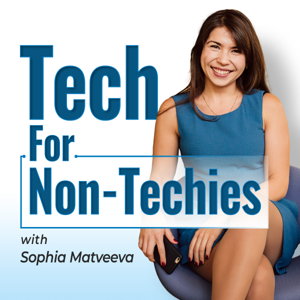
Tech for Non-Techies

Tech for Non-Techies

Download on the App Store

Tech for Non-Techies episodes

  • 77. Avoid these mistakes if you want to break into tech

    Did you know that 54% of all jobs in tech companies are non-technical, according to research by Glassdoor. This means there is plenty of opportunity for non-techies who want to transition into the world's most lucrative and exciting sector.

    Avoid these mistakes if you want to transition into a career in tech:

    • Don't sign up to a 6 month coding course, you probably won't need this level of detail. Instead take a shorter course on how software products get made, get the basic tech vocab and understand who does what on a tech team.
    • Don't spend all your time on academic learning. Combine learning with taking action. For example, take a course on tech for non-technical founders and put your knowledge to use as a tech start-up advisor.
    • Don't limit your job search to LinkedIn. Most jobs aren't advertised, which means you need to build your network to find opportunities. This is especially true when you're breaking into a new sector.
    • Don't use your old resume for tech job applications. Rebrand your existing experience to align with your dream job in tech.

    If you want 2022 to be the year when you take your career to the next level, apply for Sophia's Break Into Tech Program.

    Sophia will teach you what you really need to know about tech to succeed as a non-technical professional, help you come up with a tailored career action plan and support you throughout your journey.

    APPLY HERE

    Join the Tech for Non-Techies membership community. As a community member, you'll get:

    • Monthly coaching with Sophia Matveeva
    • Live masterclasses with global experts
    • Supportive Online Community
    • Library of masterclasses
    • Exclusive Resources & Perks

    Learn more and sign up at https://www.techfornontechies.co/membership

    Say hi to Sophia on Twitter.

    Following us on Facebook and Instagram will make you smarter.

    13 min
  • 76. From offline business owner to tech entrepreneur

    Creating a successful business is a huge feat, but even founders with profitable exits struggle when they first break into tech. Bryan Clayton co-founded Greenpal, the Airbnb for lawn mowing, after he sold his first business. But, his first business was a landscaping company, which meant that even as an experienced entrepreneur, he was a newbie in tech.

    Learning notes from this episode:

    • Non-technical founders need to know enough to be dangerous before hiring developers. Understand how your business strategy connects to product aims and know how to estimate your development budget.
    • Even badly made first products can show you're on the right track, as long as you have interest from users. If people want to use your product, but your product sucks, you can improve the product and then scale. If you have a great product and nobody wants to use it, then you have a real problem.
    • The perfect scenario of a tech founder + business savvy founder rarely happens in real life. As long as you and your team is willing to learn on the job, you don't have to put your plans on hold while looking for a technical co-founder.

    If you want to be part of the tech boom, as a founder, investor or corporate innovator, then apply for Sophia's Break Into Tech program.

    APPLY HERE

    Sophia will teach you what you really need to know about tech to succeed as a non-technical professional, help you come up with a tailored career action plan and support you throughout your journey.

    Join the Tech for Non-Techies membership community. As a community member, you'll get:

    • Monthly coaching with Sophia Matveeva
    • Live masterclasses with global experts
    • Supportive Online Community
    • Library of masterclasses
    • Exclusive Resources & Perks

    Learn more and sign up at https://www.techfornontechies.co/membership

    Say hi to Sophia on Twitter.

    Following us on Facebook and Instagram will make you smarter.

    25 min
  • 75. Do this before hiring developers

    Money isn't enough to hire the best product teams. If you want to hire great people to build your product, you need to convince them that your vision has potential. To do this, techies and non-techies alike need to come prepared.

    Learning notes:

    • A product is a solution to a problem someone is experiencing. You use Uber to get from A to B, not because you want to use an app.
    • Great outsourced product teams like the Evil Martians will question your assumptions and want to validate your idea. If a product team doesn't ask you any questions and just wants to take your money, they are probably not very good, and so you should not work with them.
    • To prepare to work with a great product team, research the problem you are solving and your target users. This research will also be useful if you are fundraising or applying for accelerators.
    • User and problem research is also relevant if you want to get a job in a tech business, invest in tech or lead digital transformation. This will help you stand out at interviews and think like a digital leader.
    Get my How To Hire Your Product Team & Go From Idea To App: The Non-Technical Founder's Guide

    Join the Tech for Non-Techies membership community. As a community member, you'll get:

    • Monthly coaching with Sophia Matveeva
    • Live masterclasses with global experts
    • Supportive Online Community
    • Library of masterclasses
    • Exclusive Resources & Perks

    Learn more and sign up at https://www.techfornontechies.co/membership

    Say hi to Sophia on Twitter.

    Following us on Facebook and Instagram will make you smarter.

    14 min
  • 74. How I got to the top in tech

    Jennifer Byrne studied Psychology at university and went on to become the Chief Technology Officer of Microsoft US. Listen to this episode to learn how this liberal arts graduate transitioned into tech and became one of the most senior people in the industry.

    Learning notes from this episode:

    • "You have to understand the difference between acquiring digital context versus digital fluency. Context means seeing the bigger picture of how things connect together, but not necessarily understanding the detail," says Jennifer.
    • Jennifer says that it is impossible to know everything about technology, even when you are at the top. Instead, she says understand the broad context of how tech products get made and do deep dives into areas that interest you.
    • As a CTO you have to think strategically: what problem are we solving? How can technology be applied to this problem?
    • Good CTOs must connect technology strategy to drive business decisions.

    Follow Jennifer Byrne on LinkedIn.

    Get the Black Friday offer: 6 months free Tech for Non-Techies membership when you sign up for an annual subscription. This is only available to the first 6 people who sign up.

    As a Tech for Non-Techies member, you'll get:

    • Monthly coaching with Sophia Matveeva
    • Live masterclasses with global experts
    • Supportive Online Community
    • Library of masterclasses from Harvard professors, Y Combinator alumni, tech investors and digital leaders to watch on demand
    • Exclusive Resources & Perks
    There are only 6 Black Friday memberships available. Grab yours here.

    Say hi to Sophia on Twitter.

    Following us on Facebook and Instagram will make you smarter.

    43 min
  • 73. How I transitioned into a career in tech

    Lots of smart people want to transition into careers in tech, but don't know how to get started. If that sounds like you, then listen to how Alexandra Soroko went from finance to tech leadership.

    Today, Alexandra is Head of Merchant Sales at Visa in France, and connects fintech companies, banks and Visa's technologies to help some of the world's largest companies process payments. In her role, she combines tech knowledge, marketing and finance skills. She started her career at JP Morgan, but didn't let her lack of tech skills stop her.

    Learning notes from this episode:

    • "You don't need to be an engineer, but you need a willingness to understand what lies beneath the surface if you want to succeed in a tech business," says Alexandra
    • "If we don't have a vision, life just happens to us," says Alexandra. Before embarking on a transition into tech, think about your values and what you want from your next role. Alexandra's six desires for her dream job were: market leading brand, growing tech market, a leadership position, balanced work schedule and international company. What do key attributes do you want your dream job to have?
    • Learn the language of tech and combine that with building your network with people and companies that recruit for the job you want.

    If you want to transition into a career in tech, then apply for Sophia's How To Break Into A Career In Tech program.

    In this program, you will learn you what you really need to know about tech to succeed as a non-technical professional, and work with Sophia to create a tailored career action plan, and get her support throughout your journey.

    APPLY HERE

    Join the Tech for Non-Techies membership community. As a community member, you'll get:

    • Monthly coaching with Sophia Matveeva
    • Live masterclasses with global experts
    • Supportive Online Community
    • Library of masterclasses
    • Exclusive Resources & Perks

    Learn more and sign up at https://www.techfornontechies.co/membership

    Say hi to Sophia on Twitter.

    Following us on Facebook and Instagram will make you smarter.

    31 min
  • 72. Break into tech: three examples of successful career transitions

    The number of technology oriented jobs is predicted to rise to 190 million in 2025, according to Microsoft. But, if you're a non-techie, how do you get in on that?

    In this episode, you'll hear how three people transitioned into successful careers and tech, and learn how to apply their tactics to your career transformation.

    Learning notes from this episode:

    • To succeed in tech as a non-techie, you need to learn core technology concepts and understand how they translate to business outcomes and user needs. You do not need to retrain as a coder.
    • There are more ways to be part of the tech boom than you think. For example, if you're a marketing expert, you could run a marketing company, which only serves tech clients.
    • Transitions into tech often have an interim step, like volunteering for a start-up or helping a product team do user feedback. You can use this interim step to build your network, learn about new opportunities and add a tech position to your LinkedIn profile.
    • Listen to learn how Oksana Stowe transitioned into venture capital; how Juliet Eysenck used her journalism experience to get into product management; how Vikas Singh used his obsession with running to launch apps as a non-technical founder, and how Ronan Walsh combines marketing nous and tech knowledge to serve his SaaS clients.

    If you want to take your career transition into tech from aspiration to reality, apply for Sophia's How To Break Into A Career In Tech program.

    We will screen applications and if we believe our program can help you, you will get a link to a free consultation call with Sophia.

    APPLY HERE

    Listen here on Apple Podcasts. Listen here on Spotify.

    Join the Tech for Non-Techies membership community. As a community member, you'll get:

    • Monthly coaching with Sophia Matveeva
    • Live masterclasses with global experts
    • Supportive Online Community
    • Library of masterclasses
    • Exclusive Resources & Perks

    Learn more and sign up at https://www.techfornontechies.co/membership

    Say hi to Sophia on Twitter.

    Following us on Facebook and Instagram will make you smarter.

    17 min
  • 71. Why Uber competes with Tinder and with Chocolate

    Consumer facing tech businesses like Uber aren't just competing with other firms that provide a similar service. They're competing with everything that vies for your attention.

    This is why B2C tech businesses tend to be more innovative, better at design thinking and take inspiration from a wider pool than their enterprise tech counterparts.

    Learning notes:

    • The Attention Economy refers to products which compete for consumers' attention, which widens the competitive landscape exponentially. Uber isn't just competing with Lyft, or your feet. Going out competes with staying in, so sometimes you're choosing between an Uber to a party or Tindering at home.
    • Smart B2B companies are taking inspiration from consumer innovation. The innovation team at Barclays asked if Domino's Pizza could track customer orders, why couldn't Barclays could keep borrowers up to date with the progress of their loans?
    • If you're working on a B2B business, learn from consumer companies. Study the UX design on Bumble. Learn about effective algorithms from TikTok, understand what product managers do at Facebook.

    Get the FREE GUIDE to how the most successful companies approach innovation (and how that applies to your business and life here:

    The Pragmatist's Guide To Innovation (in business & in life)

    Join the Tech for Non-Techies membership community. As a community member, you'll get:

    • Monthly coaching with Sophia Matveeva
    • Live masterclasses with global experts
    • Supportive Online Community
    • Library of masterclasses
    • Exclusive Resources & Perks

    Learn more and sign up at https://www.techfornontechies.co/membership

    Say hi to Sophia on Twitter.

    Following us on Facebook and Instagram will make you smarter.

    14 min
  • 70. How to solve the right problem

    95% of new products fail, according to Harvard Business School professor Clayton Christensen. But, usually this isn't because they are badly made, but because they don't solve the right problem.

    Before you delve into product development, define the problem you are solving. In this episode, you'll learn from Thomas Wedell-Wedellsborg, author of What's Your Problem and Innovation As Usual, about how to reframe problem solving in business and in life.

    Learning notes:

    • Non-techies can play an important role on product teams by being focussed on the problem they are solving, because they are less likely to get stuck in the weeds of building.
    • Not all problem solving needs fancy technology. Often, small changes in design can have a big impact, at a much lower cost.
    • Being focussed on the problem is vital at the start of product development, and as your product matures. Keep analysing how people use it to see if you're still solving the right problem.

    To learn key technology concepts you need to succeed in the innovation economy, join tomorrow's FREE session, on 28 October 12 pm EST / 5 pm BST:

    How To Speak Tech: Masterclass For Leaders

    Join the Tech for Non-Techies membership community. As a community member, you'll get:

    • Monthly coaching with Sophia Matveeva
    • Live masterclasses with global experts
    • Supportive Online Community
    • Library of masterclasses
    • Exclusive Resources & Perks

    Learn more and sign up at https://www.techfornontechies.co/membership

    Say hi to Sophia on Twitter.

    Following us on Facebook and Instagram will make you smarter.

    25 min
  • 69. What do Heads of Innovation do?

    Working in innovation at a large company can be a great way to join the tech boom for non-techies. But what do you do when you get there?

    Innovation leaders have a wide range of backgrounds. Some have deep tech expertise, and others are marketing pros. The innovation path a company has chosen determines the background of the person who'll lead it.

    Learning notes:

    • There are 6 paths to innovation: private, public, incremental, breakthrough, product and process.
    • Breakthrough innovation is when a company asks itself: we need to do something completely different. What is that thing? How do we do it?
    • Public innovation is tied to marketing and how customers see the brand.
    • Private innovation doesn't leave the company's walls until it is ready to be commercialised and often comes with patent protection (think biotech businesses).
    If you want to learn more about the paths to innovation and how to apply them to business and life, get Sophia's e-book: Innovate, but how? The practical pragmatist's guide to growth (in business & in life)

    Do you have a brilliant app idea and no tech knowledge to build it? Get your FREE guide here.

    Join the Tech for Non-Techies membership community. As a community member, you'll get:

    • Monthly coaching with Sophia Matveeva
    • Live masterclasses with global experts
    • Supportive Online Community
    • Library of masterclasses
    • Exclusive Resources & Perks

    Learn more and sign up at https://www.techfornontechies.co/membership

    Say hi to Sophia on Twitter.

    Following us on Facebook and Instagram will make you smarter.

    15 min
  • 68. How smart start-ups and corporates hire product teams

    What's technology for? Tech products can make our lives better and make businesses a lot of money. But, without a focus on the user and on the business, technology is an academic project at best, or just an expensive hobby.

    In this episode, you'll hear from Elisabeth Bohlmann, VP of strategy at December Labs, a product and development studio that works with corporates like Google, and start-ups to validate ideas and build products.

    Learning notes from this episode:

    • If you don't have a technical background, learning from other people who are succeeding in tech but aren't techies, is often the best way to learn. They can anticipate your questions and mistakes much better than someone who has been coding since they were 8.
    • Before hiring developers, always validate your ideas and create a prototype with designers. Design thinking is central to tech.
    • Whether you're working in a start-up or a corporate, think about business needs first and then find out how technology can meet them.

    Say hi to Elisabeth Bohlmann here.

    If you don't have a technical background and want to hire product teams, get Sophia's e-book on How To Hire Product Teams: a guide for non-technical founders.

    ... Do you have a brilliant app idea and no tech knowledge to build it? Get your FREE guide here.

    Join the Tech for Non-Techies membership community. As a community member, you'll get:

    • Monthly coaching with Sophia Matveeva
    • Live masterclasses with global experts
    • Supportive Online Community
    • Library of masterclasses
    • Exclusive Resources & Perks

    Learn more and sign up at https://www.techfornontechies.co/membership

    Say hi to Sophia on Twitter.

    Following us on Facebook and Instagram will make you smarter.

    26 min

About Tech for Non-Techies

From the publisher's feed

If you want to build new things and be known as the innovator in the room — this is your show.

More shows like Tech for Non-Techies

The Twenty Minute VC (20VC): Venture Capital | Startup Funding | The Pitch by Harry Stebbings

The Twenty Minute VC (20VC): Venture Capital | Startup Funding | The Pitch

541 Listeners

The McKinsey Podcast by McKinsey & Company

The McKinsey Podcast

388 Listeners

The Knowledge Project by Shane Parrish

The Knowledge Project

2,698 Listeners

The a16z Show by Andreessen Horowitz

The a16z Show

1,087 Listeners

Super Data Science: ML & AI Podcast with Jon Krohn by Jon Krohn

Super Data Science: ML & AI Podcast with Jon Krohn

305 Listeners

Founders by David Senra

Founders

2,208 Listeners

Masters of Scale by WaitWhat

Masters of Scale

3,979 Listeners

The Diary Of A CEO with Steven Bartlett by DOAC

The Diary Of A CEO with Steven Bartlett

8,527 Listeners

Inside the Strategy Room by McKinsey & Company

Inside the Strategy Room

175 Listeners

Coaching Real Leaders by Muriel Wilkins

Coaching Real Leaders

671 Listeners

Business Breakdowns by Colossus | Investing & Business Podcasts

Business Breakdowns

349 Listeners

ACQ2 by Acquired by Ben Gilbert and David Rosenthal

ACQ2 by Acquired

290 Listeners

Marketing Against The Grain by Hubspot Media

Marketing Against The Grain

358 Listeners

The AI Daily Brief: Artificial Intelligence News and Analysis by Nathaniel Whittemore

The AI Daily Brief: Artificial Intelligence News and Analysis

684 Listeners

HBR On Leadership by Harvard Business Review

HBR On Leadership

156 Listeners