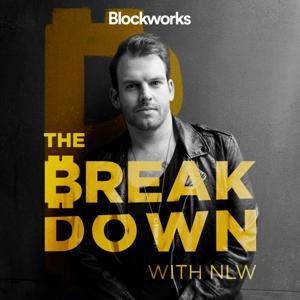
The Breakdown

The Breakdown

By BlockworksBusinessInvesting
Download on the App Store

The Breakdown episodes

  • Avoiding the Narrative Trap: Bitcoin Is More Than an Inflation Hedge

    Today on the Brief:

    • Why bitcoin sold off
    • A bank-the-unbanked narrative for the digital dollar
    • It’s Dave Portnoy’s world and we’re all just living in it

    Today’s main topic: Why inflation isn’t the only bitcoin narrative that matters.

    When bitcoin’s halving coincided with the most aggressive central bank policy of all time, it set a clear narrative framework for bitcoin as an inflationary hedge. This was captured by people like legendary hedge fund investor Paul Tudor Jones, who warned of a “great monetary inflation.” 

    In this episode, NLW argues 1) that inflation could be a dangerous narrative to focus on too closely due to a number of countervailing deflationary forces, and 2) there are a variety of other narratives that are just as important to bitcoin, including:

    • Censorship resistance 
    • Seizure-resistant asset
    • Currency controls and reshoring 
    • Nations looking to escape USD system
    • Independent banking 
    • Peaceful protest
    26 min
  • Why the Fed Keeps Denying Its Role in Increasing Inequality

    Today on the Brief:

    • Three Arrows holds more than 6% of Grayscale Bitcoin Trust
    • New platform for censorship-resistant blogging
    • Coinbase announces new token potentials as anti-surveillance hodlers flood out 

    Today’s main topic: Why the Fed keeps denying its role in inequality 

    Some key takeaways from yesterday’s Federal Open Markets Committee meeting:

    • Interest rates are likely to stay near zero through 2022
    • Unemployment anticipated to average between 9% and 10% during last three months of 2020
    • Economy expected to contract 4% to 10% this year
    • No specific discussion of yield curve control
    • Inflation expected to be 1.0% this year and 1.5% in 2021, lower than Fed target of 2%
    • According to Chairman Powell, inequality has nothing to do with Fed policy

    On this episode, NLW recaps the above and dives deeper on two of the points:

    • Net inflation stats gloss over specifics, including food prices that have been rising at an annual rate of 17.5%
    • The Fed’s pronounced role in exacerbating inequality by propping up artificially high asset prices, effectively locking low and middle income households out of the mechanism for economic advancement 
    27 min
  • Bitcoin, Property Rights, and Why the Old West Says You Should Own Your Socials, feat. Nic Carter

    Today on the Brief:

    • A record week for peer-to-peer exchanges in the developing world
    • A digital dollar gets discussed in Congress 
    • Previewing the Federal Reserve’s FOMC guidance 

    Our main topic: A brainstorm on digital property rights

    Here’s a radical idea. What if by virtue of the fact that you had put so much time and effort into building a following on social media and filling that following with content you had legal claim to and distinct property rights around your corner of social media platforms? 

    It’s wild in the context of today’s terms of service, but has significant legal precedent in the world of physical land. 

    In this new type of deep-dive 20-minute episode we’re calling a “Breakdown Brainstorm,” Castle Island Ventures investor Nic Carter looks at:

    • The two schools of thought around digital property rights
    • The historical precedent for squatter’s rights
    • What the specific example of the USA’s Westward Expansion can teach us
    • Why this type of approach can be highly economically generative, according to economists like De Soto
    • How John Locke’s theories provide a moral basis for the argument 
    • Why today’s platforms are akin to anti-democratic feudal lords
    • How bitcoin provides a model and a mechanism for digital rights enforced on the protocol level rather than by a state or other external actor 

    Find our guest online:Twitter: @nic__carterWebsite: niccarter.info

    34 min
  • What the Stock Market’s ‘Robinhood Rally’ Means for Bitcoin

    Today on the Brief:

    • Saudi Arabia injects $13 billion in bank liquidity via blockchain.
    • China’s state TV CCTV says Binance is still allowing crypto trading in China.
    • MakerDAO community greenlights real world collateral. 

    Our main topic: The “Robinhood Revolution.” 

    The next time someone tells you crypto markets are too irrational or volatile, point them to stock markets right now.

    • The largest 50-day rally in history
    • Every S&P 500 stock up from 10 weeks ago
    • Multiple bankrupt companies up more than 100% since they declared bankruptcy

    This is the “Robinhood Revolution,” as a horde of day traders are outperforming billionaire investors and commanding the stock market narrative. 

    This episode looks at:

    • Who is this new generation of investors 
    • Why they’re so active right now
    • What they’re betting will go up
    • Why they don’t care about earnings, balance sheets or any other fundamentals
    • Four scenarios for how this rally could have an impact on the bitcoin and crypto industry 
    33 min
  • Why War Reporting Is the Right Mental Model for Today’s Media, Feat. Jake Hanrahan

    On today’s episode of The Breakdown, we introduce the Breakdown Brief - a look at three key topics in bitcoin and crypto. Today, the Brief covers:

    • Brave browsers auto adding ref links to Binance.us 
    • The disconnect between Wall Street and crypto when it comes to inflation expectations
    • A 2018 Pentagon war game including bitcoin 

    Our featured interview is with Jake Hanrahan, founder of Popular Front - a podcast and independent media company covering underreported and irregular conflict with “no frills, no elitism.” Jake was previously an embedded reporter with Vice and has covered conflict in Turkey, Syria, Iraq, Palestine, Ukraine and elsewhere. 

    In this conversation, Jake and NLW discuss:

    • Why Jake left Vice and decided to build an independent journalism project
    • Why the mainstream media isn’t bad because of some political conspiracy, but because its business model doesn’t allow it to understand how real people are experiencing issues 
    • How the protests are being (mis)covered around the world
    • Why American protests are going global
    • What he learned covering protests in Hong Kong last year 
    • What situations people should be paying attention to around the world that they’re not right now 


    1 hr 18 min
  • The Revolution Will Be Retweeted: The Breakdown Weekly Recap

    The Breakdown Weekly Recap looks at the key themes that shaped the week. On this week’s episode, NLW discusses:

    • The modern significance of Tiananmen Square, and why this week’s U.S. protests show why the tools of surveillance need to be applied to states, not citizens.
    • The importance of “narrative violations,” or fighting to see things without falling into popular but often wrong conventional wisdoms 
    • The need to resist attempts from both the left and the right to fit today’s unrest into convenient culture-war frameworks that perpetuate each group’s power.


    This week on The Breakdown:

    Monday | The Power and Peril of the 'Bitcoin Fixes This' Meme 

    • A look at what role, if any, bitcoin has to play in remaking the world that is being protested around the U.S. (and world) this week.

    Tuesday | Bitcoin, Cellphones and the Citizen Tools of Anti-Authoritarianism, Feat. Alex Gladstein

    • A look at the anti-authoritarian technology stack, including where non-state money like bitcoin fits in.

    Wednesday | 5 Numbers That Tell the Story of Markets Right Now

    • From the number of U.S. flights from Chinese carriers to S&P 500 growth in the tumultuous year of 1968, these (unexpected) numbers tell the story of today’s markets.

    Thursday | The Mirage of the Money Printer: Why the Fed Is More PR Than Policy, Feat. Jeffrey P. Snider

    • An argument that the Fed is actually highly ineffectual due to the presence of the eurodollar shadow-banking system.

    Friday | The Biggest Realignment in the US-China Relationship Since Nixon, Feat. Graham Webster

    • A 101-level primer on the history of the U.S.-China relationship, and why today’s bluster represents a fundamental shift. 


    9 min
  • Everything You Need To Know About The US & China: The Biggest Realignment Since Nixon, Feat. Graham Webster

    The U.S.-China relationship has an outsized impact on global economics and politics. As that relationship comes even more into focus in the wake of COVID-19 and a return of trade tensions, this episode provides a historical primer. 

    Graham Webster is editor-in-chief of the Stanford–New America DigiChina Project at the Stanford University Cyber Policy Center. He’s also a China digital economy fellow at the New America think tank.

    In this episode, Webster explains:

    • Why the relationship with the U.S. has been at the forefront of Chinese policy since the People’s Republic of China was formed, but has flitted in and out of America’s focus.
    • Why the first most significant period in the U.S.-China relationship came between the late 1960s and 1970s, as the U.S.-China relationship normalized.
    • How Tiananmen Square undermined but didn’t destroy the relationship.
    • Why George W. Bush came into office with an intention to focus on China but got distracted in the wake of 9/11.
    • Why China has spent the last decade becoming increasingly illiberal.
    • How the rise of social media contributed to the shift.
    • Why China and U.S. policy is as much a reflection of domestic self-identity in both countries as it is a bilateral political question. 
    • Why China’s human rights abuses present such a challenge.
    • How COVID-19 changes the relationship.

    Find our guest online:

    Twitter: gwbstr

    Website: DigiChina

    1 hr 27 min
  • The Mirage of the Money Printer: Why the Fed Is More PR Than Policy, Feat. Jeffrey P. Snider

    The conventional wisdom is that central banks are the most important economic actors in the world. Markets hang on their every word. 

    Yet, what if that power has less to do with actual monetary policy and more to do with how the performance of that policy creates a self-fulfilling prophecy as market actors respond to media coverage?

    Jeff Snider is the head of global research at Alhambra Investments. In this conversation, he and NLW explore:

    • How the Fed lost the ability to even determine what the money supply is.
    • How the financialization in the 1980s exacerbated monetary confusion.
    • Why the most important force in the global economy isn’t central banks but the eurodollar and shadow banking system.
    • How the eurodollar and shadow banking sector creates a drag on real economic growth.
    • Why the conventional wisdom and “central bank savior” narrative around 2008 was dead wrong.
    • The problem with “survivor’s euphoria.”
    • Why “money printer go brr” is actually a flood myth. 
    1 hr 5 min
  • 5 Numbers That Tell the Story of Markets Right Now

    Every day that protests continue and the stock market goes up, more people ask what the disconnect between markets and the real economy is. In this episode of The Breakdown, NLW peels back the story of today’s economy by looking at five numbers:

    • The growth of the S&P500 since the March 23 low
    • Current unemployment stats and a Bloomberg Economics estimate of the number of jobs at risk
    • The performance of the S&P500 in 1968, one of the most tumultuous years in American history
    • The total percentage of the world’s debt denominated in dollar terms
    • The number of flights between the US and China by Chinese airlines going forward
    15 min
  • Bitcoin, Cellphones and the Citizen Tools of Anti-Authoritarianism, Feat. Alex Gladstein

    Alex Gladstein is the chief strategy officer of the Human Rights Foundation. He is a powerful voice for the role of bitcoin in combating authoritarianism around the globe. 

    In today's episode, he and NLW discuss: 

    • What the protests tell us about the state of democracy in the U.S.
    • The potential impact of protests and COVID-19 on surveillance norms 
    • The potential for a "biological Patriot Act" 
    • The implications of China's push to absorb Hong Kong 
    • The relevance or irrelevance of China's digital currency
    • The role of bitcoin in promoting freedom
    46 min

About The Breakdown

From the publisher's feed

The Breakdown dives into the deepest topics in crypto, blockchain, and the macro forces shaping markets and power structures. Each episode breaks down complex ideas into clear, grounded analysis — separating signal from noise across crypto, finance, and geopolitics.

More shows like The Breakdown

Unchained by Laura Shin

Unchained

1,204 Listeners

Real Vision: Finance & Investing by Real Vision Podcast Network

Real Vision: Finance & Investing

897 Listeners

TFTC: A Bitcoin Podcast by Marty Bent

TFTC: A Bitcoin Podcast

769 Listeners

The Peter McCormack Show by Peter McCormack

The Peter McCormack Show

2,190 Listeners

CoinDesk Podcast Network by CoinDesk

CoinDesk Podcast Network

643 Listeners

The Pomp Podcast by Anthony Pompliano

The Pomp Podcast

1,833 Listeners

On The Brink with Castle Island by Castle Island Ventures

On The Brink with Castle Island

292 Listeners

What Bitcoin Did by Danny Knowles

What Bitcoin Did

279 Listeners

Markets Outlook by CoinDesk

Markets Outlook

132 Listeners

Bankless by Bankless

Bankless

1,035 Listeners

The Wolf Of All Streets by Scott Melker

The Wolf Of All Streets

235 Listeners

Swan Signal Live - A Bitcoin Show by Swan Bitcoin

Swan Signal Live - A Bitcoin Show

177 Listeners

Empire by Blockworks

Empire

164 Listeners

Natalie Brunell's Coin Stories by Natalie Brunell

Natalie Brunell's Coin Stories

437 Listeners

Raoul Pal: The Journey Man by Real Vision Podcast Network

Raoul Pal: The Journey Man

131 Listeners

Bitcoin Builders by Nathaniel Whittemore

Bitcoin Builders

53 Listeners