
Sign up to save your podcasts
Or

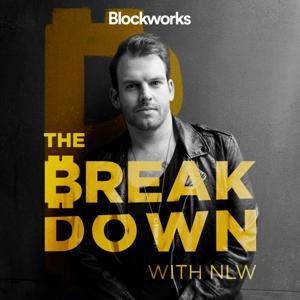


Cities around the country have been engulfed in protest in the wake of the murder of 46-year-old black man George Floyd. There is an intense battle for the narrative around the protests. Are they legitimate outcries against institutional racism and police brutality? Is the looting covertly being driven by white supremacists on the one hand or ANTIFA on the other?
In the Bitcoin community, some have plumbed the “Bitcoin Fixes This” meme to argue that the core underlying issue has to do with a monetary system that structurally creates inequality. Others have clapped back against pushing that meme in this moment.
In this episode of The Breakdown, NLW looks at:
The week's episodes in one convenient file.
As the economic dimension of the COVID-19 crisis comes into clearer view, what have we learned about the battle for the future of money? Does the dollar reign supreme? Are within-the-system competitors like the euro or China’s digital yuan gaining ground? Does an outside the system alternative like bitcoin stand a chance?
Over the last month, the “Money Reimagined” series has looked at the battle for the future of money.
Episode 1 focused on the dollar and why it is simultaneously stronger and more set up to fail than ever before.
Catch up: Why the Dollar Has Never Been Stronger or More Set Up to Fail
Episode 2 was all about the obvious contenders to replace the dollar such as the euro or China’s currency, especially as they race towards a digital yuan. It also looked at where Facebook’s Libra might fit in the mix.
Catch up: The Rise of the Dollar Killers
Episode 3 looked at one of the most unique features of this modern currency battle - the fact that there are fundamentally new systems like bitcoin in the running. Can a non-sovereign currency actually be more relevant than global fiats?
Catch up: Where Bitcoin Fits in the New Monetary Order
This final episode of the “Money Reimagined” series checks in on each of the previous episodes but brings a new set of voices to the mix. Between May 11 and May 14, CoinDesk hosted Consensus:Distributed, a virtual summit featuring some of the leading lights in crypto, finance, economics and pop culture. In this episode, we hear from those voices, including:
You know the meme: Money printer go brrr. It means inflation right?
Not necessarily, says Brent Johnson. Since 2016-2017, Johnson has been arguing the big economic issue of our time isn’t inflation of the U.S. dollar due to excess money printing, but the havoc caused by a global system where the dollar keeps getting stronger and sucks up liquidity from the rest of the world.
As the dollar has strengthened over the COVID-19 crisis, his ideas look more prescient than ever. In this conversation with NLW, Johnson discusses:
Twenty-one different people can reasonably claim to have invented the light bulb, but Thomas Edison is the one we know about. Was it just good PR? According to Matt Ridley, it was because Edison was the progenitor of an “innovation factory” that didn’t just create things but brought them to market in a way no one else did.
Innovation is one of the most important forces in the economy, and arguably the most important driver of human prosperity over the last century. Yet, for most of its life, it has been viewed as some strange exogenous force, rather than as a discipline that could be understood.
In this conversation with NLW and Ridley discuss:
The battle to control narratives is the battle to shape how people understand the world around them. But the traditional gatekeepers of narratives - the media - have never had more competition to shape what is perceived as truth.
In this episode, NLW speaks with Bedrock Capital founder Geoff Lewis about what it means to seek out opportunities in “narrative violations.” They also discuss:
The complete week's shows in one convenient episode
On Wednesday, a batch of coins mined just a month after bitcoin’s birth were moved. It was the first time since August 2017 that any bitcoin from early 2009 had been transferred, and the action set Bitcoin Twitter on fire. While a number of bitcoin archaeologists quickly and persuasively argued the tokens were almost assuredly not mined by bitcoin creator Satoshi Nakamoto, it was a moment that reinforced the living history in the bitcoin ecosystem.
In this episode, NLW looks at what makes the Satoshi mythology powerful:
And while the battles within the bitcoin community around interpretation may look more like the early history of religions than like a business ecosystem, NLW argues that fervor is a key part of what de-risks bitcoin, even for investors who don’t at all care about the mythology.
The European Union and the euro are part of the most ambitious political and economic experiment of the 21st century. The COVID-19 crisis, however, has exacerbated growing questions of political will and political legitimacy and led some to wonder if the eurozone can survive.
Tuomas Malinen is the CEO of GnS Economics, a macroeconomic advisory firm, and Adj. Professor of Economics at the University of Helsinki. In this interview, he and NLW discuss:
From the publisher's feed

1,204 Listeners

897 Listeners
769 Listeners
2,190 Listeners

643 Listeners

1,833 Listeners

292 Listeners
279 Listeners

132 Listeners
1,035 Listeners

235 Listeners
177 Listeners
164 Listeners
437 Listeners

131 Listeners

53 Listeners