
Sign up to save your podcasts
Or



Who's paying for this war? First and foremost, the people of the Middle East, who are directly in harm's way. But who pays the financial cost if Iran continues to target the lifeline for the region's oil and gas? Maritime employers out of London are officially designating the Strait of Hormuz, the Gulf of Oman and the Persian and Arabian Gulf a "warlike operations area". We ask what that means and how much pain is to come.
The United States is far less reliant on the region's crude than the last time Iran mined the narrow waterway that ships one-fifth of the planet's supply. But how about Asia and Europe, which is bracing for another Ukraine war-style jolt in natural gas prices?
As France and the UK dispatch warships, how do NATO allies defend their interests without getting sucked into a war they didn't choose? How to handle a US president that's been pressuring them – with some success – to relax the switch to renewables and "drill, baby, drill"?
More broadly, how vulnerable are Gulf states, whose petrodollars fuel massive investments in artificial intelligence and whose skyscrapers in the sand depend on that other precious lifeline: water? How safe are the Arabian Peninsula's desalination plants, for instance, in these dangerous times?
Produced by François Picard, Rebecca Gnignati, Daniel Whittington, Ilayda Habip, Christophe Bauer.
What does succession look like in Iran? The wait continues after last Saturday's assassination of the Islamic Republic’s supreme leader of nearly 41 years. We ask about calculations and delays in the nomination, as Israeli and US bombs continue to rain down and Tehran continues to put up a fight, with drones and missiles launched at Saudi oil fields and in the direction of a NATO base in Turkey.
Despite the destruction of its navy and Israel's vow to kill whoever succeeds Ayatollah Ali Khamenei, can the regime outlast the enemy? It's counting on a state apparatus unmatched by any of its Middle Eastern neighbours.
And what about the civilians still reeling from January's horrifying crackdown on nationwide protests, a movement that was leaderless? Are they running for the hills or preparing for the next battle?
Watch moreExclusive: Iran, massacre under a blackout
Produced by François Picard, Rebecca Gnignati, Daniel Whittington, Ilayda Habip, Andrew Hilliar.
It's only Day 4 and already, an under-attack Iran has drawn in the whole Middle East: targets include the US embassy in Saudi Arabia, oil and gas installations up and down the Gulf and France’s military base in Abu Dhabi. It's all part of Iran's strategy to employ cheap homemade drones to shut businesses, spook markets and scare away tourists as it defends itself against an existential threat that saw its leader eliminated in the opening hours of the US and Israeli bombing campaign.
Read moreIn pictures: Israel launches simultaneous strikes on Tehran and Beirut
That Israel would pound and even occupy parts of Lebanon to counter any response by Tehran proxy Hezbollah was to be expected, but what about the wider escalation? How far will it go? Both Israel and the US are warning of heavier bombing still to come.
While the casualty toll mounts, ordinary Iranians asking the same question as panic buyers at French filling stations: how big a spiral? And how long will it last?
Produced by François Picard, Rebecca Gnignati, Juliette Laffont, Ilayda Habip, Andrew Hilliar.
What's the plan and does it go beyond dropping bombs from the sky? On Day 3 of the US and Israeli campaign that's killed Iran's supreme leader, the United States insist there will be no boots on the ground. But while the US defence secretary talks of nuclear installations and missile launchers, the US president has spoken of laying the groundwork for regime change. Already, the escalation has gone well beyond last June's 12 days of bombing raids.
Did the Pentagon properly prepare for Tehran firing not just on Israel alongside its Lebanese proxy Hezbollah, but also targeting Gulf states, with missiles landing as far away as Cyprus? The missiles have shut down Qatar's gas production, damaged at least one oil field in Saudi Arabia and shut the Strait of Hormuz, the passageway that ships more than one fifth of the world's oil and gas.
We hear the Trump administration's rationale for starting this war, weigh the unintended consequences that might result and ask whether a US president who's so often used his military to push red lines – from the 2020 assassination of charismatic Iranian Revolutionary Guards commander Qasem Soleimani to the seizing of Venezuelan president Nicolas Maduro – can use force as he pleases against an Islamic Republic that back in January proved it was unafraid to slaughter its own people by the thousands if that's what it takes to ensure its survival.
Produced by François Picard, Rebecca Gnignati, Juliette Laffont, Ilayda Habip, Andrew Hilliar.
What would it take for Donald Trump to call off air strikes against an Iran that's told Omani mediators it sees a pathway to compromise over its nuclear programme? We delve into where the veteran Tehran team of veteran negotiators can entice US envoy Steve Witkoff, whose red lines sometimes include the Islamic Republic's missile programme, sometimes less so.
Neither side is drawing much attention to the actual situation inside Iran, where after the thousands killed in New Year's protests, fresh dissent has erupted as Amnesty International warns of looming executions of tortured demonstrators, some as young as 17.
Watch moreExclusive: Iran, massacre under a blackout
Watching from the sidelines are France, Germany, the UK and the other signatories of the 2015 UN agreement that Trump ripped up in 2018.
Where to put the accent? And what's this showdown ultimately about?
Produced by François Picard, Antonia Cimini, Juliette Laffont, Ilayda Habip, Charles Wente.
What does a boss who's built an image as a tough guy from Queens do when naysayers claim he's reached his limits? To dispel doubts, he can for instance hold the floor for an hour and 47 minutes. In the longest ever State of the Union address, US President Donald Trump proved he can stick to script instead of rambling.
Trump was as combative as ever: bashing immigrants, Iran, the opposition Democrats and even the US Supreme Court for last week's ruling striking down many of his tariffs, the biggest pushback yet for a president who's wielded historically grand executive powers since returning to office 13 months ago. We ask about his plans to not only double down on tariffs – he's saying they can replace income taxes – but to do so without congressional approval.
Read moreTrump’s marathon State of Union: Big claims and the questions he left unanswered
We weigh Trump's methods, his arguments and ask about blurred lines between public policy and personal interest. As a term-limited president approaches midterm elections that could further corner a leader whose mantra's always been "attack, attack, attack", what will Trump do? And how's the rest of the world reading the moment?
Produced by François Picard, Rebecca Gnignati, Juliette Laffont, Ilayda Habip, Charles Wente.
We think about war and peace like a light switch that's either flicked on or off. But Russia did not suddenly decide to swoop for Kyiv on a February night of 2022. To this day, it still refuses to call it a war, sticking instead to the less definitive "special military operation".
And yet the writing had long been on the wall, and the actual war started long before: in 2014. Many, through blindness or necessity, refused to heed the warning signs. Even Ukraine's president continued to downplay the intelligence reports. When does rivalry turn to hostility, hostility to war, and are we sometimes at war without knowing it?
Fast forward to the present day and there's no doubting what to call this long, brutal slog with its hundreds of thousands killed, its nightly air raids and its freezing homes due to the targeting of the power grid. How long can a war last?
Or how long can peace last? Were the last eight decades the exception for a Europe that in that time went from the zero-sum game of the Cold War to the enlarged defence shield of a US-led NATO?
As Washington's support for Ukraine now drops dramatically, what do the next four years have in store?
Forget the capture of Nicolas Maduro in Caracas and those zero US casualties. Iran is not Venezuela and the Pentagon knows it. It's deploying a second aircraft carrier to the Middle East along with a fleet of ships, aircraft and support to take on a weakened regime, but still a nation of 90 million that boasts a huge military with a homegrown arsenal of missiles and drones. Is the US prepared for all eventualities, particularly around the Strait of Hormuz, the passageway for more than one fifth of the planet's oil and gas?
Watch moreIran-US tensions soar as second US aircraft carrier approaches region
More broadly, why this potential fight? Why now? How does the same Donald Trump who now chairs a Board of Peace actually view the use of force? The president who campaigned on the promise of no boots on the ground already crossed a red line last June when the US joined Israel’s bombing of Iranian nuclear installations. Will he pull the trigger this time?
And how does the Islamic Republic and its supreme leader view an ultimatum that's mainly but not only about its nuclear programme? To ensure its survival, the regime mowed down protesters by the thousands back in January. Does it emerge further weakened or strengthened after what now lies ahead?
Justice can be slow… and then, suddenly, swift. Two months to the day after the US Justice Department began releasing the Epstein files comes the arrest of King Charles’s brother, Andrew. He had already been stripped of his titles over allegations of relations with sex-trafficked minors. Now, he stands accused of leaking state secrets to the disgraced financier at a time when his late mother was pushing for his appointment as trade envoy.
What are the consequences for Andrew – for the British monarchy – and for institutions already rattled by Peter Mandelson’s appointment as the prime minister’s ambassador to the United States, even though he too stands accused of leaking insider information to Epstein during the financial crisis? Will the arrests restore faith, or further fuel public cynicism?
Moreover, will Andrew’s arrest force Donald Trump’s Justice Department to come clean about what remains unreleased – and to pursue wrongdoing impartially? Whether it’s sex trafficking, trading state secrets, or tax evasion, who is above the law – and who is not?
Produced by François Picard, Charles Wente, Théo Vareille, Daniel Whittington and Ilayda Habip
Call it speed dating diplomacy. In Geneva, real estate magnate Steve Witkoff is playing lead US negotiator with Iran in one room, while in another acting as broker for the hard bargaining between Russia and Ukraine. We ask how the Ukrainians feel about it, especially when the mediator's boss piles fresh pressure on them. And what about the Kremlin's envoy this time, a revisionist historian who spouts the "Greater Russia" line of Vladimir Putin?
And even though Ukrainians are feeling the heat during a winter left in the cold by relentless attacks on their power grid, Kyiv has also found a way into the good graces of pro-Trump tech titans, particularly with the shutting of Elon Musk's Starlink low-orbit satellites to Russian forces. That's enabled counter-offensives in the past week.
Still, ahead of next week’s fourth anniversary of Putin's bid to take Ukraine's capital, both sides are reeling from a meat grinder of a war with lasting consequences. It’s been said that it’s politically impossible for Putin to quit now. But how viable is it to keep on fighting?
Produced by Charles Wente, Théo Vareille, Daniel Whittington and Ilayda Habip
From the publisher's feed
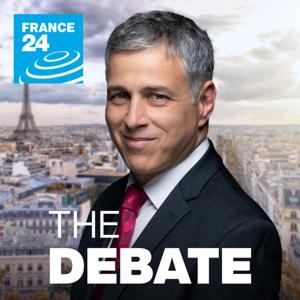
A live debate on the topic of the day, with four guests. From Monday to Thursday at 7:10pm Paris time.

7,580 Listeners

10,709 Listeners

3,369 Listeners

762 Listeners

1,046 Listeners
1,024 Listeners

1,802 Listeners

348 Listeners

4 Listeners

0 Listeners

0 Listeners

2 Listeners
1 Listeners

21 Listeners
181 Listeners

5 Listeners

0 Listeners

4 Listeners

6 Listeners

5 Listeners

39 Listeners

815 Listeners
3 Listeners
4 Listeners

5 Listeners
1 Listeners

16,143 Listeners

0 Listeners

0 Listeners

361 Listeners

0 Listeners

476 Listeners

378 Listeners