
Sign up to save your podcasts
Or



It’s not every day that a standing ovation at a medical conference goes viral. Dateline: Chicago, at the annual conference of the American Society of Clinical Oncology. Doctors from around the world rose to their feet to applaud the announcement of a new pill that doubles survival time for pancreatic cancer, one of the deadliest forms of the disease.
The conference also brought major advances in breast, bladder and head and neck cancers, among others. So why are breakthroughs coming so quickly? Is it the same wave of innovation that delivered Covid vaccines in record time? The growing use of artificial intelligence and increasingly sophisticated data science? Or a political determination to intensify the fight against diseases that affect an ever-growing share of the population?
That broader question inevitably leads to prevention. We'll examine access to screening, lifestyle choices and a factor that often receives far less attention than it deserves: environmental exposure. From air pollution to industrial chemicals, many cancer risks lie beyond the control of any one individual.
Case in point: the bill passed on Wednesday by the French Parliament to reduce cadmium levels in fertilisers and food. Lawmakers backed stricter measures than those proposed by the government, which has faced pressure from France's powerful agricultural lobby.
The dangers of tobacco and alcohol are well known. But how many of the cancers we develop are shaped not only by personal choices, but also by political decisions and commercial interests?
Produced by François Picard, Rebecca Gnignati, Juliette Laffont, Ilayda Habip, Charles Wente.
The list is long: strategic sectors in which Europe is rarely master of its own destiny – energy, manufacturing, even its nuclear deterrence. But what about digital? Who even owns the personal data of Europe's citizens? The European Commission is unveiling its tech sovereignty roadmap this Wednesday.
At the dawn of the artificial intelligence revolution, as investors around the world anticipate record-breaking stock market debuts by Silicon Valley giants this month, and as the US president tightens controls on exports of sensitive AI technologies, how can this old continent scale up and compete? Should it build its own chips, store its own data, and train its workforce to adapt to the massive labour-market disruption already underway? Is it too late? Have the United States and China already won the race? And how can Europe achieve sovereignty while preserving what is arguably the EU's greatest strength: its rules-based order?
Produced by François Picard, Rebecca Gnignati, Juliette Laffont, Ilayda Habip, Charles Wente.
Here's one for free speech absolutists to chew on: What should the French government do when the former head of Russian state television's French-language channel is offered a place of rank on an all-news station with a free-to-air broadcast license and she touts Kremlin propaganda lines with little or no pushback or fact-checking? Introducing Xenia Fedorova, who's just had her 10-year residency permit approved and who's become the darling of far-right shipping magnate-turned-media mogul Vincent Bolloré, the same Bolloré who’s swooped for French TV, radio, print and publishing outlets.
Read moreFormer RT France chief Xenia Fedorova fuels concerns over pro-Kremlin influence in French media
How much of what Fedorova says is opinion and how much is disinformation? How much can one billionaire's personal views shape French public opinion ahead of a presidential poll next year where the pro-Putin, pro-Trump far right holds the early lead?
Contrast that with current state policy. On Sunday, France seized another sanctioned Russian tanker with UK support. In the face of repeated Russia-linked aggressions big and small, Emmanuel Macron and Keir Starmer have doubled down in their support for Ukraine. How much can and should Europeans push back?
Read moreFrance backed by Britain intercepts sanctioned oil tanker sailing from Russia
Produced by François Picard, Rebecca Gnignati, Juliette Laffont, Ilayda Habip, Charles Wente.
What happened to that four-week campaign that the Pentagon promised? Overnight volleys between Iran and the United States are met by many with a shrug, so often has the current ceasefire been violated. Even the deal in the works is mostly to roll over that fragile truce and open more talks, not to permanently settle differences. Ceasefires and their violations seem to be the norm, as Israel and Hezbollah continue to trade blows and US-brokered truces for both Lebanon and Gaza go mostly ignored.
We ask if the taking of the Crusaders-era castle at Beaufort in Lebanon is a PR stunt, or are Israelis digging in at what was an army command centre for nearly two decades during the last occupation of south Lebanon?
Read moreIsraeli forces capture historic castle in deepest Lebanese incursion in 26 years
Israeli Prime Minister Benjamin Netanyahu espouses a super Sparta state mentality to national security, insisting that Israel – like the Ancient Greek state – embrace a permanent war footing. Do the benefits outweigh the costs for an Israeli leader who's again up for re-election?
And what about for Hezbollah, the Iranian regime and a United States whose leaders promised no more boots on the ground but who under Donald Trump has increasingly made use of or threatened military might around the globe. Does that project strength or weakness? And is it sustainable?
Produced by François Picard, Rebecca Gnignati, Juliette Laffont, Ilayda Habip, Charles Wente.
What exactly is the issue with Arsenal? Here in France, we just assume that everyone in England is enamored with the storied team of Arsène Wenger, Thierry Henry, Patrick Vieira…and all the other greats all the way to the team’s present French defender William Saliba. Ahead of the Champions League final between Arsenal and Paris Saint-Germain, our panel delves into the not-always-rational, always-impassionate world of football fandom. So regarding the side that has just won its first Premier League title in 22 years, what is it? The way they play? Their attitude? Anti-London sentiment? Anti-north London sentiment? Contrast that with the love the Gunners get here in France and across much of Africa.
Likewise, donning a PSG jersey will earn you compliments on several continents. But our panellists may advise against it in Marseille and a host of other cities across France. Old domestic grudges are hard to overcome – even when one side is the defending European champion, and even though PSG’s Qatari owners booted out hooligans a decade ago and streamlined the club’s big egos in favour of an exciting brand of more fast-paced, team-oriented style of play.
Perhaps what lovers and haters of both Arsenal and PSG can agree on is that Saturday’s final could serve up that key ingredient that may be lacking when the FIFA World Cup kicks off in North America: authenticity. Is the beautiful game bigger than the toxic build-up to any one tournament – or will this bloated 48-team, price-surged, travel ban-threatened World Cup be a game-changer for football?
Produced by François Picard, Rebecca Gnignati, Juliette Laffont, Riham Mahir, Guillaume Gougeon, Charles Wente
If the first thing Europeans think of when they fill up at the pump is Donald Trump's decision to attack Iran, it's little wonder that previously pro-MAGA populists are quietly distancing themselves from the president of the United States. In fact, Trump actively campaigning for Peter Magyar's rival actually helped Hungary's new conservative prime minister boot out Viktor Orban, his predecessor of 16 years. Magyar is hoping to cash in this week with a deal to unlock more than €10 billion in frozen EU funds.
If Budapest is no longer MAGA's European headquarters, then where do fellow travellers turn in places like France, Italy, Spain and the Netherlands?
Do they instead double down on the love for Russia's Vladimir Putin, like Germany's far right? For hardened Eurosceptics, does the master of the Kremlin still seem like an invincible nationalist when he's bogged down in Ukraine?
So do they cosy up to outside superpowers – like Britain's Nigel Farage, who's long been enamoured with Trump – or as shown by recent revelations surrounding the same Reform UK leader, instead find a billionaire with a bee in his bonnet to bankroll them?
Produced by François Picard, Rebecca Gnignati, Juliette Laffont, Guillaume Gougeon, Charles Wente.
Europe's in meltdown, and it's not even June yet. We're seeing a not-so merry month of May as record highs explode under a heat dome that's drifted north from the Sahara. After the frying pan of an energy crisis, the fire of a heatwave is forcing a reset by the same politicians who pandered to those who complained about the cost and red tape of recent energy transition policy.
Enter Emmanuel Macron. France's president was precisely one of those politicians who had segued from summits to make the planet great again to cuts in subsidies for homeowners and moratoriums on going green. Flanked by captains of industry, Macron on Tuesday unveiled plans to turbocharge what almost sounds like the electrification of everything. We hear about heat pumps, charging stations and electric vehicle factories here in the land of nuclear power.
Read moreWhy is Europe heating up faster than the rest of the world?
More broadly, can industry and technology come to the rescue of humanity? If blocking the Strait of Hormuz is all it takes to threaten livelihoods the world over, it's worth asking about the sustainability of the alternative: one that features a scramble for copper, cobalt, uranium and whatever else can be extracted in the name of growth.
Produced by François Picard, Rebecca Gnignati, Juliette Laffont, Guillaume Gougeon, Charles Wente.
Three months into what was originally billed as four-week war, is an end really in sight? Donald Trump's messaging on bargaining with Iran was enough to push Brent crude oil below $100 a barrel for the first time in two weeks. Both Washington and Tehran are managing expectations of a final deal or "memorandum of understanding".
Time is not on Trump's side, what with a World Cup to host in less than three weeks and inflation that's fast erasing the sweetener of tax breaks for voters ahead of the November midterm elections. But if inflation's bad in the US, Iran has economic ruin to contend with. So again, who blinks first?
Read morePossible Iran-US deal: What we know about the key issues on both sides
And how do regional players align? Gulf states are divided between hawks – led by the United Arab Emirates, who've drawn closer to Israel in this conflict – and doves, led by the Strait of Hormuz's other frontline state Oman.
So which is it: a deal, a return to war or permanent state of limbo over the world's biggest choke point for oil and gas?
Produced by François Picard, Rebecca Gnignati, Jean-Vincent Russo, Guillaume Gougeon, Charles Wente.
It's easy to lecture world leaders about how fuel subsidies ruin the environment and bleed state coffers dry, but try telling that to beleaguered Bolivians and cornered Kenyans, two of the many nations where the energy crisis has reached breaking point with citizens unable to keep up with prices at the pump. It's not just in the Americas, Africa and Asia where the Iran war is destroying livelihoods and derailing fiscal roadmaps.
France – which at the outset of an election year is already running the biggest budget deficit of the eurozone at 5.1 percent of GDP – is further loosening the purse strings, with the prime minister announcing fresh measures.
Watch moreFrance announces €710 million in new energy aid
So, to subsidise or not to subsidise? On that score, what lessons have been learned from the last energy crisis in 2022? Oil and gas prices are notoriously volatile. What if the Strait of Hormuz is never the same again? And how much fuel is left before the entire global economy's running on empty?
Produced by François Picard, Antonia Cimini, Juliette Laffont, Juliette Brown, Charles Wente.
Can border walls keep out pandemics? The World Health Organization is officially branding the Ebola outbreak in eastern DR Congo a "public health emergency of international concern". As the death toll from the rare strain climbs, so does the number of contact cases. Ituri province may seem remote on a map, but nowhere's very far in a globalised world.
Watch moreEbola in DR Congo: 'This could be a very bad outbreak,' MSF health worker says
We ask about the outbreak and the lessons learned from previous pandemics. Since Covid, the United States has quit the UN's health body. Public aid and science budgets are trending down among all G7 nations.
What does that mean for the WHO and for global health? Why is it that despite Covid and despite globalisation, there's such a backlash against vaccines, cross-border cooperation and more broadly, against science itself?
Produced by François Picard, Rebecca Gnignati, Juliette Laffont, Juliette Brown, Charles Wente.
From the publisher's feed
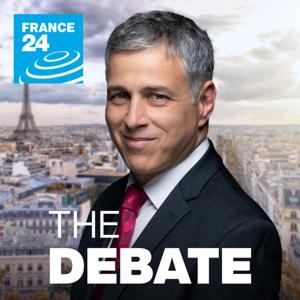
A live debate on the topic of the day, with four guests. From Monday to Thursday at 7:10pm Paris time.

7,580 Listeners

10,709 Listeners

3,369 Listeners
762 Listeners

1,046 Listeners
1,024 Listeners

1,802 Listeners
348 Listeners

4 Listeners
0 Listeners
0 Listeners
2 Listeners
1 Listeners
21 Listeners
181 Listeners
5 Listeners
0 Listeners
4 Listeners
6 Listeners
5 Listeners
39 Listeners

815 Listeners
3 Listeners
4 Listeners
5 Listeners
1 Listeners

16,143 Listeners
0 Listeners
0 Listeners

361 Listeners

0 Listeners

476 Listeners

378 Listeners