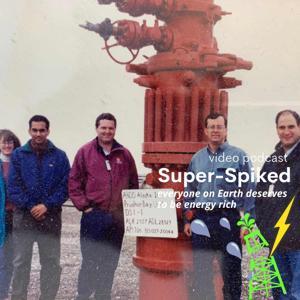
In Episode 32 of The Energy Question, David Blackmon interviews Amir Adnani, the CEO of Uranium Energy Corp. UEC is the largest, diversified, United States-focused uranium company. UEC is a pure-play uranium company and is advancing the next generation of low-cost, environmentally friendly In-Situ Recovery (ISR) mining uranium projects. The Company has two production ready ISR hub and spoke platforms in South Texas and Wyoming, anchored by fully licensed and operational processing capacity at the Hobson and Irigaray plants. UEC also has seven U.S. ISR uranium projects with all of their major permits in place.
In this episode, David and Mr. Adnani talk about UEC's business endeavors, the opportunity for uranium production in Texas and other areas of the United States, and why a renaissance of nuclear energy will be necessary of the world is to meet its net-zero goals.
Run of Show:
00:00 - Intro
01:08 - History of Amir Adnani's Company (history of uranium mining)
07:41 - Talks about energy transition debate (nuclear energy, developments due to energy bills)
15:01 - Talks about Fukushima Daiichi reactors
17:29 - Zero carbon emission source or a heavy polluting source like coal
20:52 - Jobs domestically in uranium exploration mining
24:08 - Outro
The Energy Question Episode 32 - Amir Adnani - Urainum Energy Corp
David Blackmon [00:00:10] Hello, welcome to the energy question with David Blackmon. I'm your host, David Blackman. My very special guest today is Amir Adnani, the founder and CEO of Uranium Energy, which is America's leading fastest growing uranium mining company in the United States. And I. Amir, thank you so much for your time today. I really appreciate it.
Amir Adnani [00:00:31] Pleasure's all mine. Thanks for having me.
David Blackmon [00:00:33] You bet. I'm an old oil and gas guy, but I'm also been a long time fan of nuclear energy. And I realized that I understand the need for more of it in the United States as a zero carbon energy source.
David Blackmon [00:00:48] And so I'm really glad to talk to you because we haven't focused enough on the need and the future for this key energy source here on my podcast. But before we get into the Q&A, I want to give you a couple of minutes to talk about the history of your company, you know, where it started, where it's going in, and how you plan to get there.
Amir Adnani [00:01:08] I'm an entrepreneur by background and have been involved and focused on energy-related and commodity-related businesses for the last 20 years. In 2004, 2005 timeframe, I looked at what was happening in nuclear energy and we were certainly experiencing the early innings of a nuclear renaissance. I looked at what was happening in the US and in the US. Back then we were importing 90% of our uranium requirements and I thought this doesn't make sense.
Amir Adnani [00:01:37] And I really started to take a deeper look at the history of uranium mining in the US and was fascinated by the fact that not only was the civilian nuclear energy program to generate electricity, it started in the US,.
Amir Adnani [00:01:50] But we had the largest fleet of nuclear reactors anywhere in the world and the history of uranium mining was written by US oil and gas companies in the sixties, seventies and eighties. Companies like Exxon, Chevron, Texaco, ConocoPhillips were the pioneers of uranium mining and particularly a very unique extraction of uranium called In-Situ recovery, which is much more familiar, similar to oil and gas recovery than actual mining. And these all disappeared.
Amir Adnani [00:02:19] Why did these companies disappear? Why did the uranium mining industry disappear in the United States? Because when the Cold War ended, the US decided to sign a treaty with the Russian government to dismantle Soviet era warheads that the Russians had too many of.
Amir Adnani [00:02:35] To take highly enriched uranium out of doors warheads blended down to low enriched uranium and sell it into the market. This became the equivalent of the world's largest uranium mine and destroyed the domestic industry in the US. The positive end of it is that it did, over the course of 20 years, helped dismantle and wait for this 23,000 Soviet era nuclear warheads.
Amir Adnani [00:02:58] And so it did a lot in terms of security and the stockpiling the Soviet missiles, but it destroyed our industry. So fast forward to really the company's background in Genesis. I became quite fascinated by the productive history of uranium in South Texas.
Amir Adnani [00:03:17] South Texas, according to the US Geological Survey, contains the largest potential deposits for uranium in the United States that are untapped and unexplored. Much of this potential happens alongside oil and gas basins like the Eagle Ford Shale and the Barnett Shale.
Amir Adnani [00:03:33] These areas that have been very productive for oil and gas over geologic time have also helped uranium deposits get formed in the same regions. We set up shop originally in Austin, Texas, as a company Uranium Energy Corp, before moving our offices to Corpus Christi to be closer to our South Texas business that we were building brick by brick. We expanded from 25 odd business plan.
Amir Adnani [00:03:56] We got into production in 2010 at our Hopson facility down in Karnes County. That's the four behind me right? There is a lot of supply, and that's the largest uranium recovery plant in Texas and one of the largest in the country today.
Amir Adnani [00:04:10] And so our view was that longer term nuclear power played an integral role in providing electricity in the US. One in every five home in America is powered by nuclear energy. Over 50% of carbon free electricity generation in the country is nuclear.
Amir Adnani [00:04:26] And so this made no sense that there wouldn't ultimately be a bigger domestic industry. So we focused we got into production in 2010, hired many people. We were one of the only new uranium mines in the world in 2010 in South Texas. Then we had the nuclear problems in Japan that happened in 2011 with their Fukushima Daiichi reactors.
Amir Adnani [00:04:45] So we entered their market for nuclear energy and uranium that basically lasted about a decade. Unfortunately, during this bear market, we continue to rely as an industry in the US on Russia, Kazakhstan, Uzbekistan for our uranium needs. And so during this period, domestic uranium mining basically vanished.
Amir Adnani [00:05:04] And so when I started in 05. When we were importing 90% of our required. Today we import 100% of our requirements. My company was able to survive the bear market and we took on a very counter-cyclical strategy and we thought, you know what, let's take advantage of the bear market to make acquisitions.
Amir Adnani [00:05:21] Sort of the old saying, you know, you want to buy your Christmas decorations in January. So we got really worried. We were able to roll up assets and not only in Texas where we expanded into Wyoming, we expanded into Canada, we were able to really, again, go bargain hunting.
Amir Adnani [00:05:36] And then Russia's invasion of Ukraine occurred, which, as terrible as it is, and as much as it's a humanitarian crisis, it has really brought attention to energy supply chains. And now I think there's a realization that, holy crap, we can depend on Russia. Okay. Well, I mean, a lot of people kind of knew that before Russia had to get that way. But now finally, the realization is there. Governments, utilities, everyone is trying as fast as possible to move away from Russian supplies. So we're a US based company. We're a Texas based company.
Amir Adnani [00:06:11] Today we have operations not just in Texas, but, as I mentioned, Texas, Wyoming and Canada's Saskatchewan Province, which is home to some of the highest grade uranium deposits. We believe North American supplies and US supplies can provide energy security moving forward and energy security in a world that wants to decarbonize as fast as it's trying to electrify, but needs to do all of that while actually having access to the energy supply chain.
David Blackmon [00:06:38] Yeah, I it's so interesting to hear you go through this history of development of the industry in South Texas. I grew up down there in Bellville, Texas, just 30 miles from we have a facility.
Amir Adnani [00:06:50] We have a project in the county nearby. Yes. Yeah, we're very active there. Yeah.
David Blackmon [00:06:55] Yeah. I had some cousins in Live Oak County who got very rich in the 1970s on uranium. It was either Dow or DuPont had a big plant just outside of Georgia, West Texas.
Amir Adnani [00:07:06] You're right. So we have a few of our a few of our team members worked at that operation. And the US Steel. US Steel had that project in Louisville County as well. And it was a really successful project, the one you're referring to. But absolutely.
David Blackmon [00:07:19] Yeah, Minerals and gold, the Ed County. And unfortunately we never got a lease there, but maybe sometime in the future.
Amir Adnani [00:07:25] We're we're in Gold County as well.
David Blackmon [00:07:28] Are you really? Oh, my gosh. I need to call your business development guy. Anyway, sorry I'm not trying to sell a lease here, so I. You know what? What is so perplexing to me in this whole energy transition debate is watching is the same people, the same groups, climate change lobby groups, do you know, advocate for wind and solar and zero carbon energy, Turn right around in their next breath. <...