
Sign up to save your podcasts
Or



Can having a baby later in life really help you live longer? And what do scientists actually mean when they say pregnancy changes your biological age?
This week on The Family Tribe, Afif and Anne investigate the research behind the headlines linking motherhood, ageing and longevity. They explore the remarkable demands pregnancy places on the body, changes in biological ageing markers during pregnancy and after birth, and why having your first baby later is a different question from having your last baby later.
Along the way, they discuss telomeres, epigenetic clocks, genetics, menopause and family size, asking whether later motherhood might reflect better underlying health rather than cause a longer life.
There is also Anne’s recollection of planning her family around turning 35, a discussion of age-related pregnancy risks, and some strong feelings about the phrase “geriatric pregnancy”.
With plenty of teasing and a healthy scepticism towards Instagram science, this is a conversation about understanding the evidence without turning it into another reproductive deadline. Your child’s birth certificate cannot predict your lifespan.
What happens when Anne’s lifelong best friend joins the podcast? Afif discovers just how much history he has missed, and a birth story somehow involves an offer to do the midwives’ hair. In this bonus episode, we welcome Martha Galvin, hairdresser, business owner, mother of three boys and honorary fifth Doherty sister. Martha shares the stories of her first son’s arrival and the later birth of her twins. She reflects on preparing for labour, discussing her preferences with her maternity team, choosing pain relief and understanding what might happen if plans needed to change. At the heart of her experience was feeling heard, supported and involved in the decisions being made. Martha also introduces her planned podcast, The Invisible Bag, exploring the unseen experiences and worries people carry through life. An affectionate, candid conversation about birth, friendship and the people who help us feel supported. Every birth is different, and Martha’s story reflects the choices and circumstances that were right for her. Put the kettle on, join us, and share this episode with someone who loves a good birth story.
Would banning teenagers from social media make them safer? And what might we miss if we judge their online lives by screen time alone? This week on The Family Tribe, Afif and Anne explore teenagers, technology and the daily negotiations happening in family homes, including their own. Maggie explains why she felt she received access to social media too late, while Faisal’s experience shows how recognising a problem and asking for help can become part of learning to manage it. There is also an alarming screen-time total that turns out to involve rather more Lego than expected. Alongside these family stories, Afif and Anne discuss Irish online safety rules, research on teenage mental health, school phone restrictions and the arguments for and against blanket bans. An honest conversation about setting limits, listening to teenagers and recognising our own scrolling habits.
Follow The Family Tribe, leave a rating or review, and share this episode with a parent navigating the same conversations.
Content note: This episode includes discussion of self-harm and suicide.
Headlines about babies swallowing millions of plastic particles can make an ordinary bottle feed feel like a parenting mistake. So what does the research actually tell us?
In this episode of Baby Tribe Shorts, Afif and Anne explore microplastics in baby bottles, silicone teats and milk storage bags. They revisit the Trinity College Dublin study behind many of the headlines, discuss why measuring particles is surprisingly complicated, and explain the distinction between detecting exposure and demonstrating harm.
They also separate microplastics from BPA, consider the practical drawbacks of glass bottles, and discuss why concerns about plastic should never undermine established advice on sterilisation and formula preparation. Along the way, Afif loses patience with Instagram fearmongering, Anne recalls a toddler licking a shoe, and a disagreement over millimetres becomes surprisingly competitive.
An episode about feeding choices, scientific uncertainty and helping parents make decisions without unnecessary guilt.
Weight-loss drugs are everywhere in the headlines. But what might they mean for our health beyond the number on the scales?
This week, Professor Afif EL-Khuffash and Dr Anne Doherty explore GLP-1 medicines and the research into their effects on the heart, kidneys, liver and painful knees. They explain how these medicines influence blood sugar and appetite, unpack “food noise”, and discuss why managing obesity involves much more than willpower.
They also explore emerging research on alcohol cravings, the findings in Alzheimer’s disease, and the practical realities of treatment, including side effects, nutrition, maintaining muscle and medical supervision. For breastfeeding parents, Afif explains what the available research can tell us, what remains unknown, and why individual circumstances matter.
Along the way, Anne questions both the evidence and Afif’s increasingly busy social calendar.
Science, scepticism and a little marital cross-examination as we explore what these medicines can offer, and where the questions remain.
This episode provides general information and does not replace individual medical advice.
In this Baby Tribe Short, Afif and Anne look at a recent New South Wales paper asking why birth interventions are rising. The study found that so-called cascade interventions, including induction or augmentation, epidural or spinal analgesia, and instrumental birth or intrapartum caesarean section, increased over time, even among women labelled low risk.
But what does “low risk” really mean? And does a rise in intervention automatically mean harm, overmedicalisation, or poor practice?
Afif and Anne unpack what the paper shows, what it does not show, and why the missing outcome data matters. They discuss maternal risk, hospital culture, birth preferences, induction, epidurals, caesarean birth, and the danger of drawing strong conclusions from incomplete data.
The big question is whether mothers and babies are doing better because of them.
Link to paper: https://www.mdpi.com/3042-898X/1/1/2
Baby Tribe has grown up.
In the first episode of The Family Tribe, Afif and Anne explain why they are widening the conversation from babies to the whole messy, funny and complicated world of family life.
They reflect on 18 years of parenting, raising teenagers, marriage, multicultural family life, ageing parents, disappearing villages, financial pressure and bringing up children in a digital world that none of us fully understands.
Along the way, they discuss 3:30 am wake-ups at every age, negotiating with teenagers through ChatGPT, growing up in Palestinian and West of Ireland families, and why loading a dishwasher remains one of marriage’s most dangerous tests.
They also share what they wish they had understood when their children were small, including the fleeting nature of ordinary moments and the unexpected joy of not only loving the adults your children become, but genuinely liking them.
The baby grew up. The podcast did too. Welcome to The Family Tribe.
Parenting doesn’t come with a manual but The Family Tribe is here to be part of the village that helps you through it.
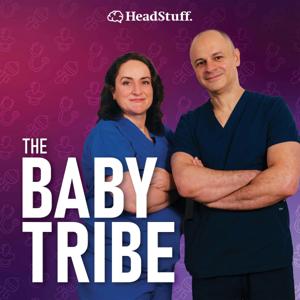
Hosted by husband-and-wife medical experts Dr Afif El Khuffash and Dr Anne Doherty, The Family Tribe offers honest, evidence-based advice for parents and guardians of children from newborns right through to teenagers. Bringing together more than 40 years of combined clinical experience, as well as their own lived experience as parents, Afif and Anne help listeners navigate the chaos, love, worry, tears and awe of family life.
With two episodes each week, the podcast cuts through the noise of online advice and misinformation to explore the topics that matter most — from pregnancy, newborn care and child development to mental health, family relationships, teenage challenges and common parenting worries.
Main episodes are released every Tuesday, with a shorter Baby Bonus episode focused on pregnancy and baby health every Thursday.
Expect myth-busting conversations, expert interviews, real listener stories, well-known guests and practical guidance designed to reassure, inform and support parents, guardians and the wider family at every stage of the journey.
A large Australian study comparing public and private maternity care seemed to show better outcomes for mothers and babies in private obstetric-led care, including lower rates of stillbirth, NICU admission, severe perineal tears, and maternal haemorrhage. But the story is much more complicated than the headline suggests.
In this episode of Baby Tribe Shorts, Afif and Anne unpack the study and ask whether it really proves that private care is safer, or whether the results reflect something deeper: differences in patient selection, continuity of care, intervention thresholds, and the fact that public hospitals often absorb the highest-risk pregnancies.
They also discuss why the findings may not translate neatly to Ireland, where private obstetric care usually sits within public maternity hospitals rather than separate private maternity units. The take-home message is not that public care is worse, but that fragmented care, lack of continuity, and risk transfer matter. A high-risk hospital having worse outcomes does not mean it gives worse care. Sometimes it simply means it is looking after the patients who need the most help.
Link to Article: https://obgyn.onlinelibrary.wiley.com/doi/10.1111/1471-0528.18286
In this episode of Baby Tribe Shorts, Afif and Anne tackle the anxiety caused by recent headlines linking paracetamol use in pregnancy with autism, ADHD and intellectual disability. They walk through a major Lancet systematic review and meta-analysis, explaining why the best-quality evidence, especially sibling comparison studies, does not support a causal link between paracetamol use in pregnancy and these neurodevelopmental outcomes.
The episode also explains why paracetamol remains the recommended first-line option for pain and fever in pregnancy, why untreated fever can itself be harmful, and why earlier studies may have suggested a risk because of confounding, recall bias and the reasons people take medication in the first place. The key message for parents is clear: use paracetamol when needed, at recommended doses, and don’t let fear-driven headlines make pregnancy harder than it already is.
https://www.thelancet.com/journals/lanogw/article/PIIS3050-5038(25)00211-0/fulltext
From the publisher's feed
Parenting doesn’t come with a manual — but The Family Tribe is here to be part of the village that helps you through it.
Hosted by husband-and-wife medical experts Dr Afif El Khuffash and Dr…
With two episodes each week, the podcast cuts through the noise of online advice and misinformation to explore the topics that matter most — from pregnancy, newborn care and child development to mental health, family relationships, teenage challenges and common parenting worries.
Main episodes are released every Tuesday, with a shorter Baby Bonus episode focused on pregnancy and baby health every Thursday.
Expect myth-busting conversations, expert interviews, real listener stories, well-known guests and practical guidance designed to reassure, inform and support parents, guardians and the wider family at every stage of the journey.

77 Listeners
6 Listeners

347 Listeners
839 Listeners
93 Listeners

52 Listeners

7 Listeners
19 Listeners
40 Listeners
18 Listeners

2 Listeners

8 Listeners

16 Listeners

30 Listeners

7 Listeners