
Sign up to save your podcasts
Or



Hello Friends!
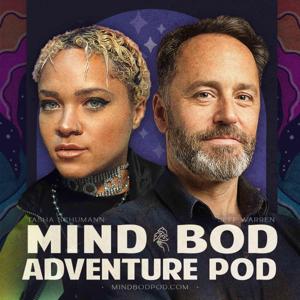
Jeff Warren & Tasha Schumann here with some exciting news for 2024 and beyond! The Consciousness Explorers Podcast has evolved into … *drumroll* …
🚀 The Mind Bod Adventure Pod! 🚀
Starting January 30, we’re coming at you with new weekly practice episodes, amazing guests, and rampant tomfoolery. In your inbox (and on Substack) every Tuesday.
Here’s what’s new:
* The Pod is now in VIDEO!! Audio-only is still available on all podcast platforms, but if you wanna see us hang out in Tasha’s living room every week, come over to www.mindbodpod.com
* Paid subscriptions for those who want to support our work: In addition to the weekly episode (which is free for everyone), paid subs will get access to our Afterparty videos, where we get weird and extra animated and talk about everything that didn’t get said in that week’s official episode.
* Community Space!: Thanks to this move to Substack, we now have a space to chat with you - the Mind Bod Pod Squad! Hop into the comment section and let us know your thoughts about the practice and the discussion. We’ll be lurking in there, waiting to nerd out and make friends.
- Tasha and Jeff
In today’s episode (the Season 1 finale!) we get slow and personal with Ev’Yan Whitney, sexuality doula, podcast host, and author of Sensual Self. “Sensuality” often gets lumped in with sexuality… Ev’Yan wants to change that, to tease apart these two aspects of being human and demonstrate how everyone can connect with a more sensual version of themselves.
Ev’Yan’s 19-minute practice is a tour of the senses. Take your time. The pacing of Ev’Yan’s guidance – the way she encourages us to pause and savor each sense – is part of its sensual magic.
Afterwards we have a wide-ranging conversation, from issues of sensuality and consent, to how sex changes over time in relationships, to the fundamental right of pleasure. Many of us feel guilty talking about pleasure, as though it were somehow frivolous or self-indulgent. For Ev’Yan, in a world that is continually forcing us out of our bodies, out of safety, out of softness … “Pleasure in such a world is an act of resistance.”
“When we feel good, we do good … so feel good!” It’s the perfect way to finish our season.
Season 1 Finale Message from Tasha & Jeff:
Thank you so much to all our listeners for an incredible 1st season! We’ve had so much fun this past year, creating these 23 episodes of mind-body adventure.
We (and our awesome producer Timmy) will be back in the fall with a BRAND NEW SEASON of exploration and consciousness-expanding guests! In the meantime, drop us a note if there’s a guide or a subject you’re keen to explore with us.
And of course, if you’d like to support our time-and-resource-intense labor of love, consider contributing to our Patreon! Have a wonderful summer ❤️
Ev'Yan's Links :
• Sensual Self podcast
• Sensual Self book
• Ev'Yan's website
• Ev’Yan’s instagram
Our guest today is Angelo DiLullo, a medical doctor and author of a fine book called Awake: It's Your Turn. Angelo points directly to the true nature of self / consciousness / or whatever you want to call this bizarre ululating mystery we all seem to be living inside. He probably wouldn’t even say he “teaches” this, since all he really does for his guided practice is describe his own experience of operating in a world without a sense of a panicked separate self running around going “I gotta get more stuff!”
In fact, the whole conversation is a direct pointing. And what is Angelo pointing Tasha, Jeff, and our listeners to? His term for it is “unfiltered reality.” Which turns out to be right here, right now, only we overlook it, on account of our enthralment to thinking and the organizing structures that lie below thinking.
This s**t is so fun. That’s why we do it. We like the existential shivers, the shiver-me-timbers, the sense of beautiful ordinary that settles all around as we get wide and full of Being (beans!), trembling righhhht at the threshold of …. of what? Of almost getting it? – but getting what? If it can’t be got, if it’s already right here? Etcetera etcetera and so on and so forth.
What pleasurable times we had conversing about perceptual distortions and the need for emotional work and metabolizing energies and the twitchy “sphincter of the mind” and the tragic way Jeff has reified awareness and thus will probably never get enlightened and that’s fine at least he still has most of his hair (not for long Dad!).
The End
Angelo's 12.5 minute nondual "direct pointing" begins at 9:28 and ends at 21:52.
Links:
In today’s episode, we’re joined by author and embodiment expert Philip Shepherd. Philip is also an actor, and thus a wonderfully entertaining tour guide. He takes us into the body’s “grounded sensitivity” – really the perfect phrase for it, a place both of exquisite intelligence and dependable common sense. Under Philip’s careful guidance, we explore how to move past the mind’s imaginary constraints, softening and merging with the world around us.
It’s an ambitious itinerary with many practical take-aways. Come feel reality beyond the head!
To go straight to Philip’s grounded sensitivity practice, it begins at 3:59 and ends at 18:03.
Links:
• Philip’s website: https://embodiedpresent.com/
• Philip’s online courses: https://embodiedpresent.com/experience/online-learning/
Today we’re joined by Rima Dib, a good friend of Tasha and Jeff’s who also happens to be an expert in unconscious bias and anti-oppression education. Rima teaches workshops about difference – race, age, gender, sexual preference, ability – to people around the planet. She makes it fun. Is this possible? Yes, it turns out. We laughed our asses off. In Rima’s words, “If it gets too heavy, we’re gonna want to put it down. By keeping it light, we can carry it longer.”
Fun doesn’t necessarily mean comfortable. Her acting and word association practices are very revealing. We go with our first flash or gesture, before we have time to edit our responses for popular consumption. Gulp. Thus Jeff squirms in his seat as various juvenile biases are uncovered. Fortunately, we also learn how our unconscious biases are NOT the same as our chosen values. So there's a lot of healthy normalization here. For Rima, everyone has biases; healing and change begin by bringing them into our awareness.
Our conversation is very lively! We explore everything from “cancel culture” to Mr Clean to educating your kids about bias and dealing with racist babies. This is good medicine my friends. Thank you Rima, we love you.
The first practice of identifying our embodied biases begins at 10:50 and ends at 19:25. The second practice, where we visit “the attic of our imaginations,” begins at 32:53 and ends at 37:56.
Links
• Rima Dib’s "Harmony at Work" website: https://harmonyatwork.ca/team/rima/
• The Harvard Implicit Bias Test: https://implicit.harvard.edu/implicit/takeatest.html
Meet Shinzen Young, a long-time instructor of mindfulness, author of The Science of Enlightenment, and now co-director of the “Science Enhanced Mindful Awareness” or “SEMA” Lab at the University of Arizona. Shinzen is Jeff’s OG meditation teacher. He is both a scholar of comparative mysticism, and a highly creative designer of strange and beautiful (and practical) meditation techniques.
In this episode, instead of trying to banish thoughts, we drop into a "global unfixated state," and allow creative images and words and associations to spontaneously unfold. Both Shinzen’s exposition and his guided practice are quite precise – so much so that Tasha kind of bristles against them, which makes for a lively discussion afterwards. But if you’re patient, and able to trust what Shinzen is pointing to, it can lead to genuine insight. Thinking can shift from something rigid and constrained, to something more free-flowing and intuitive and even wise.
This matters. For Shinzen, the best of humanity comes through via our creativity and intuition. In his words, we can train ourselves to “let nature take over.” Shinzen himself demonstrates this at the end, when he comes apart during an emotional discussion of Japanese Noh theater. Much good stuff on the “deep mind,” subconscious processing, and the better angels of our nature.
So: here we go … like “seaweed in a tide poodle”!
Links:
Today we hang out with the incomparable Tatianna Morales – aka @tatiannatarot – a Brooklyn-born spiritualist, priestess, and Tarot diviner! Together, we plunge into the imagination, learning how the age-old tradition of reading Tarot cards can give us insight into our personalities and our life situations.
It turns out we’re meeting Tatianna at the very moment her own relationship to Tarot is changing. And not only hers: there’s a revolution happening out in the culture – artists and enthusiasts are creating their own tarot decks, imagining new archetypes to better reflect the realities of 21st century life. As we discuss, this is one way that culture and consciousness change and evolve.
So how do we give listeners their own personal Tarot reading? Tatianna starts by asking listeners to think of a question or theme they want to explore. Then all of us – Jeff and Tasha too – choose a number between one and three. Tatianna pulls a card for each number and does a reading for each. Listen closely to the reading for the number you choose! All the readings are fascinating, as examples of how Tarot works and the kinds of dynamics they help us explore.
Much goodness here and a wonderful animated discussion afterwards. Enjoy!
Practice begins at 8:52 with Tatianna’s readings from 10:30-19:36; Jeff and Tasha get a personal reading from 20:17 – 32:38, and finally our general discussion begins at 32:38.
Links:
- Tatianna’s website: https://www.tatiannatarot.com
- Tatianna’s instagram: https://www.instagram.com/tatiannatarot/
Today’s episode: Peter Russell. Peter started out as a theoretical physicist, a student of Stephen Hawking’s, until sometime in the early 70s he made his way to India and had his brain blown open. He became one of the West’s early proponents of meditation, and in the 80s wrote several seminal books on consciousness and technology. He’s had a big influence on the culture of meditation in general and on Jeff in particular – Jeff tells the story of meeting Peter in San Francisco back in 2008 and afterwards getting “let go” tattooed on his forearm.
Appropriate then, that Peter’s new book is called Letting Go of Nothing. What does “letting go” actually mean, and why do so many meditation teachers go on about it? We explore this in real-time, as Peter guides us in a wonderfully simple and accessible “effortless meditation” practice. Afterwards, very relaxed, we lazily discuss whether all this effortlessness is really just cheating and won’t actually get us anywhere. “Thinking you need to get somewhere is exactly the problem!” says Peter, or something like that. And on we go, a deep dive into the ordinary perfection that is already right here. This is good medicine.
Peter’s 12 minute effortless meditation practice begins at 7:55 and ends at 19:58.
Apologies for the rustles and muffles – sound improves after the first ten minutes.
Links:
Meet psychotherapist and Feldenkrais teacher Donna Ray. In this episode, she makes us move! Ok, more like she makes us sit in chairs and roll our eyes and turn our heads a bit and suddenly everything feels better. Welcome to the subtle art of micro-movement. Donna shows us how small physical adjustments in the way we hold ourselves can change both our experience and our body’s overall functioning. She’s a true adept – Donna has been teaching this method for over 40 years, ever since Moshe Feldenkrais first brought his system to North America.
Like much of what we explore at CEP, the radical nature of Feldenkrais is hard to capture in words. Not a problem – your body doesn’t need words, it learns for itself by doing, and, in the doing, awareness expands. This is about repatterning the nervous system so that all parts can function in a more vital and free and integrated way. Ultimately it’s an exploration of pleasure as the basis for how to live inside our bodies. Thus we end our conversation with a few PG remarks on Tantric sex, and call it a day.
Donna’s 16 minute Feldenkrais practice begins at 9:02 and ends at 25:20.
Links:
Today we’re joined by the UK-based Valerie Mason-John, also known as Vimalasara, a leader in the field of mindfulness for addiction and trauma.
This episode is about the ways we get disconnected from our bodies and our lives, and the role self-compassion can play in bringing us home. We explore this in the context of our addictions – even addictions we don’t realize are addictions, like, in Vimalasara’s words, “stinking thinking” and technology. And we explore it in the context of contemporary challenges like coronavirus, and the institutional racism and violence directed to Black bodies.
For Vimalasara, the medicine is self-compassion – delivered with fierceness and strength. She guides us into a 16-minute meditation she calls the “five basic needs of the heart.” And then at the end of our time together, she guides a sobering inquiry into what she calls the “five questions of the shaman.” One of them – “when did you stop dancing?” – kind of drops a bomb into your brain!
To go straight to the “five basic needs of the heart” practice, it begins at 3:35 and ends at 19:33.
Links
• Valerie’s website, where you can also find all our resources on recovery and addiction https://www.valeriemason-john.com
From the publisher's feed

43,359 Listeners

10,508 Listeners

361 Listeners

823 Listeners

1,856 Listeners

1,473 Listeners
691 Listeners

943 Listeners

10,137 Listeners

12,722 Listeners

2,513 Listeners

1,898 Listeners

14,366 Listeners

1,370 Listeners

1,099 Listeners