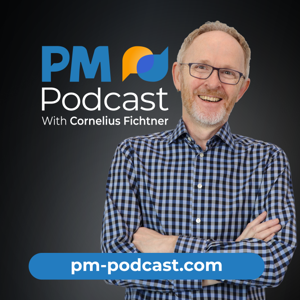
The Project Management Podcast

The Project Management Podcast

By Cornelius Fichtner, PMPBusinessCareers
Download on the App Store
  • Ranking

    2nd

    on Management & Marketing

  • Favorites

    512

    Followers

  • Typical duration

    35 min

    per episode

Based on Podcast App listening data

The Project Management Podcast episodes

  • Episode 381: Scaled Agile for The Enterprise (Free)
    Play Now: Get Project Management Professional (PMP)® exam ready by putting PMP training in your pocket! Joy Beatty and Cornelius Fichtner We continue our look at the topic of scaled agile that we started in the previous episode, this time by looking at "agiLE" - Agile in the Large Enterprise. This interview about Scaling Agile with Joy Beatty, PMI-PBA was recorded at the Project Management Institute (PMI)® Global Congress 2016 in San Diego, California. We discuss her presentation and white paper Making "agiLE" Work: Agile in the Large Enterprise. Here are the abstract and final thoughts: Abstract: Almost all large enterprises are making some transition to agile practices. There are many approaches to scale agile in the large enterprise, and we’ll give an overview of the most common scaled approaches and their limitations. This paper also discusses the most common challenges our customers’ teams are facing when scaling agile and provides suggestions to overcome those challenges. Final Thoughts: This sounds like a daunting task—to transition to agile approaches in a large organization. However, with solid collaboration and communication, it’s absolutely doable. Teams will constantly be collaborating through elicitation, answering questions, and testing the actual product. Business analysts have a critical role to play in keeping the collaboration running smoothly, including helping to facilitate backlog grooming and elaboration, participating in planning in sprints, working with interfacing teams to identify dependencies, and serving as a product owner proxy on any teams as needed. Likewise, project and program managers can act as advisors about appropriate levels of process, help guide projects toward common goals, and ensure a focus on prioritization based on business needs. Instead of instilling a hierarchical control between PMO and product owner, in agiLE the PMO and product owner work together to achieve the objective. The real goal for agiLE teams is self-organization and creativity, while still contributing as a part of a large organization Click to download the white paper Episode Transcript Below are the first few pages of the transcript. The complete transcript is available to Premium subscribers only. Podcast Introduction Cornelius Fichtner:  Hello everyone and welcome back to the Project Management Podcast™ at www.pm-podcast.com . We are coming to you live from the 2016 PMI Global Congress in sunny Southern California. We are in San Diego in the Expo Center here in the hallways and with me is Joy Beatty.  Podcast Interview Cornelius Fichtner:   Hello, Joy. Joy Beatty:   Hi. Good to see you.    Cornelius:  Yes. Your talk is Making Agile Work: Agile in the Large Enterprise. First question, have you already delivered your presentation? Joy:   I did, yes. Cornelius:   How was it? Joy:   It was great. We had a full room, a lot of excited people. I will say an interesting mix of the audience, mostly project managers and well, I was most intrigued by how many raised their hand that they are doing Agile, that they’re trying to scale it and then I asked how many have been successful? And lots of hands dropped. I would say very few actually of the organizations represented have really felt like they have conquered the large enterprise aspect of Agile. Cornelius:   What is your personal interest in making Agile work in the large enterprise and how’s your company, C-Level involved in this? Joy:   Maybe a little bit different than some of the other people here. Our background is actually in the business analysis space more so than project management. We have seen over the last, particularly I would say the last 8-10 years is a shift where our customers were all moving into the Agile space. And so, we’re bringing the business analysis requirements to product managers to project ow
    31 min
  • Episode 380: Scaled Agile (Free)
    Play Now: Studyng for your Project Management Professional (PMP)®? Put PMP training in your pocket! Andrew Burns and Cornelius Fichtner Agile began with the promise to make smaller project teams more able to react to ever changing customer requirements. But what if your project is big? I mean really, really big. Can we have scaled agile? This interview about Scaling Agile with Andrew Burns, PMI-ACP, PMP, was recorded at the Project Management Institute (PMI)® Global Congress 2016 in San Diego, California. We discuss his paper and presentation Dragon Scales: 50 Teams Scrumming -- Implementing Adaptive Project Management Practices at Scale. Here is the abstract: Product portfolios can easily scale to 50 teams or more in meeting large organizations’ needs. Large portfolios with strong foundations are derived through values-based leadership. The technique links corporate and individual values to scientific principles. Scientific principles inform us that change is constant and therefore adaptation defines good practices. Values-based leadership’s agile practices take root, thrive, and adapt at the pace of business change. The three-hundred software engineers considered herein innovated within a portfolio of 18,000 colleagues. Their agile, adaptive product development practices continue to evolve from plan-driven provenance. Leveraging agile practices at the portfolio, program, and project level continually unleashes innovation, quality, and throughput of value. Though contextualized in terms of software product development in the 2010s with Scrum, the message of innovation through values-based adoption of scientific principles is timeless and framework unallied. Implementation of practices observant of values and principles endures as a way to deliver the best products regardless of toolset. Click to download the white paper Episode Transcript Below are the first few pages of the transcript. The complete transcript is available to Premium subscribers only. Coming Soon... Above are the first few pages of the transcript. The complete transcript is available to Premium subscribers only. Please subscribe to our Premium Podcast to receive a PDF transcript.
    33 min
  • Episode 379: Emotional Intelligence in Leadership (Free)
    Play Now: Need Project Management Professional (PMP)® exam training? Have you considered PMP exam prep on your phone? Kim Wasson and Cornelius Fichtner At its core project management is all about effectively leading your team. Therefore emotional intelligence for project managers and project leaders can be just as important (if not more) than knowing how to interpret the latest earned value data. This interview about emotional intelligence in project management with Kim Wasson was recorded at the Project Management Institute (PMI)® Global Congress 2016 in San Diego, California. We discuss her paper and presentation One Unhappy Person Can Ruin Your Beautiful Plan -- Emotional Intelligence for Project Managers. Here is the abstract: Just one unmotivated person on your team can bring everything crashing down. Unhappiness, dissatisfaction, and lack of motivation are highly contagious; ‘one person’ quickly turns into an unhappy and possibly dysfunctional team. We're all focused on getting the process right and there’s no doubt that process is important. What many of us don’t take into account is that the success of most projects depends largely on the teams actually doing the work Process is important but it’s not going to build anything on its own – it’s a team of satisfied, competent people working together who will actually deliver a product. The people side of the project management equation is critical. Managing effectively requires the ability to understand individuals and teams, establish working relationships, manage goals, and motivate team members. Effective tools and techniques discover what makes the team members and the team itself tick, to communicate effectively with many different people both one-on-one and as a group, and to generally balance the process part of the equation with the people part of the equation are critical to project success. PDU Tip This interview is 24 minutes long. This means that you can "legally" only claim 0.25 PDUs for listening to it. However... if you first listen to the interview and then also read the white paper on which it is based, then you can go ahead and claim 0.50 PMP PDUs! Click to download the white paper Episode Transcript Below are the first few pages of the transcript. The complete transcript is available to Premium subscribers only. Podcast Introduction Cornelius Fichtner:  Hello everybody and welcome to the 2016 PMI Global Congress here in beautiful and very sunny San Diego. With me is Kim Wasson. Podcast Interview Cornelius Fichtner:   Hello, Kim. Kim Wasson:   Good morning, Cornelius.   Cornelius:  Hi. How are you doing? How’s the Congress so far for you? Kim:   It’s wonderful. It’s wonderful. The keynote was incredible. Cornelius:   Yeah. I enjoyed it very much as well. We’ve had you on the program before, right? Kim:   I have been on the program before indeed. Cornelius:   Glad to meet you in person here. Kim:   As am I. Cornelius:   You are a speaker, “One Unhappy Person Can Ruin Your Beautiful Plan” is the title of your presentation and in the abstract, the first sentence you say is, “One, just one unmotivated person on your team can bring everything crashing down.” Can you elaborate on that a little bit? Kim:   I can. Emotional contagiousness is a fairly new concept in Management Psychology but this is what it is. One person is unhappy and it becomes catching. Cornelius:   Kind of like a virus. Kim:   It is very much like a virus and it moves really quickly and so it’s very important to catch it at the beginning and try to keep everybody motivated because once one person’s unmotivated, pretty quickly the next person is going to be because they have to work with the unmotivated person, right? It just spreads through your team very quic
    25 min
  • Episode 378: Project Metrics (Free)
    Play Now: Preparing for your Project Management Professional (PMP)® Exam? Try PMP certification training on your phone, tablet or PC: Denise McRoberts and Cornelius Fichtner Setting up a PMO usually means setting up some Project Management KPI (Key Performance Metric). But which? This interview about PMO metrics with Denise McRoberts was recorded at the PMI® Global Congress 2016 in San Diego, California. We discuss her paper and presentation "Meaningful Metrics -- The Path toward Measuring what Matters". Here is the abstract: "The project management office (PMO) was in a rut. The number of projects in work at any one time was increasing; project managers were routinely reporting that all was well while schedules slipped, and there was limited understanding of true project costs." Does this sound all too familiar? In this session, attendees will learn some innovative methods to implement metrics and key performance indicators (KPIs) to better understand your organizational weaknesses and how to overcome them. This session will provide a case study on how a PMO did just that, with plenty of practical examples You will learn what makes a 'good' metric, how metrics should be developed, and that we also need specific project metrics and project portfolio metrics. Click to download the white paper Click to download the handout with metric samples Episode Transcript Below are the first few pages of the transcript. The complete transcript is available to Premium subscribers only. Podcast Introduction Cornelius Fichtner:  Welcome back everyone. You are listening to the Project Management Podcast™ at www.PM-podcast.com and we are coming to you live from the sunny town of San Diego in Southern California where we are at the 2016 PMI Global Congress and with me right here at the end of the day is Denise McRoberts.   Podcast Interview Cornelius Fichtner:   Hello, Denise Denise McRoberts:   Hi, Cornelius. How are you? Cornelius:  I am very well but the more important question is, how are you, you’ve just literally walked out of your presentation.    Denise:   I did. I’m doing great. I think it went excellent. I had a great crowd. They actually had to switch the rooms around because there was a lot of pre-registration so we had a full house and it was a lot of fun. We had a lot of good questions at the end as well. Cornelius:   Excellent.  That’s always what you want to hear. The topic of your presentation is Meaningful Metrics, the Path towards Measuring What Matters. What prompted you to want to speak and write about metrics? Denise:   That’s a really good question. There’s a lot of different paths towards what prompted me to speak. The first one really was earlier this year, I was leaving for lunch, I work in Rockwell, Texas and one of the frequent—my favorite fast-food joint because I really like their spicy chicken sandwich and I was sitting in line in the drive-thru and noticed that they had a new sign out front of the drive-thru. That sign said: “It was our pleasure to move 150 cars in our drive-thru yesterday from noon to 1 PM. And I thought man, that’s a really interesting performance metric that they’ve chosen to display here in the drive-thru. As I was sitting there I had a lot of time to think about that metric and assess whether I thought it was good or not. During this whole process, I really visited this fast food chain frequently and looked at their performance numbers over time and started asking questions from the people that were operating the drive-thru about their metrics and I just started thinking about what makes a good metrics, or what makes a good metric and I started relating to that to our organization knowing that we had a whole lot of metrics that we’re measuring and wanted to figure out and make sure that we really had the right metrics and why. So I started
    33 min
  • Episode 377: The PMI Educational Foundation (Free)
    Play Now: Preparing for your Project Management Professional (PMP)® Exam? Try PMP exam prep on your phone, tablet or PC: Suketu Nagrecha and Cornelius Fichtner The Project Management Institute (PMI)® Educational Foundation is a charitable nonprofit organization, with the mission to inspire and empower people to realize their potential and transform their lives and their communities through the use of project management knowledge. This interview with Suketu Nagrecha, PMIEF Chair, was recorded at the 2016 PMI Global Congress in San Diego, California. We discuss: The history of PMIEF How PMIEF can help you with - Scholarships - Grants - Awards How you can apply for a scholarship, grant, or award How your or your employer can become a PMIEF donor And we'll hear a story from a project manager whom PMIEF helped in his career Full disclosure: My own company is a PMIEF donor and offers certification scholarships. If you are thinking of earning a PMI scholarship but lack the means to do so then please visit https://www.project-management-prepcast.com/scholarships to learn how to apply. Episode Transcript Below are the first few pages of the transcript. The complete transcript is available to Premium subscribers only. Podcast Introduction Cornelius Fichtner: You are listening to the Project Management Podcast™ at www.pm-podcast.com and we are coming to you live from the 2016 PMI Global Congress in sunny Southern California in San Diego. Podcast Interview Cornelius Fichtner:   With me today is Suketu Nagrecha. You are the 2016 chair of the PMI Educational Foundation, did I get that right? Suketu Nagrecha:    Absolutely, you did get that right Cornelius:   Hello Suketu. Welcome to the program. Suketu:   Thank you very much. Happy to be here. Cornelius:   Yeah. Can you give us a high-level overview of PMIEF, the PMI Educational Foundation. What does the organization do? Suketu:   The PMIEF was founded in 1990 and it’s the philanthropic arm of PMI. It’s a separate incorporator organization on the PMI and we leverage Project Management for social good. So that’s our primary objective and the way we go about it is we achieve our vision and mission through three different pillars as we call it in our organization. These are PM-Knowledgeable Youth, PM-Capable Non-Profits and PM-Ready Work Force. We have three different arenas that we work through and that’s how we try to get our programs done. Cornelius: OK. Your role as the chair, what exactly do you do? Suketu:   This is a Board of Directors that I’m on with PMIEF and we have responsibility for setting a strategic direction and we also have    shared responsibilities and performance of the organization that we monitor as a Board of Directors. Cornelius:   And then you also have an Executive Team, I assume. Suketu:   The Exhibitor Team with our staff team, they actually carry out the programs in detail that the Board set the direction for. Cornelius:   So, the mission of PMIEF, where do we start it, what is the mission? Suketu:   For the mission, I will read out the mission word by word, “is to inspire and empower people to realize their potential and transform their lives and their communities through the use of Project Management Knowledge. We feel that this Mission strongly represents the work of our Foundation. Cornelius:   And it ties back nicely with the Project Management for Social Good, I think. Suketu:   Absolutely, it does. Cornelius:   What is the relationship between PMI and PMIEF these days? It was founded as a separate philanthropic organization. Suketu:   Both PMI and PMIEF, they’re focused on the value, application and practice of Project Management. Boards are for the PMI’s strategic plan. The PMI they view Project Management as a professional com
    20 min
  • Episode 376: Influence Without Authority (Free)
    Play Now: Preparing for your Project Management Professional (PMP)® Exam? Get Affordable PMP training on your phone, tablet or PC: Kristine Hayes Munson and Cornelius Fichtner Sharp influencing skills are a major factor that help project managers succeed. This interview about leading without authority with Kristine Hayes Munson was recorded at the 2016 PMI Global Congress in San Diego, California. We discuss her paper and presentation "Getting Things Done -- Influence Without Authority". Here is the abstract: "Project managers frequently face the dilemma of how to accomplish the project’s work without having any functional authority. Resources assigned to the project report to someone else who writes performance appraisals and recommends pay increases. In addition, resources may be assigned to multiple projects with competing priorities. Project managers must rely on their ability to influence others to get work done in a timely and thorough fashion. This paper explores the influence cycle and the associated skills to be used by project managers in order to get things done using influence rather than authority. Five stages comprise the influence cycle: (1) prepare, (2) ask, (3) trust, (4) follow up, and (5) give back." The paper concludes that in regards to leadership without authority "Developing influence skills is hard work and takes conscious effort. The influence cycle is designed to be repeated for each project in order to help us as project managers continue to improve our influence skills. Our success as project managers and the success of our projects depends on our ability to use influence to get things done". Click to download the white paper Episode Transcript Below are the first few pages of the transcript. The complete transcript is available to Premium subscribers only. Coming Soon... Above are the first few pages of the transcript. The complete transcript is available to Premium subscribers only. Please subscribe to our Premium Podcast to receive a PDF transcript.
    31 min
  • Episode 375: Project Assumptions (Free)
    Play Now: Need Project Management Professional (PMP)® exam training? Here is affordable PMP exam prep on your phone, tablet or PC: Beth Spriggs and Cornelius Fichtner This interview about assumptions in project management with Beth Spriggs was recorded at the 2016 PMI Global Congress in San Diego, California. We discuss her paper and presentation The Risky Business of Assumptions - Uncovering the Truth, as We Assume It to Be. Here is the abstract: We all hold assumptions, then make decisions and take actions based on those assumptions without verifying their validity. Worse is when other people hold assumptions about our work and we don’t know it. This can impact user adoption, timeline, scope, quality, and overall project success. Not to mention personal frustration, stress, and desires to pull out one’s own hair. Unchecked assumptions can be very dangerous in the workplace. We should be mindful of some common assumptions and actively work to uncover assumptions. Doing so will bolster project work and open up new paths for identifying risks. Some project assumption examples that Beth introduces us to are assuming a project or task is easier or faster than it actually is, assuming priorities are aligned and haven't changed, and assuming who owns, or is responsible for, what. Very importantly the paper and discussion also include a section about uncovering assumptions. Here, Beth offers us 5 ideas on how to develop and expand our project assumptions list. PDU Tip This interview is 23 minutes long. This means that you can "legally" only claim 0.25 PDUs for listening to it. However... if you first listen to the interview and then also read the white paper on which it is based, then you can go ahead and claim 0.50 PMP PDUs! Click to download the white paper Episode Transcript Below are the first few pages of the transcript. The complete transcript is available to Premium subscribers only. Podcast Introduction Cornelius Fichtner:  Welcome back everyone to the Project Management Podcast™ at www.pm-podcast.com . We are coming to you live from the hallways of the sunny San Diego Convention Center here in Southern California. We are at the 2016 PMI Global Congress and standing with me at the perfectly nice table today is Beth Spriggs.    Podcast Interview Cornelius Fichtner:   Hello, Beth. Beth Spriggs:   Hello.     Cornelius:   Good afternoon. Have you already delivered your presentation? Beth:   I have. Cornelius:   Oh! How was it? Did they kick you out? Beth:   It was great. It was great. I had a full room, lot of engagements, good conversations and I always love it when the class teaches me more than I feel like I’ve taught them. Cornelius:   That’s always the case, isn’t it? Beth:   Yeah. Cornelius:   Your topic is the risky business of Assumptions—uncovering the truth as we assume it to be. What interests you in assumptions that you decided, “Ok, I’m going to write about this and I’m going to speak about this”. Beth:   I think it’s that we don’t talk about them because they’re assumed. And by their very definition, it’s not something we talk about. I’m trying to bring it up to the forefront of our attention so that we do think about it, talk about it, discuss it and realize the implications so we can do something about it. Because most of the time it’s just in the back of our mind. We don’t even think to bring it up. Cornelius:   I don’t want to assume that everybody knows so let me ask you this: “What is an assumption?” Beth:   An assumption is a truth, a belief, it is something that we believe is true, whether it is or not, it doesn’t have to be true but in our minds, we believe it is true. It very rarely is communicated, usually we don’t t

    24 min
  • Episode 373: Stuck on your Project? Get Un-Stuck with ProjectManagement.com (Free)
    Play Now: The best Project Management Professional (PMP)® exam prep is PMP Training on your mobile device: Dani Ritter and Cornelius Fichtner This interview with Dani Ritter was recorded at the 2016 PMI Global Congress in San Diego, California. Dani is the Manager, Community Engagement at Project Management Institute and her primary focus is the PM community of www.projectmanagement.com. In the interview we discuss: Why projectmanagement.com is at the congress Its mission and relationship to PMI How much it costs being a member (spoiler alert: it's free!) The available resources, some of which are free PM templates, white papers, or webinars How the community can help you if you have a PM related question The online games (PM Wars and PM Challenge) that it offers How members can get the most out of the site How anyone can earn free PDUs by reading articles and attending virtual events PDU Tip This interview is 14 minutes 46 seconds long. This means that you can "legally" not claim any PDUs at all, because the minimum is 15 minutes for 0.25 PDUs. However... if you first listen to the interview and then also visit the site and spend at least 14 seconds reviewing all the great templates that they offer, then you can go ahead and claim 0.25 PMP PDUs in the technical category! Click to visit the website Episode Transcript Below are the first few pages of the transcript. The complete transcript is available to Premium subscribers only. Coming Soon... Above are the first few pages of the transcript. The complete transcript is available to Premium subscribers only. Please subscribe to our Premium Podcast to receive a PDF transcript.
    15 min
  • Episode 372: Stakeholder Analysis Reduces Project Risk (Free)
    Play Now: This episode is sponsored by The Agile PrepCast. Get your PMP PDUs: Dr. David Hillson and Cornelius Fichtner This interview with Dr. David Hillson was recorded at the 2016 PMI Global Congress in San Diego, California. We discuss his paper and presentation My Stakeholders are my biggest risk -- help!. Here are two passages from the paper: Abstract: Stakeholders can pose a real risk to our projects—at least some of them can—and project managers and their teams need to be aware of this and take steps to control risks to their project that arise from risky stakeholders. As with all risks, stakeholders present both positive as well as negative risks, and we need robust ways of identifying which stakeholders offer opportunities, and where potential threats might lie. This paper presents a structured way of identifying risky stakeholders based on a best-practice stakeholder analysis model (The Stakeholder Cube). It explains how risky stakeholders might influence a project based on their power, interest, and attitude. Finally, the paper shows how applied emotional literacy can be proactively used to influence risky stakeholders in order to optimize the outcome for the project. Conclusion: A risk is any uncertainty that could affect achievement of project objectives. Some of the biggest risks in projects arise from stakeholders, and project managers and their teams need to be aware of these risks and manage them proactively. As with all risks, there are both positive and negative stakeholders, and it is important to identify which stakeholders offer opportunities, and where potential threats might lie—and then act appropriately. David is retiring and this was his last active participation at a PMI Global Congress in North America. He plans on continuing to attending the EMEA congresses and he has offered to be available for interviews over Skype in the future. PDU Tip This interview is 26 minutes long. This means that you can "legally" only claim 0.25 PDUs for listening to it. However... if you first listen to the interview and then also read the white paper on which it is based, then you can go ahead and claim 0.50 PMP PDUs! Click to download the white paper Episode Transcript Below are the first few pages of the transcript. The complete transcript is available to Premium subscribers only. Podcast Introduction Cornelius Fichtner:   Welcome everybody to The Project Management Podcast™ at www.pm-podcast.com. We are coming to you live from the sunny southern California town of San Diego where we are attending the 2016 PMI® Global Congress and when I say sunny, I mean sunny because we are sitting outside overlooking the beach and with me is Dr. David Hillson, the Risk Doctor. Podcast Interview Cornelius:   Hello David. Good morning! David Hillson:   Hello Cornelius. What a lovely place for an interview. Cornelius:    It is. Yes. David:  Better than some we’ve done. Cornelius:  Absolutely. We’ve done a couple in the hallways. We’ve done one in the exhibitor hall and now we’re outside here in the sun. This is great. It’s getting better and better every year David:    I think so. Cornelius:   David, you are going to be talking about risk, as you are at most PMI congresses, but before we go into your risk presentation we have to mention that you are the co-chair of the upcoming PMBOK 6. David:   That’s right. It’s been a major expedition for me. A commitment of over two and a half years. We started in August 2014. I’m the vice-chair to the wonderful Cyndi Dionisio, who I know you’ve also interviewed.  Cornelius:  Yes. David:   And the good news is that we submitted the final manuscript to PMI Publications on the 15th of September just about ten days ago, two days earlier than our original schedule that we made in August 2014, despite a one month de
    27 min
  • Episode 371: PMBOK 6th Edition (Free)
    Play Now: This episode is sponsored by The Agile PrepCast. Earn 37 PDUs:: Cyndi Snyder Dionisio and Cornelius Fichtner This interview with Cyndi Snyder Dionisio was recorded at the 2016 PMI Global Congress in San Diego, California. We discuss her presentation "PMBOK® Guide -- Sixth Edition: Preview of Coming Attractions". Here is the session description: A Guide to the Project Management Body of Knowledge (PMBOK® Guide) is being updated as we speak, and the Sixth Edition will soon be published. This session provides insights into the new edition, including a peek at a new chapter on the role of the project manager. For each Knowledge Area, there are new sections describing key concepts, emerging trends, and tailoring considerations, as well as updates to ensure the PMBOK® Guide remains relevant to most projects, most of the time. Come and find out what to expect! Cyndi was the chair of the team that worked on updating the guide and in her presentation (as well as in this interview) she introduces us to the publication timeline as well as many of the changes that are coming our way. This was of particular interest to me professionally, because the guide is a central text that we use in our PMP certification training for our students. More About PMBOK 6 If you would you like to know more about what's coming in the new version, when and how it will be released and when the PMP exam will change to the new standard, then please click to visit our PMBOK 6 article. Episode Transcript Below are the first few pages of the transcript. The complete transcript is available to Premium subscribers only. Coming Soon... Above are the first few pages of the transcript. The complete transcript is available to Premium subscribers only. Please subscribe to our Premium Podcast to receive a PDF transcript.
    37 min

About The Project Management Podcast

From the publisher's feed

Become the project manager everyone wants on their team. Tune in to The Project Management Podcast™ and join Cornelius Fichtner, PMP, CSM, as he interviews global PM experts to uncover what drives…

Best of The Project Management Podcast

Ranked by our users in the last 21 days

More shows like The Project Management Podcast

TED Radio Hour by NPR

TED Radio Hour

21,775 Listeners

The Tim Ferriss Show by Tim Ferriss: Bestselling Author, Human Guinea Pig

The Tim Ferriss Show

16,036 Listeners

Coaching for Leaders by Dave Stachowiak

Coaching for Leaders

1,455 Listeners

HBR IdeaCast by Harvard Business Review

HBR IdeaCast

138 Listeners

Something You Should Know by Mike Carruthers | OmniCast Media

Something You Should Know

4,237 Listeners

The Diary Of A CEO with Steven Bartlett by DOAC

The Diary Of A CEO with Steven Bartlett

8,334 Listeners

Projectified by Project Management Institute

Projectified

231 Listeners

Learning English from the News by BBC Radio

Learning English from the News

237 Listeners

Life Kit by NPR

Life Kit

4,747 Listeners

The Happiness Lab with Dr. Laurie Santos by Pushkin Industries

The Happiness Lab with Dr. Laurie Santos

14,298 Listeners

Think Fast Talk Smart: Communication Techniques by Matt Abrahams, Think Fast Talk Smart

Think Fast Talk Smart: Communication Techniques

803 Listeners

Huberman Lab by Scicomm Media

Huberman Lab

28,981 Listeners

The Everyday PM: Project Management Principles for Your Everyday Life by Ann Campea

The Everyday PM: Project Management Principles for Your Everyday Life

37 Listeners

The Mel Robbins Podcast by Mel Robbins

The Mel Robbins Podcast

18,838 Listeners

HBR On Leadership by Harvard Business Review

HBR On Leadership

159 Listeners