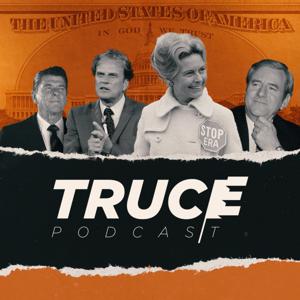
Truce - History of the Christian Church

Truce - History of the Christian Church

Download on the App Store
  • Favorites

    82

    Followers

  • Typical duration

    28 min

    per episode

Based on Podcast App listening data

Truce - History of the Christian Church episodes

  • The Liberals | Christian Fundamentalism Series

    George Marsden characterized Christian fundamentalism as "militantly anti-modernist protestant evangelicalism". Right there you see that fundamentalism is a reaction against something. And that something is modernist theology. Modernism is a broad term used to describe a few different schools of liberal theology. In this episode, we discuss the Tubingen and Berlin schools.

    Modernist theology is often marked by the desire to discuss the "historic Jesus". This term can be a bit confusing because it is less about understanding what historic texts say about Jesus and more about discussing the non-miraculous aspects of Jesus' life and ministry.

    Our special guest this episode is Chris Evans, professor of Christian History and Methodist Studies at Boston University and author of "Do Everything" a biography of Francis Willard.

    Discussion Questions:

    • What does it mean that fundamentalism is a reaction to modernist theology?
    • What is modernist theology?
    • Do you know any theologically liberal people?
    • Do you find it difficult to both love the Lord and love your neighbor?
    • What makes someone a Christian? Does your view include theologically conservative people? What about theologically liberal people? Where is the line for you?
    • How vital are Jesus' miracles to your life and faith?
    • Is there a tension in Christianity where it is culturally difficult to be theologically conservative and still want to love our neighbors?

    • Helpful Links and Sources:

      • "The Evangelicals" by Frances Fitzgerald
      • An interesting article on Arminius
      • "Church History in Plain Language" by Bruce Shelley
      • "Who is An Evangelical?" Thomas Kidd
      • Historical Handbook of Major Biblical Interpreters edited by Donald K. McKim p 350
      • Matthew 22:36-40
      • Learn more about your ad choices. Visit podcastchoices.com/adchoices

        40 min
      • The End of Reconstruction | Christian Fundamentalism Series

        The 1800s were a time of milking cows and going to the county fair.

        Sure... but what else? We tend to think of this century as a quiet, pastoral era when people were friendly and life was simple. But the 1800s were a crazy time! The American Civil War, the Napoleonic Wars, the Spanish-American War, conquest, the suffrage movement, the prohibition movement, massive technological changes. It's a wonder we ever made it out alive.

        In this episode, we explore the early life of William Jennings Bryan and the Democratic Party, the party of Jim Crow that he would soon lead. After the Civil War, it was the Democrats who created Black Codes in the South to restrict the upward mobility of African Americans. They were the party of white farmers and soon transitioned into representing labor unions and, eventually, many black people in the United States. Bryan was one of the men responsible for that transition.

        Helpful Links and Sources:

        • "A Godly Hero" by Michael Kazin
        • Truce episode about the Woman's Christian Temperance Union (WCTU)
        • Meeting notes of the 1873 Evangelical Alliance
        • "Fundamentalism and American Culture" by George Marsden
        • "A Righteous Cause" by Robert W. Cherny (book on William Jennings Bryan)
        • Interesting bio on Stephen Douglas
        • President Hays' acceptance speech

        • Discussion Questions:

          • What do you think of when you think of the 1800s?
          • Was the 1800s a simpler time?
          • What mistakes did the Republican Party make in ending Reconstruction?
          • How should abolitionists have handled the South after the Civil War?
          • Can a Christian lead a racist political party? Should they?
          • What were some technological advances that came about in the 1800s? How might they have shifted the way people lived and thought back then?
          • Are there technological changes going on now that could shift the way we think and interact with each other?
          • Chris ends the episode by talking about how Christians should be a people of the means, not necessarily the ends. Do you think the ends ever justify the means for Christians?
          • Learn more about your ad choices. Visit podcastchoices.com/adchoices

            28 min
          • Dispensationalism and John Nelson Darby | Christian Fundamentalism Series

            Become a patron of the show and help make the Truce episodes you love.


            This season we're tracing the history of Christian fundamentalism through the life of William Jennings Bryan. But first, we need to learn some important definitions. Our big word of the week is dispensationalism. It's not as complicated as it sounds. Dispensationalism is (in part) the notion that God treats humankind differently depending on what era we are in. It is not accepted by all Christians, but it is a building block of fundamentalism. Another component of dispensationalism is the secret rapture--the idea that God will take His elect to heaven just before the tribulation. It also asserts that the Christian Church will become apostate before the end times. This last tidbit is important! Premillennialism made Christians suspicious of the outside world, but it was dispensationalism that made us suspicious of each other.

            John Nelson Darby is often credited as the father of dispensationalism. He came up with the idea of the rapture and is the man who packaged a bunch of existing ideas into this systematized vision of the Bible. In the 1700s and 1800s, people adapted the scientific notion of categorizing everything into genus and species and applied it to all areas of study, even when reading the Bible. This encouraged people like Darby to break the Bible into "dispensations" or eras.

            Our guest this week is George Marsden. He's the author of "Fundamentalism and American Culture".

            Discussion Questions:

            • Are you suspicious of other Christians? Why is that?
            • Do you believe in the rapture? Why?
            • Does the God of the Bible behave differently in different parts of the Bible? Or is He the same throughout?
            • Do you believe that Jewish people were destined to return to Israel based on Matthew 24:32-33 or Romans 11:25-26?
            • What did you know about the French Revolution before our recent episodes on it? Do you think it was a significant event in world history? If so, why?

            • Helpful Links:

              • "Fundamentalism and American Culture" by George Marsden (book)
              • "The Evangelicals" by Frances Fitzerald (book)
              • "Who is an Evangelical?" by Thomas S. Kidd (book)
              • Interesting article about Napoleon, the Pope, and the French Revolution
              • A fantastic book about Napoleon (one of my fav books) is "Napoleon: A Life" by Andrew Roberts
              • "American Apocalypse" by Matthew Avery Sutton (note: only the first few chapters influenced this episode)
              • "The Roots of Fundamentalism" by Ernest Sandeen.
              • 1 Corinthians 1:8
              • Helpful article about Common Sense Realism
              • Fascination Smithsonian article about Mount Tambora
              • Learn more about your ad choices. Visit podcastchoices.com/adchoices

                31 min
              • Premillennialism and Postmillennialism | Christian Fundamentalism Series

                Give to help keep Truce going!


                What is the difference between premillennialism and postmillennialism? And what does it matter?


                After the French Revolution in the late 1700s, Christians began to see the world as coming to an end. Daniel 7 and Revelation 13 describe an oppressor who will wear the people out for a period of time. Some Christian interpret that as being 1260 years. That 1260 years can be placed over the reign of Justinian all the way through history up until the French Revolution. That is just one interpretation that not everyone shares. But if you hold that view then this event was HUGE. It meant that the end of the world was super close. It has now been over 200 years since that event, but many premillennialists still hold up this prophecy as proof of the fulfillment of scripture.


                Many Christians were sparked to uncover the meaning of it all. Some turned to an old idea -- premillennialism. It's the notion that the world is on a downward trajectory. Things are going to get really bad and then Jesus will return. Before this time, many evangelicals were postmillennialism. They thought the world was going to get better over time. This split was an important part of what would become the fundamentalist/ modernist debate.


                Premillennialism has some dark "logical" conclusions to it. Some premillennialist like pastor John MacArthur argue that since the world is going to burn anyway, we humans shouldn't worry about things like global warming.


                Discussion Questions:

                • Why was the French Revolution such an important moment in world history?
                • Pre-Revolution the nobles and clergy controlled much of the power in France. They could out-weigh 98% of the population of France. Is this perhaps a reason why the French people turned against them?
                • Are you a premillennialist, a postmillennialist, or neither?
                • Did you read the Left Behind books? What do you remember? How did they impact you?
                • Do you think you have a positive or negative view of world history? How does that impact the way you act?
                • Should premillennialists see Jesus' second coming as a reason to avoid taking care of the planet?

                • Helpful Links:

                  • The Victoria and Albert Museum's article about Mysore and Tipoos Tiger
                  • "Fundamentalism and American Culture" by George Marsden (book)
                  • "The Evangelicals" by Frances Fitzerald (book)
                  • "Who is an Evangelical?" by Thomas S. Kidd (book)
                  • Interesting article about Napoleon, the Pope, and the French Revolution
                  • A fantastic book about Napoleon (one of my fav books) is "Napoleon: A Life" by Andrew Roberts
                  • John MacArthur sermon excerpted and used with permission from "Grace to You"
                  • Learn more about your ad choices. Visit podcastchoices.com/adchoices

                    23 min
                  • What Is An Evangelical? | Christian Fundamentalism Series

                    Donate to support the Truce Podcast!

                    Correction: The original version of this episode incorrectly represented Arminian belief. It involves the belief that once grace is offered by God that a sinner can reject the offer. The original version stated that the sinner made the first move to initiate a relationship. That is incorrect. Arminians believe that God makes the first move, but His offer can be rejected. The error has been corrected in this version, My apologies for any confusion.


                    Who is an evangelical? If you go by the news today, you probably think evangelicals are all American middle-class white men. Nope! Evangelical Christians come in all shapes, colors, and sizes. They can be men or women from anywhere in the world. They can speak any language. And they can have a lot of variety in their beliefs.


                    This season on the Truce Podcast we are examining the history of Christian fundamentalism. How did fundamentalism begin? What is Christian fundamentalism? Is Christian fundamentalism a good thing, a bad thing, or somewhere in between?


                    In this episode, we're joined by author and professor George Marsden. He's the author of Fundamentalism and American Culture, which is THE book everyone else refers to when they talk about fundamentalism. According to Marsden, fundamentalism is "militantly anti-modernism protestant evangelicalism". That is a lot of big words! By the end of the season, you should understand all of that. One important part of that definition is the word "evangelicalism". It is one of those words that has been used so much in so many different ways that it can be difficult to define it. There are whole movements to create new definitions these days. But in order to move forward this season, we need to pick some frame of reference. I chose David Beggington's definition of what defines an evangelical:


                    Bebbington's Quadrilateral

                    • Biblicism (a focus on the Bible)
                    • Conversionism (an emphasis on evangelism)
                    • Crucicentrism (the centrality of the cross)
                    • Activism

                    • Those four things, according to Bebbington, are what make up an evangelical. Again, it is a hotly debated subject.

                      So when did evangelicalism begin? Many of the sources that I found pointed to the revivals in the decades leading up to the American Revolution. Evangelists like Jonathan Edwards and George Whitefield spread the gospel using a post-millennialist vision of the end times mixed with Calvinism. This was part of the First Great Awakening. Then there were others after the revolution who spread an Arminian view of salvation. Guys like Finney. Belief in God became more personal, without the direct oversight of a priest or minister. It became an individual's responsibility to look after their spiritual growth.


                      Welcome to season 5! God willing, I'll be releasing new episodes every other week.


                      Discussion Questions:

                      • What is an evangelical?
                      • What is a fundamentalist?
                      • If fundamentalists are evangelicals who are angry at something, what are they angry at? Are you one of those people?
                      • Do you believe in the Calvinist view of salvation or the Arminian one? Does it matter? Why?
                      • The Great Awakening movements established a sense that belief in God was not something that needed to be handed down by a priest or minister. Do you think that was a positive move? What are some potential drawbacks (if any)?

                      • Helpful Links and Sources:

                        • "Fundamentalism and American Culture" by George Marsden (book)
                        • "The Evangelicals" by Frances Fitzerald (book)
                        • "Who is an Evangelical?" by Thomas S. Kidd (book)
                        • "A Godly Hero" by Michael Kazin (book)
                        • Transcript of the Scopes trial (book, though you can find it free online)

                          Learn more about your ad choices. Visit podcastchoices.com/adchoices

                          30 min
                        • Season Five Trailer - The History of Christian Fundamentalism

                          Become a patron of the Truce Podcast!


                          In our present moment, it seems that people are inclined to extremes. Christian fundamentalism seems to be on the rise. This season we're examining the history of Christian fundamentalism. We'll start by defining terms like "evangelical", "premillennialism", "dispensationalism", "modernist theology", and "fundamentalism". Then we'll work our way to the Scopes Monkey Trial, that massive media event in 1925 that pitted fundamentalism against evolution.

                          Our guests this season include George Marsden, Joel Carpenter, Kevin Belmonte, Edward Larson, Paul T. McCartney, and Michael Kazin. We'll also feature a fascinating conversation with Jacob Goldstein, co-host of the Planet Money podcast.

                          We can never hope to cover every facet of a subject this huge. Instead, the goal is to help normal people like us understand the basics of this movement that is actively shaping world history.

                          Subscribe so you get every new episode as it is released.

                          Learn more about your ad choices. Visit podcastchoices.com/adchoices

                          2 min
                        • The Pew and the Picket Line (rebroadcast)
                          Donate to support the Truce Podcast at www.trucepodcast.com/donate
                          The United States and Russia ran along parallel tracks in the late 1800s and 1900s. Both were empires. Both were tangled in war. Both were feeling the weight of the Industrial Revolution. But they divided in how they would deal with labor. That critical difference changed the history of the world.
                          In this episode, Professor Heath Carter of the Princeton Theological Seminary starts the first of a two-episode conversation about Christianity and labor. Mr. Carter is the author of Union Made and editor of books such as The Pew and the Picket Line.
                          Helpful Links:
                          Heath Carter on Twitter
                          New York City in 1903 video (Library of Congress)
                          Interesting video of Heath Carter talking about labor
                          Article about the Native American from the top of the show
                          Topics Discussed:
                          Do Christians support unions?
                          The F. Scott Fitzgerald quote about first-rate intelligence and two ideas
                          Working conditions in the 1800s in Chicago
                          Pew rents
                          How do churches make their money?
                          Learn more about your ad choices. Visit podcastchoices.com/adchoices
                          36 min
                        • Christmas and the Sermon on the Mount

                          Christmas can be a difficult time for many of us. How do we love people who disagree with us? How do we cope with people who don't seem to make sense anymore?


                          In this bonus Christmas message, I just want to remind all of us of Jesus' command to both love our God AND love our neighbor.


                          How has 2021 been for you? Leave a comment on social media or on the website at www.trucepodcast.com. God willing, season 5 of Truce will begin in winter 2022.


                          Merry Christmas,

                          Chris

                          Learn more about your ad choices. Visit podcastchoices.com/adchoices

                          8 min
                        • Carry Nation and Women's Rights
                          It took a long time for women to get the right to vote. And it took a lot of different opinions about how to go about fighting for that right. Frances Willard, the second president of the Woman's Christian Temperance Union, used marches and speeches. Her fellow WCTU member, Carrie Nation, preferred... a hatchet.
                          On this episode, the second in a series, we look at a few of the women who were involved in this important movement. Frances Willard, Carrie Nation, and more.
                          Truce is a listener-supported podcast. We're about a thousand dollars in the hole after two seasons of the show. Consider donating a few dollars to keep this thing going.
                          Guests:
                          Jenna DeWitt @Jenna_DeWitt
                          Jim Vorel from Paste Magazine @JimVorel
                          Claire White from the Mob Museum in Las Vegas @TheMobMuseum
                          Sarah Ward from the Woman's Christian Temperance Union https://www.wctu.org/
                          Learn more about your ad choices. Visit podcastchoices.com/adchoices
                          27 min
                        • Suffrage and Prohibition
                          The 1800s were a drunken mess. The median adult in the US drank 1.7 bottles of 80 proof alcohol each week. Each week! The 1800s were also a time when women didn't have many rights: they couldn't vote, were expected to stay home, and were somewhat invisible in the public sphere. Until they'd had enough.
                          Thanks to the efforts of organizations like the Woman's Christian Temperance Union, women fought for their rights. On this episode of the Truce Podcast, we begin our series on this historic battle.
                          Guests:
                          Jenna DeWitt @Jenna_DeWitt
                          Jim Vorel from Paste Magazine @JimVorel
                          Claire White from the Mob Museum in Las Vegas @TheMobMuseum
                          Sarah Ward from the Woman's Christian Temperance Union https://www.wctu.org/
                          Learn more about your ad choices. Visit podcastchoices.com/adchoices
                          27 min

                        About Truce - History of the Christian Church

                        From the publisher's feed

                        Truce explores the history of the evangelical church in America, from fundamentalism to pyramid schemes to political campaigns. Host Chris Staron uses journalistic tools to investigate how the church got here and how it can do better.

                        Best of Truce - History of the Christian Church

                        Ranked by our users in the last 21 days

                        More shows like Truce - History of the Christian Church

                        The Russell Moore Show by Christianity Today, Russell Moore

                        The Russell Moore Show

                        1,126 Listeners

                        Voxology by Voxology

                        Voxology

                        1,098 Listeners

                        The Holy Post by Phil Vischer

                        The Holy Post

                        4,427 Listeners

                        Theology in the Raw by Theology in the Raw

                        Theology in the Raw

                        1,476 Listeners

                        Ask NT Wright Anything by Premier Unbelievable

                        Ask NT Wright Anything

                        2,055 Listeners

                        Roys Report by Roys Report

                        Roys Report

                        813 Listeners

                        Advisory Opinions by The Dispatch

                        Advisory Opinions

                        3,925 Listeners

                        No Small Endeavor with Lee C. Camp by Tokens Media

                        No Small Endeavor with Lee C. Camp

                        576 Listeners

                        Trinity Forum Conversations by The Trinity Forum

                        Trinity Forum Conversations

                        219 Listeners

                        Good Faith by Good Faith

                        Good Faith

                        1,926 Listeners

                        The Bulletin by Christianity Today

                        The Bulletin

                        560 Listeners

                        Curiously Kaitlyn by Kaitlyn Schiess

                        Curiously Kaitlyn

                        855 Listeners

                        The SkyePod by Skye Jethani

                        The SkyePod

                        129 Listeners

                        The Esau McCaulley Podcast by Esau McCaulley

                        The Esau McCaulley Podcast

                        872 Listeners

                        Devil and the Deep Blue Sea by Christianity Today

                        Devil and the Deep Blue Sea

                        913 Listeners