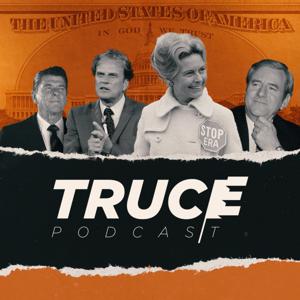
Truce - History of the Christian Church

Truce - History of the Christian Church

Download on the App Store
  • Favorites

    82

    Followers

  • Typical duration

    40 min

    per episode

Based on Podcast App listening data

Truce - History of the Christian Church episodes

  • Republicans and Evangelicals I RJ Rushdoony and Christian Reconstruction

    Give to help Chris make Truce

    RJ Rushdoony is not a household name. But he influenced a lot of interesting people, from members of the New Right to the Christian homeschooling movement. His books and lectures inspired people to pull their kids out of public schools and teach them at home. But who was RJ Rushdoony?

    He was deeply impacted by his time doing missionary work on a Native American reservation. There he saw how difficult it was to get anything done and to give people proper access to their government. He went on to work with libertarian organizations like Spiritual Mobilization and the Volker Fund. His mentor Cornelius Van Til taught him to see the triad of government, church, and family in a new way. In Rushdoony's mind, those three spheres should not interfere with each other. BUT, he did want Christians to run the government. Instead of doing a top-down change, he wanted change to begin with families, then rise to the church, eventually taking over the political sphere.

    Howard Phillips, one of the founders of the New Right, was a disciple of Rushdoony. So was his son, Doug Phillips, who founded the homeschooling movement known as Vision Forum. In this episode, Chris interviews Paul Hastings of the Compelled podcast about how they met at a Vision Forum film festival.

    The special guest for today is Michael McVicar, author of "Christian Reconstruction: R.J. Rushdoony and American Religious Conservatism."


    Sources:

    • Christian Reconstruction: R.J. Rushdoony and American Religious Conservatism by Michael McVicar
    • Reaganland by Rick Perlstein
    • The Evangelicals by Frances Fitzgerald
    • Helpful article about libertarian philosophy
    • One Nation Under God by Kevin Kruse


      Discussion Questions:

      • How do you think Rushdoony was impacted by his experiences on the reservation?
      • What is libertarianism? What do you think about it?
      • In what ways have you seen libertarianism presented in evangelical culture?
      • What did Rushdoony think about public schools? How was this a departure from progressive-era Christian thinkers?
      • How does Christian homeschooling differ from other forms of homeschooling?
      • Why did homeschooling take off in the 1980s and 1990s?
      • What role, if any, should Christians play in public schools?
      • Learn more about your ad choices. Visit podcastchoices.com/adchoices

        50 min
      • Republicans and Evangelicals I Kanawha County Textbook War

        Give to help Chris make Truce

        In 1974, Alice Moore was a member of the school board in Kanawha County, West Virginia. The board met to hear the recommendations of the textbook committee and approve them. But Alice protested when she read a portion from the Autobiography of Malcolm X, which thanked Allah for preventing Malcolm X from being a black Christian. From there they uncovered a number of potentially offensive texts, some because of language, others because of discussions of rape. Race was likely a factor as well, though Moore denied it.

        Local pastors decried what they saw as secularism and humanism creeping into public schools. Parents blocked school buses, and others kept their children at home. Soon, there were fights, and dynamite was used to blow up school buildings. What started as a disagreement over books erupted into an all-out war. One that echoed in other parts of the country at the same time as families wrestled with changes in education.

        Sources:

        • "The Great Textbook Wars" - award-winning documentary on the battle
        • "The Invisible Bridge" by Rick Perlstein
        • "Soul on Ice" by Eldrige Cleaver (archive.org)
        • "Androcles and the Lion" by Aesop
        • Texas Monthly article about the Gablers
        • Video of the Gablers talking to William F Buckley on "Firing Line"
        • The New York Times article about schools closed in WV
        • The New York Times article about the textbook war
        • Radio interview about the John Birch Society

        • Discussion Questions:

          • Had you heard of the textbook war before?
          • What did you think of the passage from "Soul on Ice"? Should it be read by senior students headed for college? What about other students?
          • Who should decide what gets taught in local school districts? How about nationally?
          • How did Alice Moore and others act appropriately? How about inappropriately?
          • The KKK and John Birch Society show up a few times this season, often opportunistically. Does their appearance automatically smear all participants as racist?
          • What else was going on in 1974 that could have escalated the panic of the era?
          • Learn more about your ad choices. Visit podcastchoices.com/adchoices

            35 min
          • Republicans and Evangelicals I The New Deal

            Partner with us by donating at: www.trucepodcast.com/donate

            Something had to be done. The Great Depression meant the loss of a vast number of jobs and left families waiting on bread lines. Economists like John Meynard Keynes puzzled over what to do. President Hoover took a laissez-faire approach to the catastrophe, only to have matters get worse. Then Franklin D. Roosevelt came into office and his administration kicked The New Deal into gear. It was a program that offered diverse aid to citizens from protections for money in banks to homeowner assistance.

            Many Christian leaders came to hate the New Deal, especially libertarians. Their opposition to the New Deal as creeping socialism sparked the National Prayer Breakfast, some of Billy Graham's speeches, and the bonding of capitalism to Christianity and the US. So we should probably know what the New Deal was!

            Our guest on this episode is Justin Rosolino. He's a high school history teacher and the author of the book "Idiot Sojourning Soul".

            You can find pictures of Chris' 50-mile New Deal Bike Tour on the website at www.trucepodcast.com.


            Helpful Links:

            • FDR's Inauguration Speech on C-SPAN
            • Interesting YouTube video about the causes of the Great Depression

            • Topics Discussed:

              • What was the Social Gospel?
              • Who was Franklin Roosevelt?
              • What was the New Deal?
              • The Civilian Conservation Corp
              • The Works Progress Administration
              • Jenny Lake - Grand Teton National Park
              • Unemployment

              • Discussion Questions:

                • Why do some people dislike the New Deal?
                • Which of the programs most impacts you?
                • What do you think of the New Deal? Was it a form of socialism?
                • Do you think there will ever be another New Deal in the US?
                • Learn more about your ad choices. Visit podcastchoices.com/adchoices

                  37 min
                • Republicans and Evangelicals I End of School Prayer

                  Give to help Chris make the Truce Podcast

                  In 1955, the Board of Regents for New York issued an optional prayer to be used in public schools. It became known as the "Regent's Prayer". Here it is: "“Almighty God, we acknowledge our dependence upon Thee, and we beg Thy blessings upon us, our parents, our teachers, and our Country.” That short prayer was contested not only by non-religious people but also by Protestants who thought that it was too vague. What God is it talking about? Where is the mention of Jesus or the Holy Spirit, salvation, sin, grace, etc.?

                  With help from the ACLU, parents sued and the case made it all the way to the US Supreme Court. It was known as Engle v. Vitale. It overturned prescribed prayer in schools. In this episode, Chris goes through the arguments the court and Justice Hugo Black made during this landmark decision. A year later, the Court heard Abington School District v. Schempp, which ended prescribed Bible reading in public schools.

                  This season we're covering how American evangelicals bonded themselves with the Republican Party. There are a lot of reasons that evangelicals started to vote as a block in the late 70s and early 1980s. They range from women's liberation, changes in attitude toward taxation, and battles over gay and lesbian rights, to education. This is part of our coverage of the education section. This episode has been rewritten and recorded, updating an episode from season 3.

                  Sources:

                  • "One Nation Under God" by Kevin Kruse
                  • Transcript of Abington School District v Schempp
                  • Census data about public and private schools
                  • Transcript and audio of Engel v Vitale


                    Discussion Questions:

                    • Did you ever pray in school? What did you pray?
                    • Did you ever read the Bible in school?
                    • Is there an "ideal" prayer that should be read in schools? If so, what is it? What objections might parents have?
                    • Is it important for school children to learn about religions in school?
                    • Do you agree or disagree with Justice Hugo Black?
                    • Learn more about your ad choices. Visit podcastchoices.com/adchoices

                      29 min
                    • Republicans and Evangelicals I Can I Love Extremists?

                      Give to support the Truce Podcast

                      It seems like so many people define their faith by what they believe about Donald Trump. How can godly Christians return to the gospel to get us back on track?

                      In this round table discussion episode, Chris is joined by Pastor Ray McDaniel of First Baptist Church in Jackson, WY and Nick Staron to prepare us for the season.

                      Topics Discussed:

                      • What is Christianity?
                      • The importance of forgiveness and going to those who are angry with us
                      • Why it is important to cover things like the Watergate scandals of the 1970s in a Christian podcast
                      • The need for humility in our lives
                      • The gospel in 10 words or less

                      • Do you have a gospel message in 10 words or less? Find Truce on social media and let us know!

                        Learn more about your ad choices. Visit podcastchoices.com/adchoices

                        47 min
                      • Republicans and Evangelicals I Long Southern Strategy (featuring Angie Maxwell)

                        Give a little to help support the Truce Podcast

                        When did Republicans, the party of Abraham Lincoln, start courting the American South? It's a big question! For decades, Republicans were known as the party that helped black people (except, you know, for ending Reconstruction to help gain the White House). Then, with the nomination of Barry Goldwater, the tide turned. Goldwater's team promoted him as a racist when he toured the South. And... he won some ground in the traditionally Democratic region.

                        So when it came time for Richard Nixon to run in 1968, his team decided to court the South. Not out in public like Goldwater had. Instead, they decided to operate a campaign of "benign neglect" where they would not enforce existing laws meant to protect African-Americans.

                        Our special guest this week is Angie Maxwell, author of The Long Southern Strategy.


                        Discussion Questions:

                        • What caused the rift in the Democratic Party that made Strom Thurmond leave (hint: it has to do with Truman)?
                        • What was the Democratic Party like before Truman?
                        • What influence did Strom Thurmond have on Nixon?
                        • Who was Barry Goldwater? How did he change the Republican Party by courting white Southerners?
                        • How might the idea of the South being "benighted" impact them as a people?
                        • Why do so many evangelicals see themselves as "benighted"?

                        • Sources:

                          • "The Long Southern Strategy" by Angie Maxwell and Todd Shields.
                          • "Reaganland" by Rick Perlstein
                          • YouTube clip of Nixon not wanting "Law and Order" to mean "racist"
                          • Nixon talking about "law and order" in a speech
                          • Nixon's campaign ad about protests and tear gas
                          • Article about Nelson Rockefeller
                          • Nixon's civil rights ad
                          • Helpful Time Magazine article
                          • "These Truths" book by Jill Lepore
                          • Bio on Strom Thurmond
                          • Article about Reconstruction
                          • "The Evangelicals" book by Frances Fitzgerald
                          • Truman's speech to the NAACP
                          • Learn more about your ad choices. Visit podcastchoices.com/adchoices

                            38 min
                          • Republicans and Evangelicals I Billy Graham and Nixon

                            Give to help make Truce!

                            Billy Graham, the famous evangelist, was good friends with Richard Nixon. The two played golf and gave each other advice. Graham was the person who encouraged Nixon to run for president a second time. He also encouraged Nixon to regularly attend church, so Nixon started the first regular church service in the White House, only to make it another "it" place to be seen. But when Nixon's crimes were made public, Graham continued to support him, commenting only on the strong language used by the president.

                            What does it mean for Christian leaders to stand behind a corrupt president? In this episode, Chris interviews David Bruce, a historian at the Billy Graham Evangelistic Association.

                            NOTE: I thought it was especially important to outline the many crimes of the Nixon administration. Today these crimes are downplayed by bad actors wishing to rewrite history. It is important to emphasize that not only were there immoral acts of shenanigans, there were real crimes perpetrated against individuals, organizations, and the American people.

                            Sources

                            • "The Surprising Work of God" by Garth M. Rosell
                            • An article from The Atlantic about the Pope and Mussolini
                            • "The Popes Against the Protestants" by Kevin Madigan
                            • NPR interview with Kevin Madigan
                            • "A Prophet With Honor" book by William Martin
                            • "The Invisible Bridge" by Rick Perlstein
                            • "The Evangelicals" by Frances Fitzgerald
                            • "The Failure and the Hope: Essays of Southern Churchmen" book of essays accessed on Google Books
                            • New York Times article about how the Watergate break-in was financed
                            • Pat Buchanan hearings during the Watergate investigation
                            • Frost/Nixon transcript

                            • Discussion Questions:

                              • Was Billy Graham being a good friend by supporting Nixon after Watergate?
                              • Should religious leaders maintain a certain amount of distance between themselves and people of power?
                              • Why do we like to see our governmental leaders as religious people?
                              • Was Nixon's church service in the Whitehouse wrong to be a gathering place of the rich and famous?
                              • How bad was the Watergate break-in? How does it change your mind about Nixon to know about the other criminal activity?
                              • Learn more about your ad choices. Visit podcastchoices.com/adchoices

                                36 min
                              • Republicans and Evangelicals I Harold Ockenga - Can Christians Unite? (featuring Joel Carpenter)

                                Give to help the Truce Podcast!

                                Harold Ockenga was a famous fundamentalist(ish) pastor from Boston. And he had a problem. Liberal Christians had the ear of the government. That meant that military chaplain positions and free radio time were going to liberals, not conservatives. Why shouldn't conservatives have access to the radio waves like theologically liberal Christians? But that would take unity among evangelicals, or, what he called neo-evangelicals.

                                Neo-evangelicals were evangelicals who didn't separate from the world. In Ockenga's case, this meant maybe going to the movies or an opera. So he, along with other preachers like Billy Graham, founded the National Association of Evangelicals with the hope of uniting neo-evangelicals under one banner.

                                It didn't work.

                                The real story, though, sometimes gets lost. The was a big boom in evangelism in the 1940s as WWII wrapped up. Evangelists targeted the youth with organizations like Campus Crusade for Christ springing up left and right. This boom meant that churches swelled in the 1950s, only to begin their long slide a few decades later.

                                In this episode, Chris speaks with Joel Carpenter, a senior research fellow at Calvin College and author of "Revive Us Again".


                                Resources Used:

                                • "Revive Us Again" by Joel Carpenter
                                • "The Evangelicals" by Frances Fitzgerald
                                • "The Surprising Work of God" by Garth Rosell
                                • "Reaganland" by Rick Perlstein
                                • NPS article about the Bonus Army
                                • “After the Ivory Tower Falls” book by Will Bunch
                                • Billy Graham audio
                                • National Association of Evangelicals "The New Treason"
                                • Interviews from Harold Ockenga at Wheaton College


                                  Discussion Questions:

                                  • What spurred the revivals of the 1940s?
                                  • How has youth evangelism shaped American society?
                                  • Why is it important to understand the role that cheap higher education played in shaping the 1960s?
                                  • Why did neo-evangelicals feel that they needed access to the radio waves?
                                  • Is unity important to the Christian walk?
                                  • Learn more about your ad choices. Visit podcastchoices.com/adchoices

                                    32 min
                                  • Republicans and Evangelicals I Prologue: What Is Biblical?

                                    Give to help the Truce Podcast

                                    Thomas McIntyre stood before the US Congress to deliver a moving speech. The man was being hounded by a fringe movement known as the New Right. The movement came from the work of men like Paul Weyrich, Howard Phillips, and Richard Viguerie. Their goal was to disrupt the Republican Party. They wanted to do away with much of the federal government and program to help the poor while simultaneously cutting taxes and increasing the military. They hoped to accomplish this by controlling direct mail. Direct mail! It sounds silly, but by inundating voters and congressional offices with bulk mail they could control the story.

                                    Men like McIntyre and Senator Mark Hatfield didn't know what to do with this influx of petty politics. Someone had even gone so far as to question Hatfield's Christian salvation just because of how we was going to vote on the Panama Canal treaty. What does giving the Panama Canal back to Panama have to do with salvation? Almost nothing.

                                    Today, we're going to explore this wacky phenomenon where we call something "Christian" or "biblical" if it fits out politics not if it is addressed in the Bible. How are we being manipulated by propaganda like this? And what can we do about it?


                                    Discussion Questions:

                                    • Was the United States responsible in its claiming the Panama Canal as a territory?
                                    • Are there things in your life that you mix with Christianity?
                                    • How have your politics gotten confused with your faith?
                                    • Does the Bible have anything to say on the Panama Canal treaty?

                                    • Sources:

                                      • "Reaganland" book by Rick Perlstein
                                      • Handy article on the history of the Panama Canal
                                      • Congressional record including the speeches

                                        Learn more about your ad choices. Visit podcastchoices.com/adchoices

                                        21 min
                                      • Behind the Scenes Bonus

                                        Give to help Chris make Truce

                                        In this special bonus episode, Truce host Chris Staron walks you through a day in the life of a podcast host. He works about 11 hours per day between this show and his full-time job driving a school bus. Imagine what he could do if he were doing this show full-time!!!!


                                        Chris has worked on Truce for 6 1/2 years and is ready to make the show his main focus. We could make that happen if every listener gave $15 per year!

                                        Learn more about your ad choices. Visit podcastchoices.com/adchoices

                                        12 min

                                      About Truce - History of the Christian Church

                                      From the publisher's feed

                                      Truce explores the history of the evangelical church in America, from fundamentalism to pyramid schemes to political campaigns. Host Chris Staron uses journalistic tools to investigate how the church got here and how it can do better.

                                      Best of Truce - History of the Christian Church

                                      Ranked by our users in the last 21 days
                                      More shows like Truce - History of the Christian Church

                                      The Russell Moore Show by Christianity Today, Russell Moore

                                      The Russell Moore Show

                                      1,128 Listeners

                                      Voxology by Voxology

                                      Voxology

                                      1,098 Listeners

                                      The Holy Post by Phil Vischer

                                      The Holy Post

                                      4,431 Listeners

                                      Theology in the Raw by Theology in the Raw

                                      Theology in the Raw

                                      1,480 Listeners

                                      Ask NT Wright Anything by Premier Unbelievable

                                      Ask NT Wright Anything

                                      2,054 Listeners

                                      Roys Report by Roys Report

                                      Roys Report

                                      815 Listeners

                                      Advisory Opinions by The Dispatch

                                      Advisory Opinions

                                      3,931 Listeners

                                      No Small Endeavor with Lee C. Camp by Tokens Media

                                      No Small Endeavor with Lee C. Camp

                                      570 Listeners

                                      Trinity Forum Conversations by The Trinity Forum

                                      Trinity Forum Conversations

                                      220 Listeners

                                      Good Faith by Good Faith

                                      Good Faith

                                      1,926 Listeners

                                      The Bulletin by Christianity Today

                                      The Bulletin

                                      560 Listeners

                                      Curiously Kaitlyn by Kaitlyn Schiess

                                      Curiously Kaitlyn

                                      853 Listeners

                                      The SkyePod by Skye Jethani

                                      The SkyePod

                                      128 Listeners

                                      The Esau McCaulley Podcast by Esau McCaulley

                                      The Esau McCaulley Podcast

                                      873 Listeners

                                      Devil and the Deep Blue Sea by Christianity Today

                                      Devil and the Deep Blue Sea

                                      915 Listeners