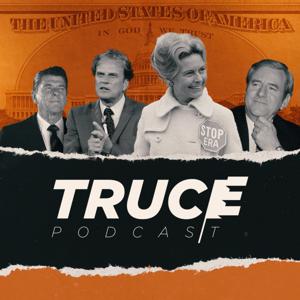
Truce - History of the Christian Church

Truce - History of the Christian Church

Download on the App Store
  • Favorites

    82

    Followers

  • Typical duration

    28 min

    per episode

Based on Podcast App listening data

Truce - History of the Christian Church episodes

  • Republicans and Evangelicals I Fundamentalist Takeover of the Southern Baptist Convention

    Give to help Chris continue Truce


    It all started with a meeting over fancy donuts. Paige Patterson and a friend met together to plot the fundamentalist takeover of the Southern Baptist Convention. Before that time, the SBC had been more theologically diverse (though, not necessarily racially diverse due to its founding as a group that desired slavery). But if this group of fundamentalists was going to get a whole denomination to turn their way, they'd have to be clever. It would take time.


    Their scheme involved getting fundies elected into high office who could then turn committees and sub-committees to their side. It's a story of a minority group gaining control of a large organization, and steering it toward their vision of what it means to be a Christian.


    Sources

    • The Fundamentalist Takeover of the Southern Baptist Convention – by Rob James, Gary Leazer
    • The Evangelicals by Frances Fitzgerald
    • Christianity Today article about Paige Patterson's allegations
    • Religion News article about Patterson
    • Tennesseean article about Patterson
    • Article about early Baptists
    • Church History in Plain Language by Bruce Shelley
    • Cornell's article about the separation of church and state
    • Frances Shaeffer and the Shaping of Evangelical America by Barry Hankins
    • Johnson Archives about SBC
    • Johnson Archives SBC Resolutions
    • Certified Pastry Aficianatro article about beignets


      Discussion Questions

      • The episode starts with a discussion of accusations about Paige Patterson. What was your reaction to that story and why?
      • Is it possible for a spouse to be a part of the salvation of their husband or wife? Where are the lines?
      • When were you baptized? Did you do it as an adult, child, or both? Why?
      • What do you think is the "right" way to baptize someone? Why?
      • What are your thoughts on inerrancy?
      • Learn more about your ad choices. Visit podcastchoices.com/adchoices

        29 min
      • Mike Cosper: The Church in Dark Times

        Give $10/ month to help Chris make Truce

        What are the warning signs that a church leader will become a tyrant? How do we prevent church hurt from becoming our identity? What are ideologies and how do they become the overall focus of some ministries?

        Mike Cosper is the co-host of Christianity Today's The Bulletin podcast, the producer and host of The Rise and Fall of Mars Hill, and now the author of The Church in Dark Times.


        Discussion Questions:

        • How does Mike define "Ideology"? What does it mean to have a strong ideology? Do you have any? How does this differ from having a simple belief?
        • Why do you think so many people today struggle with anxiety? How can ideologies protect us from our anxiety? Why might that be a poor crutch?
        • Mike recommends worship as a way to fend off anxiety. Why could that help?
        • Is it wrong for churches and organizations to have a missions statement or goals?
        • Learn more about your ad choices. Visit podcastchoices.com/adchoices

          41 min
        • The Cask of Amontillado by Edgar Allan Poe

          Give to help Chris continue to make Truce


          In the Kanawha County Textbook War episode, Chris shared that the people of that county fought against some textbooks and stories being read in classrooms and as homework. Edgar Allan Poe's The Cask of Amontillado is one of the texts that was contested.

          So Chris decided to read it here as a bonus episode at the end of October. Enjoy!

          Learn more about your ad choices. Visit podcastchoices.com/adchoices

          18 min
        • Republicans and Evangelicals I Francis Schaeffer and the Shaping of Christian Nationalism (feat. Barry Hankins)

          Give to help Chris make Truce.

          Francis Schaeffer is one of the most important theological thinkers of the 20th century. He urged fundamentalists and evangelicals to think outside of their separatism and consider how they could reach the world and expand their worldview. He began his career as a preacher in the United States, but a foreign missions board asked him to assess the state of fundamentalism in Europe after WWII. While there he saw great works of art and met fascinating people. Eventually, Schaeffer moved to Switzerland to start L'Abri, a chalet community where wanderers could come, live, and discuss the gospel.

          That's where the story may have ended. But his lectures were turned into audio cassettes and books. Then, from this small mountain village, Schaeffer became one of the best-known evangelicals in the world. Once he returned to the United States, his books took on a Christian nationalist tone which sticks with us today.

          Our guest for this episode is Barry Hankins. He's the author of Francis Schaeffer and the Shaping of Evangelical America. He is a professor of history at Baylor University.


          Sources:

          • Francis Schaeffer and the Shaping of Evangelical America by Barry Hankins
          • The Evangelicals by Frances Fitgerald
          • Reaganland by Rick Perlstein
          • A helpful article about the Renaissance
          • A helpful article about the Enlightenment
          • Schaeffer's film How Should We Then Live?
          • Gospel Coalition article about secular humanism
          • A Christian Manifesto by Francis Schaeffer


            Discussion Questions:

            • Have you read any of Schaeffer's work?
            • What is your "worldview"? How did you get it? How did you become aware of that concept?
            • Should all Christians have an idea of their worldview? Should it look a certain way?
            • What do you think about the middle part of Schaeffer's ministry when he was preaching in L'Abri? How does it differ from the last third of his ministry?
            • How have you seen Christian nationalism? What parts of the Bible do people use to justify it?
            • Learn more about your ad choices. Visit podcastchoices.com/adchoices

              53 min
            • Republicans and Evangelicals I Women's Roundtable Book Discussion

              Give to help Chris continue making Truce

              Betty Friedan's The Feminine Mystique kicked off second-wave feminism in the United States. The book was published in 1963 and addressed what she called "the problem that has no name". As women's roles shifted with the invention of electricity and the number of workers needed to run farms decreased, women's roles shifted. The idea of a "traditional" woman went from a farm laborer or factory worker to someone who kept the home and managed her children's schedules. This left many women feeling unsatisfied and searching for their purpose in life. Friedan's book addressed those issues and inspired more extreme views of women.

              Several "Christian" books were published to respond to Friedan and second-wave feminism. One was The Total Woman, the number one bestselling nonfiction book of the year which has sold over 10 million copies. Published in 1973, it was the genesis of the scene in Fried Green Tomatoes where Kathy Bates goes to the door to meet her husband wrapped in Saran Wrap. It encouraged women to use costumes to greet their husbands, to avoid being "shrewish", and to use Norman Vincent Peele's philosophy of positive thinking.

              Another book was The Spirit-Controlled Woman by Beverly LaHaye. This was a companion piece to a book written by her husband Tim LaHaye, but it somehow managed to avoid telling women how to live by the Spirit.

              Special guests join Chris for this episode. Each took a different book so we can better understand this movement and counter-movement.

              Special Guests:

              • Amy Fritz of the Untangled Faith podcast
              • Anna Tran of the Love Thy Neighborhood podcast
              • Jen Pollock Michel author of In Good Time, A Habit Called Faith, and Surprised by Paradox


                Sources:

                • The Feminine Mystique by Betty Friedan
                • The Spirit-Controlled Woman by Beverly LaHaye
                • The Total Woman by Marabel Morgan


                  Discussion Questions:

                  • What is your relationship to the books we discussed in these episodes?
                  • What is the difference between first-wave feminism and second-wave feminism?
                  • How have the roles of women changed in society in the last 200 years? What role did electricity, the Industrial Revolution and wars shaped those roles?
                  • What was the "problem that has no name"? How did/does it impact women's lives?
                  • How does this vision of feminism compare and contrast to biblical images of women?
                  • How have we added or subtracted from what the Bible says about women to create our modern image of a "Christian woman"?
                  • Morgan advised her readers to meet their husbands at the door in costumes. What is your opinion of this idea?
                  • What did she mean when she said she had been "shrewish"? Is that term insulting to women? Why?
                  • Is the "Christian ideal" vision of women one that requires women to stay home with children?
                  • Learn more about your ad choices. Visit podcastchoices.com/adchoices

                    51 min
                  • Compelled - KKK Terrorist Finds Christ

                    Donate to help Chris make Truce

                    In the 1960s, Tom Tarrants was a young man on a mission - to save America from Communism, Marxism, and desegregation. He was prepared to do anything, including joining the Ku Klux Klan, drive-by shootings, or even dying for his cause. Yet God had a far greater plan for this would-be revolutionary.

                    Find the Compelled Podcast at https://compelledpodcast.com/

                    Learn more about your ad choices. Visit podcastchoices.com/adchoices

                    34 min
                  • Republicans and Evangelicals I National Women's Conference Part 2 (featuring Marjorie Spruill)

                    Give to help Chris continue making Truce

                    The National Women's Conference was set to take place. State meetings were overrun by conservative women causing disruptions to the meetings as they paid the entrance fee with pennies or made noises during the discussions. But liberal women were not angels either. Some went so far as to accuse the conservatives of sending in mental patients to do their voting.

                    It's easy in all of the noise to forget that this was a monumental meeting. Women from all over the country gathered together to discuss issues that impacted them. They ran the show. They set the agenda. Conservative women, by and large, didn't show up for the main meeting. Why? Because of conspiracy theories circulated by groups led by people like Phyllis Schlafly saying that the elections would be rigged. Also, they started their own conference across town.

                    This pro-life, pro-family rally was only about three hours long. But it packed a big punch. People from all over the country took busses overnight to attend. They couldn't stay the night because hotels were already booked up for the main meeting. So they came and went on the same day, taking the pro-family, pro-life movement with them.

                    In this episode, Chris winds up a three-part mini-series that takes us from Phyllis Schlafly's turn against the ERA to this momentous weekend in 1977. The fallout of the conference is still with us today as religious people on the right work together to accomplish their goals, often trying to undo what liberals on the far left have already done. Extremes continue to snipe at extremes as the middle tries to get things done.

                    Our guest for this episode is Marjorie Spruill, author of the book Divided We Stand. It is an excellent resource that is balanced and well-notated.

                    Sources:

                    • Divided We Stand by Marjorie Spruill
                    • Reaganland by Rick Perlstein
                    • Interviews from the National Women's Conference
                    • Phyllis Schlafly Report from December 1977
                    • NBC's coverage of Phyllis Schlafly's funeral with Donald Trump's eulogy


                      Discussion Questions:

                      • What were some positive outcomes of the National Women's Year conference?
                      • What were some challenges they faced?
                      • Why did conservatives feel shut out of the conference?
                      • What do you think about the role of conspiracy theories in conservative circles (example: Schlafly's insistence that the meeting votes were rigged)?
                      • Schlafly was overlooked in the Reagan administration. Why do you think that is?
                      • Why is it so hard for people of different beliefs to work together, even for the common good?
                      • What do you think would have happened if the IWY conference had not featured lesbian rights? Should it have avoided that controversial topic, or was it an issue whose moment had come?
                      • Learn more about your ad choices. Visit podcastchoices.com/adchoices

                        39 min
                      • Republicans and Evangelicals I National Women's Conference Part 1 (featuring Marjorie Spruill)

                        Give to help Chris make the Truce Podcast

                        In 1977, the Congress of the United States allotted $5 million for the National Women's Conference. The money was intended to bring together women from around the country so that they could put together recommendations for the Congress and President. It would highlight women of color, and those minorities who were sometimes overlooked like Native American women. But there was conflict from its inception.

                        Liberal women, some of the same who turned NOW into a liberal group, took control. They did not want the far-right to participate, women like Phyllis Schlafly who had fought so hard to stall the ERA. This only made conservative women more bitter.

                        There was more fuel for the fire. Gay and lesbian rights were added to the discussion topics of the convention. That was a big deal in 1977 when conservative women rallied around Anita Bryant and her fight against equal rights for homosexuals in Miami, Florida. The Bible says that homosexuality is a sin, so some conservative religious people did not want to give homosexuals rights in the US. So for liberal women to incorporate a gay and lesbian plank into the National Women's Conference was a BIG deal. And a way to pick a fight with conservatives.

                        The battle ultimately led to conservatives hosting their own conference a few miles away. This gathering ultimately united the Religious Right and kicked off the Pro-Life, Pro-Family movement that we know today. How did women play a role in uniting evangelicals with the Republican Party?

                        Our guest today is Marjoie Spruill. She is the author of the fantastic book Divided We Stand. She is a distinguished professor emerita of history at the University of South Carolina.

                        Sources:

                        • Divided We Stand by Marjorie Spruill
                        • Reaganland by Rick Perlstein
                        • The Evangelicals by Frances Fitzgerald
                        • Anita Bryant's orange juice commercial
                        • Phyllis Schlafly on PBS video
                        • Former President Trump's eulogy for Phyllis Schlafly
                        • Andy Warhol's cover art for Time Magazine of Bella Abzug
                        • New York Times article about women swinging while their husbands were in Vietnam
                        • "Revive Us Again" by Joel Carpenter

                        • Discussion Questions:

                          • What is your impression of Anita Bryant? Do you remember her?
                          • What rights should homosexuals have in the United States? In the last episode about Phyllis Schlafly, we looked at conflicting opinions of what equal rights look like for women. Should they be treated the same as men or have equality plus protections? Let's transfer that question to homosexuals. Should they have equal rights, fewer rights, or equal rights plus protections?
                          • Should women on the president's council have opened the National Women's Conference to women on the far right?
                          • What do you think will happen once the conference is launched?
                          • Learn more about your ad choices. Visit podcastchoices.com/adchoices

                            50 min
                          • Republicans and Evangelicals I Phyllis Schlafly and the ERA (featuring Marjorie Spruill)

                            Give to help Chris continue the Truce Podcast.

                            Phyllis Schalfly was a remarkable woman. Regardless of your politics, you have to admire the impact that one person, who was never elected to office, could have on national political conversations. Schlafly was already part of the in-crowd in Washington when she took a stance against the Equal Rights Amendment (ERA). She was an exercise in nuance herself-- a woman who fought for traditional views of women in society, while also earning a law degree and touring the nation on speaking tours. She had a family and held a prominent position in the national zeitgeist, even building on battles fought by Anita Bryant.

                            But who was Phyllis Schlafly? She was a Catholic woman, which is important because Catholics had long been the victims of prejudice in the United States. She was a mother, a popular speaker, publisher of The Phyllis Schlafly Report newsletter, and author of books like A Choice, Not An Echo, which was a conspiratorial screed about stealing elections. This lady knew how to turn a story. She ran for Congress in 1955 and again in 1970, losing both times.

                            Then in 1972, she learned about the ERA. The Equal Rights Amendment was first proposed by Alice Paul in 1923. The goal was to have men and women treated equally under the law. That means that women would no longer receive special protections either. So... a double-edged sword, right? Women in the 1960s and 70s still had a ways to go when it came to equality. It brought forth some big questions about how to achieve it.

                            Schlafly wanted to protect the protections. So she formed STOP ERA (Stop Taking Our Protections, ERA) to rally her followers against the ERA. This was a big twist because state after state had rushed to ratify the amendment. But once Phyllis got going, they applied the brakes and waited.

                            Schlafly may have single-handedly stopped an Amendment to the Constitution.

                            In this episode, we're going to learn about this dynamo. A woman who is both loved and hated. An intelligent woman, and someone who traded in falsities.

                            Our guests for this episode are Marjorie Spruill, author of Divided We Stand and Angie Maxwell, author of The Long Southern Strategy.


                            Important Sources:

                            • Divided We Stand by Marjorie Spruill
                            • The Long Southern Strategy by Angie Maxwell
                            • Reaganland by Rick Perlstein
                            • A helpful list of milestones in women's rights
                            • Video of Esther Peterson
                            • Video of Phyllis Schlafly talking about A Choice, Not An Echo on C-SPAN
                            • A copy of Ladies, Have Ya' Heard? as mentioned in the episode
                            • Illinois State Archives interview with Phyllis
                            • An article from Time Magazine about the ERA's history
                            • Britannica article about The Fairness Doctrine
                            • Smithsonian article about Phyllis Schlafly


                              Discussion Questions:

                              • What do you think about legal protections for women? Are you an Esther, an Alice, or a Phyllis?
                              • The ERA is really short. Do you think it should be more specific to clarify its position?
                              • How have you seen sexism? How has it impacted your life?
                              • Have you seen women treated well in the workplace? What made the difference?
                              • Are stay-at-home mothers respected in our society? If not, what can you and your church do to support them?
                              • What are your impressions of Phyllis?
                              • Are you okay with people using conspiracy theories to bolster their followings?
                              • We've spent a fair bit of time this season talking about parachurch organizations. What are your thoughts on them?
                              • Learn more about your ad choices. Visit podcastchoices.com/adchoices

                                35 min

                              About Truce - History of the Christian Church

                              From the publisher's feed

                              Truce explores the history of the evangelical church in America, from fundamentalism to pyramid schemes to political campaigns. Host Chris Staron uses journalistic tools to investigate how the church got here and how it can do better.

                              Best of Truce - History of the Christian Church

                              Ranked by our users in the last 21 days
                              More shows like Truce - History of the Christian Church

                              The Russell Moore Show by Christianity Today, Russell Moore

                              The Russell Moore Show

                              1,127 Listeners

                              Voxology by Voxology

                              Voxology

                              1,098 Listeners

                              The Holy Post by Phil Vischer

                              The Holy Post

                              4,430 Listeners

                              Theology in the Raw by Theology in the Raw

                              Theology in the Raw

                              1,479 Listeners

                              Ask NT Wright Anything by Premier Unbelievable

                              Ask NT Wright Anything

                              2,054 Listeners

                              Roys Report by Roys Report

                              Roys Report

                              814 Listeners

                              Advisory Opinions by The Dispatch

                              Advisory Opinions

                              3,928 Listeners

                              No Small Endeavor with Lee C. Camp by Tokens Media

                              No Small Endeavor with Lee C. Camp

                              572 Listeners

                              Trinity Forum Conversations by The Trinity Forum

                              Trinity Forum Conversations

                              220 Listeners

                              Good Faith by Good Faith

                              Good Faith

                              1,925 Listeners

                              The Bulletin by Christianity Today

                              The Bulletin

                              560 Listeners

                              Curiously Kaitlyn by Kaitlyn Schiess

                              Curiously Kaitlyn

                              853 Listeners

                              The SkyePod by Skye Jethani

                              The SkyePod

                              128 Listeners

                              The Esau McCaulley Podcast by Esau McCaulley

                              The Esau McCaulley Podcast

                              872 Listeners

                              Devil and the Deep Blue Sea by Christianity Today

                              Devil and the Deep Blue Sea

                              914 Listeners