
Sign up to save your podcasts
Or



Based on Podcast App listening data
Give to help Chris make Truce
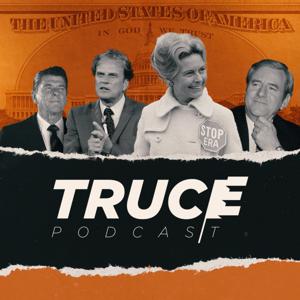
Season six is almost here! This season we're exploring the backstory of why so many evangelicals turned to the Republican Party in the 1970s and 80s. It's a huge story that involves murder, corruption, greed, taxes, school choice, racism, and a lot of big questions. Special guests include Rick Perlstein, Frances Fitzgerald, Marjorie Spruill, Jesse Eisinger, and so many more.
Subscribe to Truce wherever you get your podcasts, or listen at trucepodcast.com
Learn more about your ad choices. Visit podcastchoices.com/adchoices
Give to help Chris keep Truce going!
Season six is coming along nicely! I'm super busy trying to get it all put together before I start releasing episodes. But I want to also make everyone aware that I'm looking for more advertisers for the show. Want to participate? Visit www.trucepodcast.com/advertise to get started!
Learn more about your ad choices. Visit podcastchoices.com/adchoices
Give to help Chris make Truce!
Joseph McCarthy was an unexceptional junior congressman from Wisconsin. He grew up brawling in the streets, playing cards, and embellishing his stories. Then, during a Lincoln Day address in 1950, Joseph McCarthy told an audience that he had a list of 205 communists working in the government. Within days, he was a household name.
McCarthy started "investigating" suspected communists in the American government, focusing on the US State Department. Along the way, he brought in a young lawyer named Roy Cohn. Cohn was already known for his work sending Julius and Ethel Rosenberg to the electric chair. Now, he and McCarthy bullied and cajoled during private hearings. Being labeled a communist, or even a suspected communist could ruin a person's career. People committed suicide rather than face their scrutiny.
Their reign lasted four years, ending in the televised broadcasts of the Army-McCarthy hearings in which a lawyer asked if McCarthy had any decency. That was pretty much it for McCarthy. But Roy Cohn went on to have a well-connected career, providing legal services for the mob and Rupert Murdoch, owner of Fox News. He also became a mentor to a young real estate mogul named Donald Trump. Famous people like Andy Warhol attended his birthday party at Studio 54. Cohn died of AIDS, something that was killing gay men rapidly in the 1980s, though he denied he ever had it.
This is the story of two men allowed to prey on the fears of the American people for their own gain. One fell hard, the other found himself fighting against his own people.
In this episode, Chris interviews Larry Tye, author of the book "Demagogue". He's also the author of "Satchel: The Life and Times of an American Legend" and "Bobby Kennedy: The Making of a Liberal Icon".
Sources:
Discussion Questions:
Learn more about your ad choices. Visit podcastchoices.com/adchoices
Give to help Chris make the Truce Podcast!
The Love Thy Neighborhood podcast is really well produced. But they also take deep dives into some of the things going on in modern Christianity that I can't cover on Truce. They are a good supplement to the stuff we cover on this feed. So we thought... why not share each other's show?
In this bonus episode, you'll hear Chris talking with Anna Tran and Jesse Eubanks about their episode "Where the Gospel Meets Artificial Intelligence". It is a look into the ways in which AI may someday try to gain ground in the spiritual realm. Also, they do an interview with TikTok evangelist York Moore who uses that medium to share the gospel. I was especially interested in the ways in which AI chatbots are building false relationships with people, taking the place of human interactions.
They cover a lot of ground! Let them know that you heard about their show from the Truce Podcast!
Season six starts in just a few months, but I will be launching a bonus episode in a few weeks. Subscribe so you get every new episode as it's released.
Learn more about your ad choices. Visit podcastchoices.com/adchoices
Season 5 of the Truce Podcast was a blast! I'm hard at work on season 6, which will discuss how American evangelicals got tied to the Republican Party. It is already coming together so well! I can't wait to share it with you.
God willing, season 6 will drop in the fall or early winter of 2023.
Like, subscribe, sign up for the email list, and remember the show in your prayers!
Godspeed!
Learn more about your ad choices. Visit podcastchoices.com/adchoices
Give to support the Truce Podcast
On March 4, 1933, FDR delivered his inaugural address. In it, he used the phrase "the only thing we have to fear is fear itself". I did a little searching and this phrase is used a LOT in Christian books. So often. But it almost always refers to the fear one person has in their heart. In reality, it is a comment on collective fear. The Great Depression started in 1929 and was exacerbated by a bank run in which Americans lost faith in the value of our currency and the banking systems.
That is an important distinction. FDR's speech is about collective fear. As I've contemplated the modernist/fundamentalist debate this season, I keep returning to the idea of fear, not in the US economy but in God's economy. He commands us to love the Lord, keep His commands, love our neighbors, turn the other cheek, and give to those who ask of us. Why do we forget to do this important work? Could it be because we've lost faith in God's economy?
This episode features a clip from my discussion with Jacob Goldstein, former host of NPR's Planet Money podcast and the current host of Pushkin's What's Your Problem? podcast. His book is Money: The True Story of a Made-up Thing.
Select Sources
Discussion Questions:
Learn more about your ad choices. Visit podcastchoices.com/adchoices
Love Truce? Give a little to help support the show!
"The ends justify the means" is a phrase we hear occasionally. Often it is used to justify bad behavior, so long as it creates a profitable outcome. But we Christians know that we are called to live righteous lives. Are we people of the ends, or should we be known as a people of the means?
Chris is joined this week by Pastor Ray McDaniel of First Baptist Church in Jackson, WY, and his twin brother Nick Staron to discuss this important issue.
Discussion Questions:
Learn more about your ad choices. Visit podcastchoices.com/adchoices
Give a little to help Chris continue to make Truce!
In 1945, C.S. Lewis published his excellent book "The Great Divorce". It happens to be one of my favorite books. It has many themes, the biggest of which is that there can be no hell in heaven. The two are divorced from each other (hence the title). Another is that humans are easily distracted from God's work and the gospel.
This season I've been telling the backstory of Christian fundamentalism. I think many of us have been distracted from the gospel because of politics or the people around us. If you were joined by a loved one who passed away or an angel who challenged you to walk to heaven, would you? What distracts you from following Jesus? From really going for it?
Special thanks to my improv troupe (Nick, Josh, and Jackie) who helped with voices. Additional vocal work came from Paul Hastings from the "Compelled" podcast and Jerry Dugan from "Beyond the Rut". Give their shows a listen and let me know what you think!
Sources:
Discussion Questions:
Learn more about your ad choices. Visit podcastchoices.com/adchoices
In the fall of 1814, the powers of Europe gathered together to discuss what to do with the continent after the Napoleonic Wars. Napoleon had changed a lot in his time in power! He cowed the Roman Catholic Church, ended serfdom where he went, freed Jews from their ghettos, took away kingdoms, and placed new kings in charge. The Congress of Vienna was tasked with a Humpty Dumpty scenario and they couldn't put Europe back together again.
The various countries also wanted to be compensated for their efforts to stop Napoleon. Couldn't they take a little piece of land? Encroach on one of the lesser kingdoms? Install their own puppet governments? In trying to undo all of the changes Napoleon made, they became little Napoleons themselves.
In the same way, when we confront extremism with extremism we become exactly what we dislike. Shouldn't Christians be more focused on simple righteousness than culture wars?
Select Sources:
Discussion Questions:
Learn more about your ad choices. Visit podcastchoices.com/adchoices
Donate to help Chris make Truce!
The first-century Christian Church had a lot going on. Their Savior died and was resurrected, sending the Holy Spirit and leaving them with the command to take this new message to all tribes and tongues. The book of Acts records some of their travels, as they went all over the known world with this good news. But they were not the only people evangelizing. So were the gnostics. Gnosticism takes a lot of different shapes. It was a belief system that challenged Christianity, even as some tried to incorporate elements into the faith.
Now consider modernist theology - what we've been talking about all season. It is a belief system that doesn't believe in the miracles or the divinity of Jesus. To evangelicals of the 1800s and 1900s, this was a real threat. Like Gnosticism before it, modernism threatened to destabilize the gospel message. What to do?
In this bonus episode, Chris takes a look at 1-3 John to see what they have to say about dealing with heresy.
Chris is hard at work on season 6! He'll be presenting these short episodes in the meantime to recap some of the themes of season 5.
Discussion Questions:
Selected Source Materials:
Learn more about your ad choices. Visit podcastchoices.com/adchoices
From the publisher's feed
Ranked by our users in the last 21 days

1,127 Listeners

1,098 Listeners
4,430 Listeners
1,479 Listeners

2,054 Listeners

814 Listeners

3,928 Listeners

572 Listeners
220 Listeners

1,925 Listeners

560 Listeners

853 Listeners
128 Listeners
872 Listeners
914 Listeners