
Sign up to save your podcasts
Or

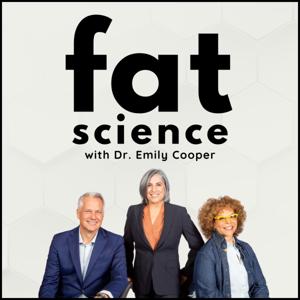

What really happens when you stop GLP-1 medications — and are the headlines telling you the whole story? The answer is more nuanced than social media wants you to believe.
This week on Fat Science, Dr. Emily Cooper, Mark Wright, and Andrea Taylor break down four recent studies on GLP-1 treatment outcomes, weight regain, and a groundbreaking new drug that could preserve lean mass during treatment. They walk through the methodology behind each paper, explain why two studies asking the same question got opposite answers, and reveal what a new monoclonal antibody called bimagrumab could mean for the future of metabolic treatment.
Key Takeaways
When you stop treating any chronic metabolic condition, the condition returns — that's not failure, that's biology.
Real-world data showed 56% of people who stopped filling GLP-1 prescriptions maintained or continued losing weight — likely because they continued working with their clinician on alternative treatments.
A new monoclonal antibody called bimagrumab showed 11% body weight reduction on its own, while simultaneously increasing lean mass by 3% — without affecting appetite.
When combined with semaglutide, bimagrumab reduced lean mass loss from 28% to just 11% of total weight lost.
Not eating enough while on GLP-1s drives greater lean mass loss — nutrition is still the best tool for preserving muscle.
Notable Quote
"It wasn't my failure and it was disease underneath everything. Finding that out — that it wasn't my fault — that was the miracle of the whole process to me." — Andrea Taylor
Links & Resources
Podcast Home: fatsciencepodcast.com
Cooper Center for Metabolism: coopermetabolic.com
Resources from Dr. Cooper: coopermetabolic.com/resources
Join Our Community: patreon.com/cw/FatSciencePodcast
Submit Your Question: [email protected] or [email protected]
Fat Science is supported by the Diabesity Institute, a nonprofit dedicated to increasing access to effective, science-based metabolic care.
Disclaimer: This podcast is for informational purposes only and is not intended as medical advice. Please consult with a qualified healthcare provider for personalized recommendations
 View all episodes
 By Dr Emily Cooper

4.6
154154 ratings
What really happens when you stop GLP-1 medications — and are the headlines telling you the whole story? The answer is more nuanced than social media wants you to believe.
This week on Fat Science, Dr. Emily Cooper, Mark Wright, and Andrea Taylor break down four recent studies on GLP-1 treatment outcomes, weight regain, and a groundbreaking new drug that could preserve lean mass during treatment. They walk through the methodology behind each paper, explain why two studies asking the same question got opposite answers, and reveal what a new monoclonal antibody called bimagrumab could mean for the future of metabolic treatment.
Key Takeaways
When you stop treating any chronic metabolic condition, the condition returns — that's not failure, that's biology.
Real-world data showed 56% of people who stopped filling GLP-1 prescriptions maintained or continued losing weight — likely because they continued working with their clinician on alternative treatments.
A new monoclonal antibody called bimagrumab showed 11% body weight reduction on its own, while simultaneously increasing lean mass by 3% — without affecting appetite.
When combined with semaglutide, bimagrumab reduced lean mass loss from 28% to just 11% of total weight lost.
Not eating enough while on GLP-1s drives greater lean mass loss — nutrition is still the best tool for preserving muscle.
Notable Quote
"It wasn't my failure and it was disease underneath everything. Finding that out — that it wasn't my fault — that was the miracle of the whole process to me." — Andrea Taylor
Links & Resources
Podcast Home: fatsciencepodcast.com
Cooper Center for Metabolism: coopermetabolic.com
Resources from Dr. Cooper: coopermetabolic.com/resources
Join Our Community: patreon.com/cw/FatSciencePodcast
Submit Your Question: [email protected] or [email protected]
Fat Science is supported by the Diabesity Institute, a nonprofit dedicated to increasing access to effective, science-based metabolic care.
Disclaimer: This podcast is for informational purposes only and is not intended as medical advice. Please consult with a qualified healthcare provider for personalized recommendations

9,231 Listeners

7,995 Listeners
336 Listeners

142 Listeners

628 Listeners

67 Listeners

1,680 Listeners
425 Listeners

354 Listeners

1,196 Listeners

264 Listeners

230 Listeners

369 Listeners
119 Listeners

178 Listeners