
Sign up to save your podcasts
Or

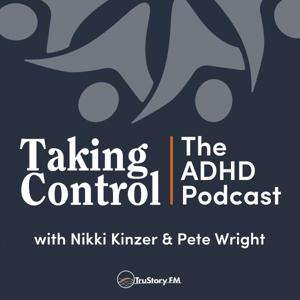

This week kicks off a three-part series on planning, and it starts where every planning conversation should: with honesty about why plans fall apart in the first place. Pete opens with his own cascading construction disaster at home, where raccoon damage set off a chain reaction of disruptions that has bled directly into his work life. Nikki’s diagnosis is both simple and profound: when you make a plan, you’re trying to predict the future with the information you have right now. When that future doesn’t cooperate, the real problem isn’t the plan failing. It’s that we treat plan failure like a personal failure.
From there, Nikki walks through the full spectrum of executive function challenges that make ADHD planning uniquely hard: time blindness that operates at every scale from individual task to entire month, working memory that drops the ball the moment you turn around, prioritization paralysis where everything feels equally urgent, the cognitive inflexibility that turns one bad morning into a ruined day, emotional regulation struggles and the sharp edge of RSD when disappointing someone is unavoidable, and sustained attention that evaporates the moment your environment gets interesting. At the center of it all is what Pete calls “fantasy Pete,” the imaginary version of himself who wields time like a saber and never lets anyone down, and whom nobody would actually like at a party.
The antidote isn’t a better system. It’s moving from shame to curiosity. Nikki’s framework: instead of asking what’s wrong with you, ask what your brain actually needs. Find the friction. Learn your own flavor of ADHD. Build in margin so that when things go sideways, you have something left in the tank for recovery. The episode closes on Pete’s central paradox, the one he returns to with clients again and again: it’s not your fault, but it is yours. You didn’t design this brain. But you’re the one who has to work with it, and building that muscle, one honest conversation at a time, is exactly what this trilogy is for.
If this episode hit close to home, we made something to help it land a little deeper. Your Planning Reflection is a free companion guide—just four honest questions to help you connect what you heard to what's actually happening in your own life. No productivity exercise. No grade at the end. Just a quiet moment to start paying attention.
Links & Notes
 View all episodes
 By TruStory FM

4.6
436436 ratings
This week kicks off a three-part series on planning, and it starts where every planning conversation should: with honesty about why plans fall apart in the first place. Pete opens with his own cascading construction disaster at home, where raccoon damage set off a chain reaction of disruptions that has bled directly into his work life. Nikki’s diagnosis is both simple and profound: when you make a plan, you’re trying to predict the future with the information you have right now. When that future doesn’t cooperate, the real problem isn’t the plan failing. It’s that we treat plan failure like a personal failure.
From there, Nikki walks through the full spectrum of executive function challenges that make ADHD planning uniquely hard: time blindness that operates at every scale from individual task to entire month, working memory that drops the ball the moment you turn around, prioritization paralysis where everything feels equally urgent, the cognitive inflexibility that turns one bad morning into a ruined day, emotional regulation struggles and the sharp edge of RSD when disappointing someone is unavoidable, and sustained attention that evaporates the moment your environment gets interesting. At the center of it all is what Pete calls “fantasy Pete,” the imaginary version of himself who wields time like a saber and never lets anyone down, and whom nobody would actually like at a party.
The antidote isn’t a better system. It’s moving from shame to curiosity. Nikki’s framework: instead of asking what’s wrong with you, ask what your brain actually needs. Find the friction. Learn your own flavor of ADHD. Build in margin so that when things go sideways, you have something left in the tank for recovery. The episode closes on Pete’s central paradox, the one he returns to with clients again and again: it’s not your fault, but it is yours. You didn’t design this brain. But you’re the one who has to work with it, and building that muscle, one honest conversation at a time, is exactly what this trilogy is for.
If this episode hit close to home, we made something to help it land a little deeper. Your Planning Reflection is a free companion guide—just four honest questions to help you connect what you heard to what's actually happening in your own life. No productivity exercise. No grade at the end. Just a quiet moment to start paying attention.
Links & Notes

1,337 Listeners
914 Listeners

8 Listeners
117 Listeners

21 Listeners

47 Listeners

2,870 Listeners

37 Listeners

715 Listeners
38 Listeners

29 Listeners

12 Listeners
166 Listeners

101 Listeners

178 Listeners

19,524 Listeners
290 Listeners
97 Listeners

51 Listeners
381 Listeners

4 Listeners

2 Listeners

8 Listeners

283 Listeners
0 Listeners

69 Listeners

6 Listeners

0 Listeners

5 Listeners
8 Listeners

0 Listeners
0 Listeners
2 Listeners