
Sign up to save your podcasts
Or



“Revising is about making sure that you're saying what you want to say in the way you want to say it. . . . To me, revision is the sport. It's the impact. It's the reason we're writers.”
Have you ever read a book and thought, Holy cow, this is amazing. How did this author DO this?
Or, maybe you’ve read a book and thought, Wow, I wish I could write (or in my case, edit) a book like this, but this is incredible and it might be beyond me?
Well, that’s how I feel when I read an A.S. King novel.
She’s an impressively decorated author of novels for middle grade, teens, and adults. She’s the only author to win the Printz award for young adult literature twice—and that’s just two of many, many accolades.
She writes brilliant stories that are surrealist and puzzling and weird, and at the same time beautiful and heartfelt and honest and real.
And when I heard that she loves revision, I knew I had to bring her to Your Next Draft and ask her: how does she do it?
How does she manage to craft such intricately plotted, complex stories?
How does she innovate so much on a technical level, and keep me hooked on a brilliant story all the way through?
How does she turn her completely pantsed first drafts into award-winning novels—and then hit it out of the park again, and again, and again?
So I was thrilled when A.S. King agreed to join me on the podcast and spill all the details of her revision process.
In our conversation, she shares:
Plus, I’ve created a revision reading list to pair with this conversation so you can see A.S. King’s specific editorial choices at work in her novels.
A.S. King is an absolute gem of a human as well as a brilliant writer. I hope you enjoy our conversation as much as I did.
P.S. My very favorite part of our conversation begins at 1 hr 21 min. Here’s a sneak peek:
“In the end, it is all about your voice and your experiences and your feelings. That's it. It's all writing is.”
Links mentioned in the episode:
Send me a Text Message!
Support the show
Rate, Review, & Follow on Apple Podcasts
"I love Alice and Your Next Draft." If that sounds like you, please consider rating and reviewing my show! This helps me support more writers through the mess—and joy—of the editing process. Click here, scroll to the bottom, tap the stars to rate, and select “Write a Review.” Then be sure to let me know what you loved most about the episode!
Loving the show? Show your support with a monthly contribution »
Ever wondered what an editor actually does all day?
What it looks like to spend all day supporting writers in their stories?
Or what your editor’s doing in all that time when they’re not sharing their feedback with you?
If those questions pique your curiosity, you’re in luck. I’m pulling back the curtain to share a week in my life as a developmental editor and book coach.
You’ll get a behind-the-scenes look at what I do with writers and what I’m working on when I’m not on calls giving feedback.
Plus, I’ll share all the best editing strategies, tips, and tricks that emerge as I dig into stories with writers this week. You’ll hear:
I love my job and can’t imagine spending my days any other way. I hope you enjoy this peek at what it really looks like to be an editor and book coach!
Links mentioned in the episode:
Further Listening:
Send me a Text Message!
Support the show
Rate, Review, & Follow on Apple Podcasts
"I love Alice and Your Next Draft." If that sounds like you, please consider rating and reviewing my show! This helps me support more writers through the mess—and joy—of the editing process. Click here, scroll to the bottom, tap the stars to rate, and select “Write a Review.” Then be sure to let me know what you loved most about the episode!
Loving the show? Show your support with a monthly contribution »
When to use frameworks to solve your story problems—and when to trust yourself and lean on your own story authority.
You’ve heard of Save the Cat! Story Grid. Blueprint for a Book.
These are all frameworks designed to help you edit a novel. If you don’t know these names, I bet you know others—Hero’s Journey, Freytag’s Pyramid, 7 Point Story Structure, Dan Harmon’s Story Circle, there are dozens more.
Each one promises that if you use it, you’ll be able to craft better stories. And because we want to write good books, the writers I know are constantly learning new frameworks and analyzing their stories through them.
I use frameworks like these in the editing process, after the first draft is already written. But I’ve seen many writers use them earlier, even before they begin writing.
It’s a tempting thought, right? What if you could use these frameworks to solve your story problems and make writing your first draft so much easier? What if you could build a story from the ground up that already fulfills everything those frameworks require from the very first draft?
Would that shortcut the creative process? Would it help you create a better story faster?
Or would it get in the way of your storytelling? Are there moments in the creative process when frameworks like these might just do more harm than good?
I’m a big fan of storytelling frameworks. But today, we’re taking a hard look at them to see what they offer, what they can’t do for us, and how to tap into your true authority as the writer of your own story.
Links mentioned in the episode:
Further listening:
Send me a Text Message!
Support the show
Rate, Review, & Follow on Apple Podcasts
"I love Alice and Your Next Draft." If that sounds like you, please consider rating and reviewing my show! This helps me support more writers through the mess—and joy—of the editing process. Click here, scroll to the bottom, tap the stars to rate, and select “Write a Review.” Then be sure to let me know what you loved most about the episode!
Loving the show? Show your support with a monthly contribution »
Escape analysis paralysis with one powerful question. It’s deceptively simple—and yet it unlocks everything.
If you’re like most of the writers I work with, you’re pretty savvy about story structure. You know your Story Grid, your Save the Cat!, your Hero’s Journey. You’ve probably analyzed your story six ways to Sunday, and you’ve got the spreadsheets and outlines and diagrams and graphs to prove it.
And all that analysis has leveled up your story significantly. You’ve solved major structural problems by applying your extensive knowledge of story theory.
But I also bet there are still some issues nagging at you. Issues that you still can’t crack, no matter how many times you map every act and arc in your story on a spreadsheet.
In fact, if you’re still spreadsheeting your story by this point, you’re probably starting to spin out a little. You’ve analyzed and analyzed and analyzed again, and now all that story structure that was supposed to make revising your story clear and straightforward has turned against you, leaving you overwhelmed and lost.
What if you could break through all that overwhelm and find your footing in your story again?
What if you could snap out of analysis paralysis and reconnect with your characters and the inspiration that compelled you to write in the first place?
And what if you could do all of that by asking just one deceptively simple question?
You can, I promise. And in this episode, I’ll show you how.
Links mentioned in the episode:
Send me a Text Message!
Support the show
Rate, Review, & Follow on Apple Podcasts
"I love Alice and Your Next Draft." If that sounds like you, please consider rating and reviewing my show! This helps me support more writers through the mess—and joy—of the editing process. Click here, scroll to the bottom, tap the stars to rate, and select “Write a Review.” Then be sure to let me know what you loved most about the episode!
Loving the show? Show your support with a monthly contribution »
The best novels combine rock-solid story structure with scenes that are unputdownable on every page. Here’s how one writer and two editors polished a story at every level.
If you want to move your reader in every moment, keep them hooked on every page, you need to refine your scenes until each one is unputdownable.
And that refinement? It’s SUCH a joy. It’s my favorite thing to do and it will transform your entire story.
But in order to make every scene matter, you first need to make sure you have all the right scenes in all the right places.
The big-picture story structure can’t be kinda-sorta-maybe working. It needs to be locked in, watertight.
Otherwise, all those beautiful scenes won’t build to anything. They might be pretty on their own. But they won’t create compelling narrative drive, an irresistible build to the cathartic payoff your readers can’t get enough of.
So how do you do it? How do you get your macro storytelling crystal clear and refine every scene into its most powerful form?
In this episode, I want to share with you the story of how one writer did just that. You’ll hear how Cathryn leveraged multiple revision passes to transform her manuscript from a massive pile of words that made her cringe to a story she’s immeasurably proud of.
It’s also a tale of two editors—because Cathryn worked with both me and my colleague Kim to make her story shine on every level.
Most of all, it’s a story of mastering two storytelling skills—the micro and the macro—and all the story magic you can unlock when you do.
Links mentioned in the episode:
Further listening:
Send me a Text Message!
Support the show
Rate, Review, & Follow on Apple Podcasts
"I love Alice and Your Next Draft." If that sounds like you, please consider rating and reviewing my show! This helps me support more writers through the mess—and joy—of the editing process. Click here, scroll to the bottom, tap the stars to rate, and select “Write a Review.” Then be sure to let me know what you loved most about the episode!
Loving the show? Show your support with a monthly contribution »
It’s the most common developmental editing service you’ll see. Know what to look for and when (or if) you need one.
If you google “developmental editor” and start looking through editors’ websites, you’ll see a common service appear again and again:
A manuscript evaluation.
(Or assessment, or diagnostic, or critique. A rose by any other name, etc.)
Typically, in a manuscript evaluation, an editor will offer to read your manuscript and tell you what’s working and what to focus on next to make it even better.
It sounds like the dream, right? Someone who will read the book you’ve spent months and months writing, tell you what they think of it, and give you a to-do list.
And manuscript evaluations sell like hotcakes because what they’re offering is exactly what writers want.
Or at least—
what writers think they want.
But when you don’t know what you really need, you risk wasting hundreds or thousands of dollars on a service that leaves you disappointed, stuck in the same spot, or even feeling false confidence that your story’s problems have all been solved when they’re not.
What if you don’t need someone else’s to-do list for your story? What if you have access to all the evaluation you need right now, without paying a single cent?
And if you don’t need someone else’s to-do list, what do you need instead?
In this episode, I’m giving you a crash course on manuscript evaluations. You’ll hear:
Here’s the thing: there are no regulations in the author services industry.
That means it’s up to YOU to vet every professional you work with.
I’m equipping you with everything you need to know to make the most of manuscript evaluations—or find the service you need instead.
Links mentioned in the episode:
Send me a Text Message!
Support the show
Rate, Review, & Follow on Apple Podcasts
"I love Alice and Your Next Draft." If that sounds like you, please consider rating and reviewing my show! This helps me support more writers through the mess—and joy—of the editing process. Click here, scroll to the bottom, tap the stars to rate, and select “Write a Review.” Then be sure to let me know what you loved most about the episode!
Loving the show? Show your support with a monthly contribution »
You get one shot to grab their attention. Don’t waste it with characters staring off into space.
You've put all this work into uncovering your character's internal arc. You know them SO WELL.
When you step into a scene, you're giving your absolute all to uncovering the deep meaning and purpose behind it, the profound arc of character transformation that's happening in even the smallest moments.
Yet in doing all that . . . you've lost the plot. You've crafted complex inner worlds for your characters, but all they're literally doing is staring off into space.
And you're worried that in the times when you most want to hook your readers—like your absolutely critical opening pages—you're boring them instead.
Bored readers put books down.
So what do you do? Throw in some discord and explosions to create external chaos? Cut the scene and start the story at a different point entirely?
Or is there a way to use what you know of your character's internal arc to find the perfect external action that will hook your readers and keep them turning pages?
This is exactly the challenge Cathryn deVries encountered in the first chapter of her novel. So we workshopped it together—and in this episode, you'll hear how we solved it, and how you can hook your readers, too.
Links mentioned in the episode:
Send me a Text Message!
Support the show
Rate, Review, & Follow on Apple Podcasts
"I love Alice and Your Next Draft." If that sounds like you, please consider rating and reviewing my show! This helps me support more writers through the mess—and joy—of the editing process. Click here, scroll to the bottom, tap the stars to rate, and select “Write a Review.” Then be sure to let me know what you loved most about the episode!
Loving the show? Show your support with a monthly contribution »
It’s unpopular, but essential if you’re aiming to craft your best work.
Picture this: one year from now, you’re holding your book in your hands. You see the gorgeous cover art, feel the slight resistance when you open the cover for the first time, run your hands over the soft, smooth paper, flip the pages and smell that delicious new book smell.
Does that sound amazing? Holding your book in your hands just one year from now?
Being done soon is so tempting. But just being done soon won’t lead to a book you’re proud of, a book you love, a book that accomplishes everything you know it can be.
Does it sound amazing to imagine holding your book in your hands six months from now . . . and still not feel creatively fulfilled?
To flip the pages and know that there’s more you could still fix?
To skim the lines and cringe just a little?
To picture the glorious story vivid in your imagination and wonder what your readers will miss because you couldn’t quite capture it on the page?
No, that doesn’t sound delightful? I didn’t think so.
The book world is filled with services promising to help you finish your book fast. If your dream is to hold your book in your hands this year, there are tons of people out there who can help you make that happen.
But after years of helping writers who seek to craft their very best books, the ones they’re truly proud of, I’ve found that speed is not what you need to get there.
In this episode, I’ll show you:
It’s not the popular path. But it’s the only path I know to craft the books you’re truly capable of writing.
Links mentioned in the episode:
Send me a Text Message!
Support the show
Rate, Review, & Follow on Apple Podcasts
"I love Alice and Your Next Draft." If that sounds like you, please consider rating and reviewing my show! This helps me support more writers through the mess—and joy—of the editing process. Click here, scroll to the bottom, tap the stars to rate, and select “Write a Review.” Then be sure to let me know what you loved most about the episode!
Loving the show? Show your support with a monthly contribution »
Your book is important. But sometimes, worthy interruptions will delay it for a while.
For the last few months, this podcast feed has been quiet. It went dark with no notice in mid-June.
I didn’t mean to disappear on you. In fact, I didn’t plan to pause the podcast at all.
But a family emergency struck, and all my best-laid plans for summer 2024 changed in a matter of hours.
This summer, I learned what it takes to edit when your world is in crisis.
Happily, for me and my family, the crisis is over. But emergencies are bound to happen to everyone at some point.
And so in today’s episode, I’m sharing my best advice for you and your editing should a crisis come to you.
In it, you’ll hear:
I hope you don’t need these tips for a long time. But if you do find your world falling apart around you, I hope these tips help you find a way forward for your story and yourself.
Links mentioned in the episode:
Send me a Text Message!
Support the show
Rate, Review, & Follow on Apple Podcasts
"I love Alice and Your Next Draft." If that sounds like you, please consider rating and reviewing my show! This helps me support more writers through the mess—and joy—of the editing process. Click here, scroll to the bottom, tap the stars to rate, and select “Write a Review.” Then be sure to let me know what you loved most about the episode!
Loving the show? Show your support with a monthly contribution »
Your reader experiences your story one scene at a time. Make every scene un-put-down-able.
Great stories are made of great scenes.
Sure, your novel has a clever plot with twists and turns from the first page to the last. But the way your readers will experience that plot is . . .
. . . one scene at a time.
Which means if you want your readers to fall in love with your novel, you need to captivate them with scenes they can’t put down.
How do you do it?
I’ll show you in this episode. I’m analyzing a scene from The Seven Husbands of Evelyn Hugo to show you how and why it works—
—and how you can create the same magic with your own scenes.
You’ll learn:
This episode is a sneak peek inside my upcoming Scene Mastery Workshop. In fact, this is the first scene we’ll study in the workshop. Then, we’ll dig into seven more scenes from other great novels.
So if you enjoy this episode, you’ll love the workshop.
Want to master editing scenes this summer? Click here to get all the details and apply »
Links mentioned in the episode:
Send me a Text Message!
Support the show
Rate, Review, & Follow on Apple Podcasts
"I love Alice and Your Next Draft." If that sounds like you, please consider rating and reviewing my show! This helps me support more writers through the mess—and joy—of the editing process. Click here, scroll to the bottom, tap the stars to rate, and select “Write a Review.” Then be sure to let me know what you loved most about the episode!
Loving the show? Show your support with a monthly contribution »
From the publisher's feed
Supporting fiction writers doing the hard work of revising unputdownable novels. The novel editing process is the creative crucible where you discover the story you truly want to tell—and it can…
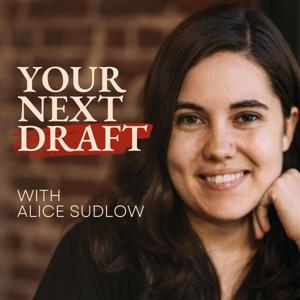
Developmental editor and book coach Alice Sudlow will be your companion through the mess and magic of revision. You’ll get inspired by interviews with authors, editors, and coaches sharing their revision processes; gain practical tips from Alice’s editing practice; and hear what real revision truly requires as Alice workshops scenes-in-progress with writers.
It’s all a quest to discover: How do you figure out what your story is truly about? How do you determine what form that story should take? And once you do, how do you shape the hundreds of thousands of words you've written into the story’s most refined and powerful form?
If you’ve written a draft—or three—but are still searching for your story’s untapped potential, this is the podcast for you. Together, let’s dig into the difficult and delightful work of editing your next draft.

38,654 Listeners
1,296 Listeners
1,007 Listeners
627 Listeners
251 Listeners
1,479 Listeners
114 Listeners
782 Listeners
430 Listeners

40 Listeners
32 Listeners

17 Listeners
21 Listeners

12,521 Listeners

15 Listeners