
Sign up to save your podcasts
Or



This skater didn't win an Olympic medal, and I'm obsessed with him.
I watched Cha Jun-Hwan’s figure skating routine last week in the Olympic men’s short program competition. I never finished watching that competition—I was busy rewinding Jun-Hwan’s routine to watch him over and over again.
I filmed my TV screen on my phone and watched it again while I sat in the courthouse on jury duty. I gushed about it to friends and family. I’ve been listening to the song he skated to on loop for a week.
Jun-Hwan didn’t win a medal. He placed fourth, just off the podium. But his skate has stuck in my mind like no other skater’s has throughout this entire Olympics.
There is no Olympic gold medal for literature.
Still, most writers I work with are chasing their own version of Olympic gold. You’re reaching for lofty achievements: to sign an agent, to get a book deal, to land on the endcaps of Barnes and Noble, maybe even to rise up in the bestseller lists.
Which, on the one hand, is fantastic. As I’m sure every Olympic athlete knows, it’s so incredibly satisfying and rewarding to push the limits of your potential, to set a high bar and then become the person who can surpass it.
But on the other hand, it’s a hidden trap. Because the achievements we compete for are merely proxies for what we actually want. The agents, the deals, the bookstores, the lists are simply stand-ins for excellence and validation and engagement with readers who love what we write.
Which means that it’s possible to win the agents and the deals without reaching excellence and connecting with readers. And it’s possible to lose the agents and the accolades, and still attain the excellence and engagement we most want.
So in this episode, I’m raving about Cha Jun-Hwan.
Not because he medaled, or he was expected to medal but didn’t, or he was part of any figure skating drama. He was simply there, skating a great skate—one that lives on in my mind and on my phone and in my Youtube history.
And I’m unpacking why.
What magic did his skate hold that surpassed any other?
What am I measuring besides Olympic gold?
And how can writers weave that magic, too?
Links mentioned in the episode:
Send me a Text Message!
Support the show
Rate, Review, & Follow on Apple Podcasts
"I love Alice and Your Next Draft." If that sounds like you, please consider rating and reviewing my show! This helps me support more writers through the mess—and joy—of the editing process. Click here, scroll to the bottom, tap the stars to rate, and select “Write a Review.” Then be sure to let me know what you loved most about the episode!
Loving the show? Show your support with a monthly contribution »
When will you be truly satisfied with your novel? How will you know when you’ve succeeded?
How will you know when you’re done?
Will it be when you LOVE your book? When you stop cringing as you read it? When you can’t think of a single change left to make?
When beta readers rave about it? When they tell you the romantic scenes made them swoon and the funny scenes made them laugh, the scary scenes gave them nightmares and the sad scenes made them cry?
When a reader tells you your book impacted them profoundly? That it changed the way they think about something that matters?
Or will it be when an agent requests your full manuscript, then returns with an offer of representation? When an editor offers you a book deal? When your book is published and you see it on bookstore shelves?
One of the most difficult editing decisions you’ll face is determining when your book is done. When you have finished, when it’s ready to share with the world, when this project you’ve poured so much of your heart into is complete.
In this episode, I’ll help you uncover the factors that matter most to you.
You’ll learn:
Calling your book “done” will always be a challenging decision. After all, art is never finished, only abandoned.
But when you know what you value most, you can chase it with clarity and determination, and celebrate when you reach it.
Links mentioned in the episode:
Send me a Text Message!
Support the show
Rate, Review, & Follow on Apple Podcasts
"I love Alice and Your Next Draft." If that sounds like you, please consider rating and reviewing my show! This helps me support more writers through the mess—and joy—of the editing process. Click here, scroll to the bottom, tap the stars to rate, and select “Write a Review.” Then be sure to let me know what you loved most about the episode!
Loving the show? Show your support with a monthly contribution »
What if editing isn’t drudgery, but the most delightful part of your writing process?
So you’re revising yet another draft. You’re hoping against hope that this draft will be your final draft. Which, coincidentally, is also what you hoped for the last draft, and the one before that.
Editing is a slog you’re trudging through. You dream of the day when you can escape this drudgery and return to the free-flowing fun of writing the first draft of your next book.
But what if editing isn’t an obstacle you have to grit your teeth and bear?
What if it’s where the magic happens?
It would release the pressure to make this draft your last draft. It would make the process itself more fun, a reward in and of itself. And paradoxically, when you’re working from pleasure rather than pressure, your editing work could become more efficient, because you give the process the space it needs.
So I asked six authors, editors, and book coaches the same question:
What do you love about editing?
The answers they shared vary widely. They’re a whole host of things: everything from puzzle-solving and understanding the mechanics that makes something work to personal development, community building, and meaning-making.
In this episode, I’m sharing all their answers with you, in hopes of sparking a little of your own editing joy.
Listen for what resonates with you. You might discover one new thing to love—or a whole new perspective on revision.
And if you already love editing, well, I think you’ll find this episode an absolute delight.
Plus, I want to know what you love about editing! Record a 1-minute voicemail sharing what you love about editing, and I might feature it in a future podcast episode.
Tell me what you love about editing here »
Links mentioned in the episode:
Send me a Text Message!
Support the show
Rate, Review, & Follow on Apple Podcasts
"I love Alice and Your Next Draft." If that sounds like you, please consider rating and reviewing my show! This helps me support more writers through the mess—and joy—of the editing process. Click here, scroll to the bottom, tap the stars to rate, and select “Write a Review.” Then be sure to let me know what you loved most about the episode!
Loving the show? Show your support with a monthly contribution »
Is story excellence something you "know when you see it"—or can it actually be measured?
Is excellence defined by hitting bestseller lists? Filling seats at every book tour stop? Being selected for “Best Books of 2025” lists?
Is excellence defined by getting gatekeeper approval? Getting agent representation? Landing a book deal? Winning awards?
Is excellence defined by earning money? Getting a big advance? Earning out the advance and bringing in royalties?
Or is it something else?
How can we measure that a book is good? What is the pinnacle we’re trying to reach, and how will we tell when we achieve it?
This is a big, big question, and feels in some ways impossible to answer. But I’m going to try. Because if we want to craft excellent novels, we need to know what we’re aiming for so we can recognize when we reach it and spot when we’re going off course.
Come journey with me to discover what excellent stories truly do. We’re going to get lightly philosophical so you can shape your stories to excellence too.
You’ll hear:
Once you’ve heard how I’m defining excellence, I’d love to hear your definition! Head to the comments on the blog post and let me know what makes a story excellent to you.
Share your standard of excellence in the comments »
Links mentioned in the episode:
Send me a Text Message!
Support the show
Rate, Review, & Follow on Apple Podcasts
"I love Alice and Your Next Draft." If that sounds like you, please consider rating and reviewing my show! This helps me support more writers through the mess—and joy—of the editing process. Click here, scroll to the bottom, tap the stars to rate, and select “Write a Review.” Then be sure to let me know what you loved most about the episode!
Loving the show? Show your support with a monthly contribution »
If you get feedback that grinds you to a halt, there's a problem. But YOU are not the problem—the feedback is.
Recently, a writer came to me with feedback she was struggling to implement. She’d written a draft of her story, but she knew it needed revision. So she’d gotten a manuscript evaluation from another editor. And the feedback she got in that evaluation really threw her off.
When this writer and I talked, she was so confused. She knew what her vision was for her story, and why she’d made the story structure choices she’d made.
But the feedback she’d gotten called some of those foundational structure choices into question. It would be a really big overhaul—a different core conflict and a different genre.
The writer was quick to assure me that she was willing to do that work. She was not afraid of a page one rewrite. She was not afraid of getting tough critique. She wanted honest feedback from experts, and she was determined to do whatever it took to revise her manuscript into a story that works.
And yet, she was stuck. She had started mapping what it would look like to implement the feedback she’d gotten. And she had this nagging feeling that it would mean walking away from something about her story that mattered to her.
So what was she to do?
What do you do when feedback gets you stuck? When it seems to make things worse, not better? When you can’t figure out how to implement it, no matter how hard you try?
In this episode, I’m sharing what to do with feedback when it doesn’t get you traction, but grinds you to a halt.
You’ll hear:
If you have ever gotten feedback that you just can’t make work, this is what I want you to hear.
Links mentioned in the episode:
Send me a Text Message!
Support the show
Rate, Review, & Follow on Apple Podcasts
"I love Alice and Your Next Draft." If that sounds like you, please consider rating and reviewing my show! This helps me support more writers through the mess—and joy—of the editing process. Click here, scroll to the bottom, tap the stars to rate, and select “Write a Review.” Then be sure to let me know what you loved most about the episode!
Loving the show? Show your support with a monthly contribution »
If the line writing is lovely, but the story still falls flat, check for these surprisingly hard-to-spot problems.
You’ve written a draft of your novel. It’s a pretty good draft, actually. Maybe you’ve revised it—once, or twice, or five times. The line-by-line writing is evocative, and a lot of the scenes are exciting and fun.
But.
Come on, you knew there was a “but” coming. You can feel it in your gut. Your story is just not doing everything you want it to do.
There’s something missing. Something not quite right. The ending isn’t paying off the way you want it to. Even though you structured your story with care, crafted the plot and cross-checked it with every story outline you know, something is still falling flat.
You’ve taken it as far as you know to go. So why isn’t it working? And what can it possibly still need, when you’ve done everything you know to do?
I have met so many writers at this exact moment. And I’ve noticed common patterns cropping up again and again—three incredibly common, surprisingly subtle pitfalls stories tend to fall into without their writers even realizing.
I can’t guarantee that your story has any of these problems. But what I can tell you is, if your story isn’t landing the way you want it to yet, these three pitfalls are the first things to check. And the best part is, when you solve even one of them, that solution will cascade down to make so many more things work even better in your story.
So if you’ve taken your story as far as you can, and you’re not sure what to do with it, here’s where to go next.
Links mentioned in the episode:
Go deeper with these episodes:
Send me a Text Message!
Support the show
Rate, Review, & Follow on Apple Podcasts
"I love Alice and Your Next Draft." If that sounds like you, please consider rating and reviewing my show! This helps me support more writers through the mess—and joy—of the editing process. Click here, scroll to the bottom, tap the stars to rate, and select “Write a Review.” Then be sure to let me know what you loved most about the episode!
Loving the show? Show your support with a monthly contribution »
What do you do when your genre just refuses to work?
When you’ve tried every content genre you know—Action, Crime, Horror, Thriller, Performance, Love, Society, and more—and every single one just does not fit your story?
Sure, some parts of several of those genres fit your story. Those parts even seem essential.
Some parts feel like a stretch, but you can make them work if you squint.
And some parts don’t fit at all.
If you’re honest, it’s like your story is secretly three genres in a trenchcoat trying to sneak past some gatekeeper rubric.
In other words: your genre feels like an utter mess. A confusing mish-mash. Like somewhere, somehow, your story took a wrong turn, and now it’s doing a bunch of things poorly and nothing really well. It simply refuses to check all the right genre boxes at the same time.
And when you try to just pick the best-fitting genre and make it work, it feels like you’re ham-fistedly shoving your beautiful, unique, personal creation into a standardized mold it truly doesn’t fit.
When genre feels like all of that, what do you do?
That’s what I’m exploring in this episode. I’m taking genre deeper than conventions and obligatory moments to show you what it’s really measuring.
You’ll hear:
Plus, I’m taking you on vacation with me. I just got back from the beach, where my brother and I rode bikes along the marsh. And in this episode, I’m bringing you along for the ride.
What genre was our bike ride? You’ll have to listen to find out!
Links mentioned in the episode:
Send me a Text Message!
Support the show
Rate, Review, & Follow on Apple Podcasts
"I love Alice and Your Next Draft." If that sounds like you, please consider rating and reviewing my show! This helps me support more writers through the mess—and joy—of the editing process. Click here, scroll to the bottom, tap the stars to rate, and select “Write a Review.” Then be sure to let me know what you loved most about the episode!
Loving the show? Show your support with a monthly contribution »
If you’re second-guessing your pacing, give your turning point this two-part check.
Where the heck is the turning point?
If you’ve ever tried to spot the turning point in a story you love, you’ve probably asked some version of this question.
I always feel like I’m playing that old children’s video game: Where in the world is Carmen Sandiego?
(In my imagination, the turning point is captured in shadowy profile, wearing a red hat with a wide brim.) (this is also called, tell me you’re a 90s baby without telling me you’re a 90s baby.)
Anyway. When you’re analyzing someone else’s story, it feels like a hunt for something you just can’t spot.
When you’re analyzing your own story, it feels like second-guessing your pacing.
Did you put the turning point in the right spot? Is it happening too early? Too late? Will the reader get bored waiting for it to happen? Or have you rushed something critical?
If any of those questions sound familiar, you won’t want to miss this episode.
It’s all about where in the story the turning point is located—and yes, this question is complicated enough to require an entire episode to unpack.
You’ll hear:
You know what the turning point is—the moment that makes it clear the protagonist cannot achieve their goal in the way they wanted to.
You know what it does—it forces the protagonist into a crisis choice.
And now, you’ll know where to look for it—and where to put it in your own stories.
Links mentioned in the episode:
Send me a Text Message!
Support the show
Rate, Review, & Follow on Apple Podcasts
"I love Alice and Your Next Draft." If that sounds like you, please consider rating and reviewing my show! This helps me support more writers through the mess—and joy—of the editing process. Click here, scroll to the bottom, tap the stars to rate, and select “Write a Review.” Then be sure to let me know what you loved most about the episode!
Loving the show? Show your support with a monthly contribution »
It's the hinge your entire story turns on—and one of the hardest story elements to identify and write.
Can I be honest? I struggled with turning points for years.
I knew they were essential. They’re the moment when everything changes. The moment that forces the character to face a crisis choice. The moment that reveals what the story is really, at its heart, about.
And yet . . . I couldn’t see them.
I found so many things that weren’t the turning point. I found inciting incidents, and midpoints, and climaxes.
The turning point, though? It eluded me.
Until I learned a simple framework that finally, finally unlocked them for me.
That framework:
That framework marked my turning point in the way I edit turning points.
If you have ever struggled to figure out what the heck the turning point is in a story, well, you’re not alone.
I hope this framework gives you a breakthrough. It certainly did for me!
Further listening:
Send me a Text Message!
Support the show
Rate, Review, & Follow on Apple Podcasts
"I love Alice and Your Next Draft." If that sounds like you, please consider rating and reviewing my show! This helps me support more writers through the mess—and joy—of the editing process. Click here, scroll to the bottom, tap the stars to rate, and select “Write a Review.” Then be sure to let me know what you loved most about the episode!
Loving the show? Show your support with a monthly contribution »
If your structure is perfect on paper, but your story still falls flat, this might be what you're missing.
Have you ever structured a story with all the right pieces, but something still feels flat?
You check all the boxes on paper:
✅ Inciting incident
✅ Progressive complications
✅ Turning point
✅ Crisis
✅ Climax
✅ Resolution
And yet it still falls flat. They mostly align, probably, you’re pretty sure. But somehow, they’re not working together the way they should.
The turning point doesn’t pack the right punch. The crisis doesn’t feel devastating enough, even though all is technically lost. The climax doesn’t feel like a cathartic payoff, but a gentle womp-womp.
All the pieces are there. So what went wrong?
Here’s the thing: in order for the six elements of story to work, you have to understand your character’s goal.
Most writers have a vague sense of what their protagonist generally wants. But that’s not enough.
You need to know specifically the thing that they want—and the thing they don’t want.
So in this episode, I’m putting the goal under the microscope. You’ll learn:
Without a clearly defined goal, all the structure in the world won’t make your story come alive.
With it, everything else falls neatly into place.
Dig deeper with these related episodes:
Send me a Text Message!
Support the show
Rate, Review, & Follow on Apple Podcasts
"I love Alice and Your Next Draft." If that sounds like you, please consider rating and reviewing my show! This helps me support more writers through the mess—and joy—of the editing process. Click here, scroll to the bottom, tap the stars to rate, and select “Write a Review.” Then be sure to let me know what you loved most about the episode!
Loving the show? Show your support with a monthly contribution »
From the publisher's feed
Supporting fiction writers doing the hard work of revising unputdownable novels. The novel editing process is the creative crucible where you discover the story you truly want to tell—and it can…
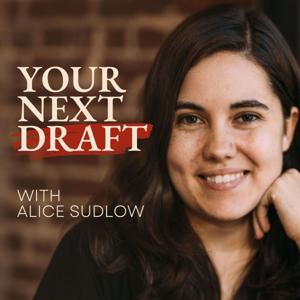
Developmental editor and book coach Alice Sudlow will be your companion through the mess and magic of revision. You’ll get inspired by interviews with authors, editors, and coaches sharing their revision processes; gain practical tips from Alice’s editing practice; and hear what real revision truly requires as Alice workshops scenes-in-progress with writers.
It’s all a quest to discover: How do you figure out what your story is truly about? How do you determine what form that story should take? And once you do, how do you shape the hundreds of thousands of words you've written into the story’s most refined and powerful form?
If you’ve written a draft—or three—but are still searching for your story’s untapped potential, this is the podcast for you. Together, let’s dig into the difficult and delightful work of editing your next draft.
38,735 Listeners
1,294 Listeners
1,007 Listeners
628 Listeners
251 Listeners
1,481 Listeners
114 Listeners
782 Listeners
432 Listeners

40 Listeners
34 Listeners

16 Listeners
21 Listeners
12,417 Listeners
15 Listeners