
Sign up to save your podcasts
Or



Show and tell your readers why time matters to your characters.
Time matters.
When you look up and it’s dark outside, time matters to you.
When your characters look around and summer is turning into fall, time matters to them.
When your readers are reading a novel and they can’t figure out how time is passing? Well, time matters to them, too—mostly because they’re confused.
In this episode, I’m sharing two ways to make time matter to your readers the way it matters to your characters.
That is, how to make time matter because it impacts your characters’ lives. (And not because your readers can’t get a grip on what’s happening in your story.)
You’ll learn:
Your readers want to understand why time matters to your characters. Show and tell them, and they’ll feel it passing just as your characters do.
Links mentioned in this episode:
Send me a Text Message!
Support the show
Rate, Review, & Follow on Apple Podcasts
"I love Alice and Your Next Draft." If that sounds like you, please consider rating and reviewing my show! This helps me support more writers through the mess—and joy—of the editing process. Click here, scroll to the bottom, tap the stars to rate, and select “Write a Review.” Then be sure to let me know what you loved most about the episode!
Loving the show? Show your support with a monthly contribution »
Don’t lose your readers. Just tell them what time it is.
The passage of time seems intuitive. It just happens, right? (Like, whether you want it to or not. Time and tide wait for no man, etc.)
Here’s the thing, though. If you don’t tell your readers that time is passing in your novel . . .
. . . they won’t know.
It seems wild, I know. It feels like time passing should be obvious. But I promise you, it’s not.
Luckily, conveying the passage of time to your readers is simple (and it doesn’t take a lot of words to do it!). And in this episode, I’ll tell you exactly how it’s done.
You’ll learn:
This is one of those elements of storytelling that feels tiny, inconsequential, like your readers will catch on without you needing to think too hard about it.
But trust me, it makes a big difference. I’ve read so many manuscripts that are missing any indicators of time passing. And they make me as a reader feel completely lost.
Don’t lose your readers. Just tell them what time it is.
Links mentioned in the episode:
Send me a Text Message!
Support the show
Rate, Review, & Follow on Apple Podcasts
"I love Alice and Your Next Draft." If that sounds like you, please consider rating and reviewing my show! This helps me support more writers through the mess—and joy—of the editing process. Click here, scroll to the bottom, tap the stars to rate, and select “Write a Review.” Then be sure to let me know what you loved most about the episode!
Loving the show? Show your support with a monthly contribution »
This is often overlooked, but it’s essential for great stories.
How do you make time pass?
Well, when you’re living your regular life in the real world, you don’t have to do anything.
Time is constantly passing, no matter what you do. And when a timer goes off, or you look outside and see the sun’s gone down, or you feel your stomach growl with hunger, you notice time has passed.
You hardly have to think about it. It’s just happening, all around you, all the time.
In your novel, though—well, there, you are responsible for charting the passage of time. You are the filter who determines how time passes.
More than that, you are responsible for telling your readers how much time is going by.
It’s an essential part of storytelling, and yet it’s often overlooked. So in this episode, we’re talking about time.
You’ll learn:
I’ve read so many manuscripts where I lose track of time and have to ask the writer, “Wait, when does this happen?” Check out this episode and save yourself from this common oversight.
Send me a Text Message!
Support the show
Rate, Review, & Follow on Apple Podcasts
"I love Alice and Your Next Draft." If that sounds like you, please consider rating and reviewing my show! This helps me support more writers through the mess—and joy—of the editing process. Click here, scroll to the bottom, tap the stars to rate, and select “Write a Review.” Then be sure to let me know what you loved most about the episode!
Loving the show? Show your support with a monthly contribution »
Write your best stories—and know when to let go and publish them.
In order to write great books, you first have to learn how to write great books.
But when it comes to writing, there’s always something more to learn.
So how do you know when to practice your writing skills—and more importantly, when to publish the stories you’re creating?
That’s what I’m talking about in this episode.
In it, you’ll learn:
So are you practicing or publishing? There’s no right or wrong answer. It’s just a question of which approach is best for you, right now.
Check out the episode and find out!
Links mentioned in the episode:
Send me a Text Message!
Support the show
Rate, Review, & Follow on Apple Podcasts
"I love Alice and Your Next Draft." If that sounds like you, please consider rating and reviewing my show! This helps me support more writers through the mess—and joy—of the editing process. Click here, scroll to the bottom, tap the stars to rate, and select “Write a Review.” Then be sure to let me know what you loved most about the episode!
Loving the show? Show your support with a monthly contribution »
Before you can master writing great stories, you have to learn to craft great stories.
When I was fifteen, I got my learner’s permit and began learning how to drive a car.
This made me very unhappy.
See, I wanted to know how to drive a car. I didn’t want to learn to drive a car.
Knowing how to drive a car was fun, freeing, and exciting. Learning to drive a car was dangerous, tedious, dangerous, difficult, and also dangerous.
Writers, I find, feel the same way about writing great books.
Writers want to write great books. They don’t want to learn how to write great books.
The stakes aren’t life or death. But the sentiment is the same.
And just like fifteen-year-old me, writers face an uncomfortable truth:
You can’t skip the learning stage of skill development. If you want to write great books, you have to spend time learning to write great books.
In this episode, I’m digging into what it really takes to learn the skill of writing great books—and how to know when you’ve mastered it.
You’ll learn:
The amazing book you want to craft is on the other side of the learning stage.
Check out the episode and build the skills that empower you to write it.
Send me a Text Message!
Support the show
Rate, Review, & Follow on Apple Podcasts
"I love Alice and Your Next Draft." If that sounds like you, please consider rating and reviewing my show! This helps me support more writers through the mess—and joy—of the editing process. Click here, scroll to the bottom, tap the stars to rate, and select “Write a Review.” Then be sure to let me know what you loved most about the episode!
Loving the show? Show your support with a monthly contribution »
Because working with an editor should be delightful, not scary.
Let's be honest. When you start working with an editor for the first time, it can feel a little scary.
You’re sharing your manuscript, the project you’ve worked so hard on, with a stranger on the internet. You’re inviting another person into a process that up until now has been entirely solo.
And you’re entering an industry of professionals that’s probably entirely new to you. What should you expect? And what’s expected of you?
In this episode, I’m demystifying what it’s like to work with an editor. I’m sharing four tips to help you make the most of your time with your editor—even (or especially!) if you’ve never worked with an editor before.
You’ll learn:
Your work with your developmental editor can be one of the most rewarding creative partnerships you’ll ever experience. That may sound hyperbolic, but it’s 100% true.
The first step is simply knowing what to expect. And that’s what you’ll learn in this episode.
Links mentioned in the episode:
Send me a Text Message!
Support the show
Rate, Review, & Follow on Apple Podcasts
"I love Alice and Your Next Draft." If that sounds like you, please consider rating and reviewing my show! This helps me support more writers through the mess—and joy—of the editing process. Click here, scroll to the bottom, tap the stars to rate, and select “Write a Review.” Then be sure to let me know what you loved most about the episode!
Loving the show? Show your support with a monthly contribution »
What you need to know BEFORE you start working with an editor—and how to tell if they’re the right fit for your novel.
Working with a developmental editor can be the most rewarding part of your editing process.
But if you’ve never worked with an editor before, it can also be . . . intimidating. Confusing. Scary.
After all, you’ve got to hand your manuscript that you’ve worked so hard on to a stranger on the internet and hope their feedback will be helpful and not soul-crushing.
If you’ve ever wondered how to find the right editor for your book—
—or maybe you’ve worked with an editor before, and it wasn’t a great experience—
—then this episode is for you. In it, I’m sharing my top tips to find the right editor for your novel.
You’ll learn:
When you find the right editor for your book, the developmental editing process can be so incredibly rewarding. My coaching clients often tell me that the hour we spend together on calls is their favorite hour of the week.
But if you don’t know how any of this works, you might feel a little lost. So let’s make it a little clearer and easier, shall we?
And if you’d like to see if I’m the right editor for your novel, let’s talk!
Go here to check out my manuscript wishlist and see whether I’m a good fit for your
story.
And go here to reach out and tell me about your book!
Links mentioned in the episode:
Send me a Text Message!
Support the show
Rate, Review, & Follow on Apple Podcasts
"I love Alice and Your Next Draft." If that sounds like you, please consider rating and reviewing my show! This helps me support more writers through the mess—and joy—of the editing process. Click here, scroll to the bottom, tap the stars to rate, and select “Write a Review.” Then be sure to let me know what you loved most about the episode!
Loving the show? Show your support with a monthly contribution »
What we get wrong about creativity—and the truth that will make your writing and editing so much more effective.
Do you know how great stories work?
Scratch that. Let’s start with an easier question. Do you know how your stories work?
Not all writers do. Even published authors often struggle to articulate how they created the books their readers love. They rely on intuition, following gut feelings to shape their stories.
But while your intuition can guide you to create a commercially successful novel . . .
. . . I believe there’s a better way. An easier way. A less confusing and chaotic, more reliable and repeatable way.
And that’s what this episode is all about.
In it, you’ll learn:
Your intuition is a powerful storytelling tool. But it’s not your only tool.
And in this episode, I’ll show you why that’s such wonderful news.
Links mentioned in the episode:
P.S. What do you get when an editor and a nuclear physicist walk into a swing dance? Powerful truths about jazz music and storytelling, it turns out. Check out the episode to see what I mean.
Send me a Text Message!
Support the show
Rate, Review, & Follow on Apple Podcasts
"I love Alice and Your Next Draft." If that sounds like you, please consider rating and reviewing my show! This helps me support more writers through the mess—and joy—of the editing process. Click here, scroll to the bottom, tap the stars to rate, and select “Write a Review.” Then be sure to let me know what you loved most about the episode!
Loving the show? Show your support with a monthly contribution »
Why group coaching might be the perfect way to get feedback on your writing.
When I was first getting started, I pictured editing like this:
A writer writes a manuscript and sends it to their editor. The editor writes feedback and sends it back. The writer takes that feedback and uses it to edit their manuscript.
That’s the classic form of editing. But it’s far from the only form of editing.
Editing doesn’t even have to be one-on-one. In fact, sometimes group coaching can be exactly what you need!
In this episode, I’m breaking down the pros and cons of group coaching for writers.
You’ll learn:
Group coaching isn’t better than one-on-one editing, or vice versa. It’s just different—a different experience that can meet different needs in your writing in a different way.
In fact, you might decide to try both group and one-on-one editing at different points in your writing career. So it’s great to know what your options are!
Links mentioned in the episode:
Send me a Text Message!
Support the show
Rate, Review, & Follow on Apple Podcasts
"I love Alice and Your Next Draft." If that sounds like you, please consider rating and reviewing my show! This helps me support more writers through the mess—and joy—of the editing process. Click here, scroll to the bottom, tap the stars to rate, and select “Write a Review.” Then be sure to let me know what you loved most about the episode!
Loving the show? Show your support with a monthly contribution »
The simple editing process to turn your messy first draft into a second draft you love.
“I’ve written first drafts before, but I’ve never edited a second draft. How do you actually do it?”
A writer asked me this a few days ago. And they’re not alone—it’s a question I hear a lot.
How do you actually edit a novel? Is there a process? A system? A strategy? Something, anything, to guide you after you finish the first draft?
Yes. Yes, there’s a process to edit a novel.
Better yet, it’s a simple process. (That doesn’t mean it’s easy—don’t get those confused. But it’s not complicated.)
And in this episode, I’ll walk you through this process step by step.
You’ll learn:
If you’ve ever felt lost, confused, daunted, or completely overwhelmed by the very idea of editing your novel—
—or if you’ve been editing, but you can’t tell whether you’re making progress or just spinning your wheels—
—then this episode is for you.
Links mentioned in the episode:
Send me a Text Message!
Support the show
Rate, Review, & Follow on Apple Podcasts
"I love Alice and Your Next Draft." If that sounds like you, please consider rating and reviewing my show! This helps me support more writers through the mess—and joy—of the editing process. Click here, scroll to the bottom, tap the stars to rate, and select “Write a Review.” Then be sure to let me know what you loved most about the episode!
Loving the show? Show your support with a monthly contribution »
From the publisher's feed
Supporting fiction writers doing the hard work of revising unputdownable novels. The novel editing process is the creative crucible where you discover the story you truly want to tell—and it can…
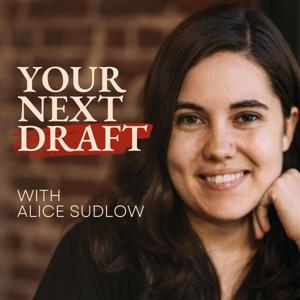
Developmental editor and book coach Alice Sudlow will be your companion through the mess and magic of revision. You’ll get inspired by interviews with authors, editors, and coaches sharing their revision processes; gain practical tips from Alice’s editing practice; and hear what real revision truly requires as Alice workshops scenes-in-progress with writers.
It’s all a quest to discover: How do you figure out what your story is truly about? How do you determine what form that story should take? And once you do, how do you shape the hundreds of thousands of words you've written into the story’s most refined and powerful form?
If you’ve written a draft—or three—but are still searching for your story’s untapped potential, this is the podcast for you. Together, let’s dig into the difficult and delightful work of editing your next draft.

38,654 Listeners
1,296 Listeners
1,007 Listeners
627 Listeners
251 Listeners
1,479 Listeners
114 Listeners
782 Listeners
430 Listeners
40 Listeners
32 Listeners

17 Listeners
21 Listeners

12,521 Listeners
15 Listeners