
Sign up to save your podcasts
Or

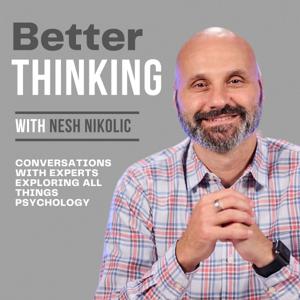

In this episode of Better Thinking, Nesh Nikolic speaks with Associate Professor Jacqueline Anderson about the long-term impact of traumatic brain injuries and how they affect cognition, identity, and daily life.
Jacqueline Anderson, PhD, is an Associate Professor in Clinical Neuropsychology in the Melbourne School of Psychological Sciences. She is also the Convenor of the School’s flagship postgraduate training program in Clinical Neuropsychology. As well as undertaking research in the area of clinical neuropsychology, she has more 25 years of experience working as a Clinical Neuropsychologist in both the public and private health sectors; for most of this time she has also provided training to postgraduate clinical neuropsychology students. Clinical work roles have primarily been in acute tertiary referral public hospitals, but have also included roles in rehabilitation settings; she has worked in private practice for many years, including undertaking medico-legal work.
A/Prof. Anderson’s research program specialises in abnormal cognitive functioning. She and her lab members use a combination of clinical and laboratory-based tools to investigate adult patient populations with neuropsychological disorders. Her research interests primarily relate to outcome after mild traumatic brain injury (mTBI) in community-based adults. In particular, she is focused on investigating the neuropsychological (cognitive, behavioural, psychological) and neuropathological aetiologies of individual patient variation in outcome after mTBI as well as developing interventions for individuals who experience poor recovery. She has a further specific interest in abnormalities of attention and memory, executive function and subcortical cognitive networks in the context of neuropsychological disorders.
 View all episodes
 By Nesh Nikolic

4.9
77 ratings
In this episode of Better Thinking, Nesh Nikolic speaks with Associate Professor Jacqueline Anderson about the long-term impact of traumatic brain injuries and how they affect cognition, identity, and daily life.
Jacqueline Anderson, PhD, is an Associate Professor in Clinical Neuropsychology in the Melbourne School of Psychological Sciences. She is also the Convenor of the School’s flagship postgraduate training program in Clinical Neuropsychology. As well as undertaking research in the area of clinical neuropsychology, she has more 25 years of experience working as a Clinical Neuropsychologist in both the public and private health sectors; for most of this time she has also provided training to postgraduate clinical neuropsychology students. Clinical work roles have primarily been in acute tertiary referral public hospitals, but have also included roles in rehabilitation settings; she has worked in private practice for many years, including undertaking medico-legal work.
A/Prof. Anderson’s research program specialises in abnormal cognitive functioning. She and her lab members use a combination of clinical and laboratory-based tools to investigate adult patient populations with neuropsychological disorders. Her research interests primarily relate to outcome after mild traumatic brain injury (mTBI) in community-based adults. In particular, she is focused on investigating the neuropsychological (cognitive, behavioural, psychological) and neuropathological aetiologies of individual patient variation in outcome after mTBI as well as developing interventions for individuals who experience poor recovery. She has a further specific interest in abnormalities of attention and memory, executive function and subcortical cognitive networks in the context of neuropsychological disorders.

2,529 Listeners

1,389 Listeners

133 Listeners

570 Listeners

323 Listeners

8,748 Listeners

1,345 Listeners

11,994 Listeners

4,045 Listeners

27,775 Listeners

335 Listeners

29,207 Listeners

11 Listeners

805 Listeners
118 Listeners