
Sign up to save your podcasts
Or

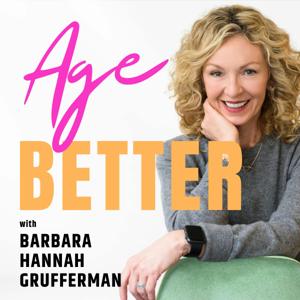
By Barbara Hannah Grufferman


4.8
3939 ratings


The podcast currently has 215 episodes available.
The most played episodes among Podcast App listeners.
"A wrist fracture is a marker of increased risk for a hip fracture later in life. I tell women: that is a wake-up call. Don't wait until you're 65 to have your bone density checked." — Dr. Jocelyn Wittstein KEY LINKS Subscribe to Age Better Cheat Sheet newsletter on Substack — where I go deep into the research behind every episode – HERE Learn more about Dr. Wittstein's book, The Complete Bone and Joint Health Plan HERE Follow Dr. Jocelyn Wittstein on Instagram HERE Get more info about the Bone Health & Osteoporosis Foundation HERE ABOUT THIS EPISODE I'm replaying my conversation with Dr. Jocelyn Wittstein — orthopedic surgeon and sports medicine specialist at Duke University and author of The Complete Bone and Joint Health Plan — because since it first aired, I've received more questions about bone density, joint pain, and osteoporosis than about any other topic. This episode answers them. WHAT YOU'LL LEARN Why bone loss accelerates after menopause — and why it's never too late to build bone, at any age The landmark LIFTMORE trial: how women in their 60s and beyond gained bone density in just eight months of heavy lifting How heavy is "heavy"? The difference between lifting that builds bone and lifting that doesn't Can you jump if you have arthritis? Dr. Wittstein's surprising answer — plus her simple swelling rule What your DEXA scan may be missing, and the one add-on test to ask about The truth about calcium: why spinach doesn't count, and the best non-dairy sources Prunes, vitamin K, magnesium — which supplements and foods have real evidence behind them Why a wrist fracture in your 50s or 60s is an early warning sign you should never ignore Dr. Wittstein's top three daily habits for stronger bones and joints after 60 Aging isn't the problem. Losing strength is — and that's something you can change. Follow AGE BETTER so you never miss an episode. Would rather watch than listen? Episodes can be found on the Barbara Hannah Grufferman YouTube channel (Playlist: AGE BETTER) by clicking HERE.

“One of the biggest mistakes I’ve made is overvaluing status and undervaluing purpose. And as I get older, I hope to switch that out.” — Maggie Rowe KEY LINKS Lisen to ‘50 Words for Snow’ podcast HERE Learn more about Maggie Rowe HERE Read AGE BETTER CHEAT SHEET newsletter HERE What if some of the problem with aging is simply that we don’t have good enough words for it? English gives us elderly, senior, over the hill, anti-aging—and the particularly maddening “you look good for your age.” But in other languages, there are words that describe growing older very differently: as ripening, accumulating wisdom and experience, becoming more grounded, letting go of old burdens, and approaching life with renewed curiosity and wonder. My guest today is writer and performer Maggie Rowe, co-host of the fascinating podcast 50 Words for Snow, which explores words from other languages that have no direct English equivalent. Maggie introduces me to words and ideas I wish we had been using all along—including a Japanese concept that compares aging to ripening and becoming more complex and layered with time, another that describes the treasure trove of experience we accumulate through life, and shoshin, or “beginner’s mind”: the ability to approach life with curiosity instead of assuming we already know everything. We also have some fun deciding which aging words deserve to be retired forever. But the deeper question is one worth thinking about: Do the words we use merely describe aging—or do they influence what we expect aging to be? Because if the language surrounding getting older is mostly about decline and loss, it’s easy to start believing that story. What happens when we replace some of those words with ones that recognize what can actually increase with age—perspective, freedom, purpose, curiosity, self-knowledge and the ability to appreciate our lives? This conversation may make you think differently about the words you use to describe yourself—and this stage of your life. Listen to this episode and then tell me: What word would YOU choose to describe growing older? Send me your word at [email protected] or share it with me on social media. And if this episode made you think, please follow AGE BETTER, leave a rating or review, and share it with a friend.Those small actions make a huge difference in helping more women discover the show. And don’t forget to sign up for the AGE BETTER CHEAT SHEET for more of the ideas, research and practical strategies that can help all of us age better.
“For vaginal estrogen . . . there’s no window of timing. If you’re 80 years old and your body has not seen estrogen in 30 years, you can still start local vaginal estrogen. It’s not too late. You can start.” — Dr. Margaret Nachtigall We talk a lot about protecting our hearts, our brains, and our bones as we get older. But what about vaginal health? In this episode of AGE BETTER, Dr. Margaret Nachtigall joins me to talk about what really happens to the vagina and urinary tract after menopause — and, more importantly, what we can do about it. We cover vaginal dryness, burning and discomfort; why urinary urgency and recurrent UTIs can be connected to menopause; when symptoms are normal and when they’re a red flag; and the treatments that can make a real difference. Dr. Margaret explains the role of local vaginal estrogen, hyaluronic acid, moisturizers and lubricants, pelvic floor physical therapy, and other options — including what women with a history of breast cancer should discuss with their medical team. We also talk about sex after 60, STI protection with a new partner, pelvic exams as we age, and one message I especially want women to hear: you do not have to simply accept vaginal discomfort as part of getting older. There are treatments, and it is never too late to ask for help. If you’re in your 60s, 70s or beyond — or care about someone who is — this is an important conversation to hear and share. Listen now, and then talk with your healthcare provider about what makes sense for you. Are you loving AGE BETTER? Consider subscribing and following wherever you tune in. Check out AGE BETTER CHEAT SHEET newsletter on Substack. See you next week!
“Your doctor can be the expert on the medicine. But you are still the expert on the life you’re trying to protect.” – Barbara Hannah Grufferman KEY LINKS The original study in PLOS One is HERE AGE BETTER CHEAT SHEET on Substack is HERE What do we really want as we get older—more years, or better years? A fascinating new study of more than 6,000 adults over 50 asked people to make some surprisingly personal choices about aging, health, quality of life, independence, and who should have the final say when medical decisions need to be made. In this solo episode, I unpack the findings that caught my attention most—especially what women said about quality of life versus simply living longer, why what our bodies can do becomes increasingly important as we age, and why maintaining a voice in our own healthcare matters. I also share the experience that fundamentally changed the way I think about physical function and independence: watching my mother’s world become smaller after a hip fracture. You’ll come away with a different way to think about longevity—not simply as adding years, but as protecting your ability to live the life you want for as long as possible. And I’ll give you one question to ask yourself that can help clarify what you’re really trying to protect as you get older. If this episode makes you think, share it with another woman and ask her: What is the one thing you most want to protect as you get older? And please follow AGE BETTER with Barbara Hannah Grufferman on Apple Podcasts, Spotify, or wherever you listen. It’s one of the easiest ways to help more women find the show.
"Our own personal longevity is only 25% genetic. So the other 75% are in our control." — Michael Clinton KEY LINKS Learn more about “Longevity Nation: The People, Ideas, and Trends Changing the Second Half of Our Lives” HERE Michael Clinton's Roar Forward, including the Reimagineers stories and free monthly newsletter is HERE Connect with Michael Clinton on LinkedIn HERE Read Age Better Cheat Sheet on Substack HERE Barbara’s Website is HERE ABOUT THIS EPISODE Michael Clinton ran Hearst Magazines. Then he left, wrote ROAR, built a company, and ran a marathon on every continent — most of it after 60. For his new book – Longevity Nation -- he interviewed more than 70 experts. Not just doctors. Technologists, urban planners, dermatologists, wealth strategists. What came back was a single, connected picture of what it actually takes to live a long life well — and it is far more in your hands than you have been led to believe. Here's what you'll take away: Life layering. Why the old sequence — school, work, retire — is obsolete, and how to build a second set of identities in your 50s, 60s, and beyond. The 57-year-old with the kids gone and the job gone is at a beginning, not an end. Proof it's never late. A woman took her first welding class at 70 and launched a business at 81. A veterinarian started school at 56. Baby steps, not overhauls. Michael's exact instruction for starting anything new — and why nobody solves this in a weekend. The money conversation nobody has. The one question to ask your bank that tells you whether your money outlives you. Plus a statistic about women and their finances that will make you sit up. Loneliness and frailty. Why your world quietly shrinks, how that becomes a physical problem, and the single habit every expert on this show agrees on. What's actually here now. Wearables, early-detection testing, GLP-1s beyond weight loss, and precision medicine built around your biology, not the average. And one thing to do this week. Just one. You'll know it when you hear it. You can't control getting older . . . but you can control how you do it.
The podcast currently has 215 episodes available.
1,085 Listeners
448 Listeners
1,157 Listeners
2,018 Listeners
422 Listeners
2,619 Listeners
4,874 Listeners
3,456 Listeners

9,182 Listeners
1,820 Listeners
132 Listeners
617 Listeners
1,140 Listeners
112 Listeners
1,214 Listeners