
Sign up to save your podcasts
Or

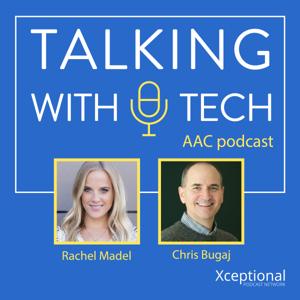

This week on TWT, we present part 2 of Chris’s interviews from ATIA! Before the interviews, Chris shares even more stories from ATIA. There were two “smackdown” sessions which focus on sharing strategies. biy.ly/appsmack20 gives you links to all of the apps at the App Smackdown, and bit.ly/pdsmackdown20 links to all the strategies discussed at the Professional Development Smackdown. Chris also shares about the AAC Certification town hall, poster sessions on AAC camps, using robots to teach language, updates to the AAC Agreements ranking the evidence behind them, and more!
Interviews this week:
🔑 Jeanna Antrim & Maggie Judson from BASSC share about their session on building capacity and supporting staff with implementation, strategies, and supports. Building capacity includes empowering families and increasing the AAC knowledge of educators and administrators. To build capacity, Jeanna and Maggie use the Power:AAC modules to create a learning community, hold monthly AT meetings with administrators, and host family AAC nights. Jeanna and maggie discuss the McNaughton et. al. (2019) article on building capacity, the Nate Network that connects AT specialists in Education, and other great resources!
🔑 Susan Todd & Laura Vaughan discuss why AAC assessment should not be a pass/fail test, but rather a dynamic assessment that occurs over a number of sessions. Family involvement should also be central to the assessment process whenever possible. They also discuss the Dietz et. al. (2012) article that describes seven aspects of AAC assessment for each assessment - Multi-Modal Approaches, Communicative Assessment, Symbol Assessment, Device Trials, Access Method, AAC Instruction, and Personalization. There is no hierarchy of mastery - it is a circle that changes for each individual.
🔑 Marlene Cummings shares about her presentation on breaking through barriers to AAC implementation utilizing the participation model from Beukelman & Mirenda. Barriers discussed include attitude, skill, practice, policy, and knowledge.
If you love Talking with Tech, help us develop new content and keep the podcast going! Support our podcast at patreon.com/talkingwithtech!
Visit bit.ly/twtpod for access to previous episodes, resources, and CEU credits that you can earn for listening to TWT episodes!
 View all episodes
 By Rachel Madel and Chris Bugaj

4.9
220220 ratings
This week on TWT, we present part 2 of Chris’s interviews from ATIA! Before the interviews, Chris shares even more stories from ATIA. There were two “smackdown” sessions which focus on sharing strategies. biy.ly/appsmack20 gives you links to all of the apps at the App Smackdown, and bit.ly/pdsmackdown20 links to all the strategies discussed at the Professional Development Smackdown. Chris also shares about the AAC Certification town hall, poster sessions on AAC camps, using robots to teach language, updates to the AAC Agreements ranking the evidence behind them, and more!
Interviews this week:
🔑 Jeanna Antrim & Maggie Judson from BASSC share about their session on building capacity and supporting staff with implementation, strategies, and supports. Building capacity includes empowering families and increasing the AAC knowledge of educators and administrators. To build capacity, Jeanna and Maggie use the Power:AAC modules to create a learning community, hold monthly AT meetings with administrators, and host family AAC nights. Jeanna and maggie discuss the McNaughton et. al. (2019) article on building capacity, the Nate Network that connects AT specialists in Education, and other great resources!
🔑 Susan Todd & Laura Vaughan discuss why AAC assessment should not be a pass/fail test, but rather a dynamic assessment that occurs over a number of sessions. Family involvement should also be central to the assessment process whenever possible. They also discuss the Dietz et. al. (2012) article that describes seven aspects of AAC assessment for each assessment - Multi-Modal Approaches, Communicative Assessment, Symbol Assessment, Device Trials, Access Method, AAC Instruction, and Personalization. There is no hierarchy of mastery - it is a circle that changes for each individual.
🔑 Marlene Cummings shares about her presentation on breaking through barriers to AAC implementation utilizing the participation model from Beukelman & Mirenda. Barriers discussed include attitude, skill, practice, policy, and knowledge.
If you love Talking with Tech, help us develop new content and keep the podcast going! Support our podcast at patreon.com/talkingwithtech!
Visit bit.ly/twtpod for access to previous episodes, resources, and CEU credits that you can earn for listening to TWT episodes!

21,790 Listeners

43,528 Listeners

12,237 Listeners
14,880 Listeners
69,540 Listeners

4,802 Listeners
428 Listeners
4,480 Listeners

3,461 Listeners

5,751 Listeners

12,794 Listeners

17,668 Listeners

11,157 Listeners

13,636 Listeners
3,581 Listeners