
Sign up to save your podcasts
Or



Based on Podcast App listening data
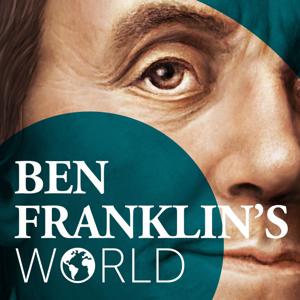
What in the first 40 years of his life made Benjamin Franklin the genius he became?
Benjamin Franklin serves as a great window on to the early American past because as a man of “variety” he pursued many interests: literature, poetry, science, business, philosophy, philanthropy, and politics.
But one aspect of Franklin’s life has gone largely unstudied: his childhood and early life.
Nick Bunker, author of Young Benjamin Franklin: The Birth of Ingenuity, joins us to explore Benjamin Franklin’s early life and how family, childhood, and youthful experiences shaped him as a scientist and diplomat.
Show Notes: https://www.benfranklinsworld.com/207
Sponsor Links
Complementary Episodes
Helpful Show Links
*Books purchased through this link will help support the production of Ben Franklin's World.
Learn more about your ad choices. Visit megaphone.fm/adchoices
Between 1500 and the 1860s, Europeans and Americans forcibly removed approximately 12 million African people from the African continent, transported them to the Americas, and enslaved them.
Why did Europeans and Americans enslave Africans? How did they justify their actions?
Katherine Gerbner, an Assistant Professor of History at the University of Minnesota and author of Christian Slavery: Conversion and Race in the Protestant Atlantic World, leads us on an exploration of ways Christianity influenced early ideas about slavery and its practice.
Show Notes: https://www.benfranklinsworld.com/206
Sponsor Links
Complementary Episodes
Helpful Show Links
*Books purchased through this link will help support the production of Ben Franklin's World.
Learn more about your ad choices. Visit megaphone.fm/adchoices
La Presidente? The Presidentess? The First Lady of the Land?
The Second Article of the United States Constitution defines the Executive Branch of the government, the powers it has, and the role of the chief executive, the President of the United States. But what about the position of the President’s spouse?
Jeanne Abrams, a Professor at the University Libraries and the Center for Judaic Studies at the University of Denver, joins us to explore the lives and work of the first First Ladies of the American Republic with details from her book, First Ladies of the Republic: Martha Washington, Abigail Adams, and Dolley Madison and the Creation of an Iconic American Role.
Show Notes: https://www.benfranklinsworld.com/205
Sponsor Links
Complementary Episodes
Helpful Show Links
*Books purchased through this link will help support the production of Ben Franklin's World.
Learn more about your ad choices. Visit megaphone.fm/adchoices
Aaron Burr: Revolutionary War hero, talented lawyer, Vice President, and Intriguer of treason?
Between 1805 and 1807, Aaron Burr supposedly intended to commit treason by dividing the American union. How did Americans learn about and respond to this treasonous intrigue?
James Lewis Jr., a Professor of History at Kalamazoo College and author of The Burr Conspiracy: Uncovering the Story of an Early American Crisis, guides us through what we know and don’t know about about Aaron Burr’s supposed plot to divide the American union.
Show Notes: https://www.benfranklinsworld.com/204
Sponsor Links
Complementary Episodes
Helpful Show Links
*Books purchased through this link will help support the production of Ben Franklin's World.
Learn more about your ad choices. Visit megaphone.fm/adchoices
Hamilton the Musical hit Broadway in August 2015 and since that time people all around the world have been learning about a man named Alexander Hamilton. Or, at least they’ve been learning about the musical’s character Alexander Hamilton.
But who was Alexander Hamilton as a real person?
Joanne Freeman, a Professor of History and American Studies at Yale University, and one of the foremost experts on the life of Alexander Hamilton, joins us to explore this large question so we can discover more about the man who helped to create the United States.
Show Notes: https://www.benfranklinsworld.com/203
Sponsor Links
Complementary Episodes
Helpful Show Links
Learn more about your ad choices. Visit megaphone.fm/adchoices
On September 17, 1787, a majority of the delegates to the Constitutional Convention approved the new form of government they had spent months drafting and submitted it to the 13 states for their ratification and approval.
On June 21, 1788, New Hampshire became the 9th state to ratify the Constitution, which prompted the transition to the government of the United States Constitution.
Matt Wasniewski, the Historian of the United States House of Representatives and Terrance Rucker, a Historical Publications Specialist in the Office of the Historian at the United States House of Representatives, lead us on an exploration of why and how the United States Constitution established a bicameral Congress and how and why the House of Representatives took the shape and form that it did during its early meetings.
Show Notes: https://www.benfranklinsworld.com/202
Sponsor Links
Complementary Episodes
Helpful Show Links
Learn more about your ad choices. Visit megaphone.fm/adchoices
What kind of character should Americans have? Is it possible to create a shared sense of national character and identity that all Americans can subscribe to?
Americans grappled with many questions about what it meant to be an American and a citizen of the new republic after the American Revolution. They grappled with these questions because the people who made up the new United States hailed from many different cultural and ethnic backgrounds. So they wondered: How do you unite the disparate peoples of the United States into one national people?
Catherine Kelly, author of Republic of Taste: Art, Politics, and Everyday Life in Early America, joins us to explore the world of art, politics, and taste in the early American republic and how that world contributed to the formation of American character and virtue.
Show Notes: https://www.benfranklinsworld.com/201
Sponsor Links
Complementary Episodes
Helpful Show Links
*Books purchased through this link will help support the production of Ben Franklin's World.
Learn more about your ad choices. Visit megaphone.fm/adchoices
What would you like to know about Early American History?
It turns out, you wanted to know about the establishment of schools, how the colonial postal service worked, and about aspects of health and hygiene in early America.
In this listener-inspired Q&A episode, we speak with Johann Neem, Joseph Adelman, and Ann Little to explore these aspects of early American history and to get answers to your questions about them.
Show Notes: https://www.benfranklinsworld.com/200
Sponsor Links
Complementary Episodes
Helpful Show Links
Learn more about your ad choices. Visit megaphone.fm/adchoices
When we explore the history of early America, we often look at people who lived in North America. But what about the people who lived and worked in European metropoles?
What about Native Americans?
We explore early American history through a slightly different lens, a lens that allows us to see interactions that occurred between Native American peoples and English men and women who lived in London.
Our guide for this exploration is Coll Thrush, an Associate Professor of History at the University of British Columbia, Vancouver and author of Indigenous London: Native Travelers at the Heart of the Empire.
This episode originally posted as Episode 132.
Show Notes: https://www.benfranklinsworld.com/199
Sponsor Links
Complementary Episodes
Helpful Show Links
*Books purchased through this link will help support the production of Ben Franklin's World.
Learn more about your ad choices. Visit megaphone.fm/adchoices
When we think of Native Americans, many of us think of inland dwellers. People adept at navigating forests and rivers and the skilled hunters and horsemen who lived and hunted on the American Plains.
But did you know that Native Americans were seafaring mariners too?
Andrew Lipman, an Assistant Professor of History at Barnard College, Columbia University and author of The Saltwater Frontier: Indians and the Contest for the American Coast, leads us on an exploration of the northeastern coastline and of the Native American and European peoples who lived there during the seventeenth century.
This episode originally posted as Episode 104.
Show Notes: https://www.benfranklinsworld.com/198
Sponsor Links
Complementary Episodes
Helpful Show Links
*Books purchased through this link will help support the production of Ben Franklin's World.
Learn more about your ad choices. Visit megaphone.fm/adchoices
From the publisher's feed
Ranked by our users in the last 21 days

1,247 Listeners
1,148 Listeners
1,786 Listeners

1,678 Listeners
3,804 Listeners

742 Listeners
1,502 Listeners

784 Listeners

549 Listeners
3,998 Listeners
6,175 Listeners
520 Listeners
881 Listeners

19,155 Listeners
1,034 Listeners

448 Listeners
334 Listeners

135 Listeners

1,674 Listeners

657 Listeners
6 Listeners
3,378 Listeners
928 Listeners
1,893 Listeners

383 Listeners

1,599 Listeners

39 Listeners

51 Listeners
234 Listeners

261 Listeners
69 Listeners

13 Listeners