
Sign up to save your podcasts
Or

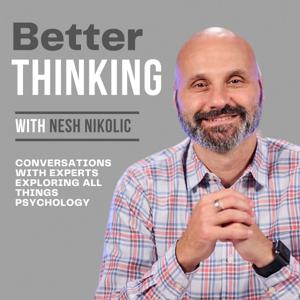


In this episode of Better Thinking, Nesh Nikolic speaks with Richard Hill and Matthew Dahlitz about their new book, The Practitioner's Guide to the Science of Psychotherapy.
Richard Hill, MA, MEd, MBMSc, DPC, has emerged from a diverse and fascinating journey to become an innovative speaker on the mind, brain and the human condition. From an early career in the creative arts, Richard returned to intellectual studies at 42 (1996) beginning with a Bachelor of Arts majoring in linguistics. This triggered a curiosity that led to a diploma in counselling and a new career in psychotherapy.
Studying continued and he has added three Masters degrees – an MA in Social Ecology; an MEd in Social Ecology; and a Masters in Brain and Mind Sciences (MBMSc) from Sydney University. Richard is also fortunate to be mentored by the esteemed Ernest Rossi PhD who has invited Richard into the International Psychosocial Genomics Research Team to study the impact of therapeutic practice on the genetic level.
Matthew Dahlitz is both university trained and an autodidactic, whose knowledge spans across the arts, technology, psychology, neuroscience, emergency medicine, and business. Studied psychology at the University of Queensland and gained a Master of Counselling postgraduate degree – now a specialist in neuropsychotherapy and the Editor-in-Chief of The Neuropsychotherapist, has taught post-graduate courses in neuropsychotherapy, and is author of the book The Psychotherapists’s Essential Guide to the Brain.
Matthew, like Richard, has a musical bent, having studied at the Queensland Conservatorium of Music in both music technology and master of composition – having scored for film and produced a number of albums of original music he has also been a producer in a film production company. Matthew has also been an Advanced Care Paramedic for a decade, managed commercial property and property development projects in the tens of millions of dollars, is the Editor-in-Chief of the technology magazine Age of Robots, covering the technology and the social and psychological impacts of this second machine age, and runs a media and publishing company with an emphasis on cutting edge science and technology. Matt’s life is rather full!
Episode link at https://neshnikolic.com/podcast/richard-hill-matt-dahlitz
See omnystudio.com/listener for privacy information.
In this episode of Better Thinking, Nesh Nikolic speaks with Professor Kenneth Pakenham about the processes that foster personal growth in the context of health adversities and the power of embracing inner pain.
Kenneth Pakenham, PhD, is an Emeritus Professor of clinical and health psychology in the School of Psychology at The University of Queensland, Australia. His research and clinical practice in psychology spans 40 years.
Inspired by the resilience of some people with serious illnesses, he has committed much of his career to investigating the processes that foster personal growth in the context of health adversities, and to translating his findings into interventions that help people live fully with illness. This passion has driven his empirical, theoretical and translational research, curriculum development, and clinical training and supervision.
Importantly, his work has included not only the person with chronic illness, but also his or her network, particularly the carer. Through his 160+ publications, over 70 conference presentations, 3 research awards, and more than 3 million dollars of competitive grant funding, he has become a leader in the application of positive health frameworks to several chronic illnesses, and to caregiving in these contexts. His research has helped to inform government policies, particularly those related to carers, and establish interventions and assessment protocols within government and community services.
The "living fully with illness" theme integrates his early research in stress/coping theory, his mid-career shift to incorporate the rise of positive psychology, and his current and future focus on Acceptance and Commitment Therapy (ACT). Using ACT to extend his research on living fully with illness has also invigorated his teaching. He developed the first ACT university course in Australia. This course integrates training in therapist competencies and self-care skills and shows published empirical evidence of fostering competent and resilient clinicians.
Episode link at https://neshnikolic.com/podcast/kenneth-pakenham
See omnystudio.com/listener for privacy information.
In this episode of Better Thinking, Nesh Nikolic speaks with Virginia Slaughter about the controversial topic of whether newborns have the ability to imitate.
Virginia Slaughter is Professor of Psychology at the University of Queensland, Australia, where she founded the Early Cognitive Development Centre.
Her research focuses on social and cognitive development in infants and young children, with particular emphasis on social behaviour in infancy, theory-of-mind development and the acquisition of peer interaction skills. She is a Fellow of the Academy of the Social Sciences in Australia and a Fellow of the Association for Psychological Science.
Episode link at https://neshnikolic.com/podcast/virginia-slaughter
See omnystudio.com/listener for privacy information.
In this episode of Better Thinking, Nesh Nikolic speaks with Winnifred R. Louis about ways on how to create a successful activism campaign.
Winnifred R. Louis is a Professor in the School of Psychology at the University of Queensland. Her research interests focus on the influence of identity and norms on social decision-making.
She has studied this broad topic in contexts from politics and community activism to health and environmental choices. She is a Fellow of the Society for the Psychological Study of Social Issues, a Fellow of the Society for Personality and Social Psychology, and a Fellow of the Australian Psychological Society.
Winnifred has served or is serving on the editorial board of journals including Peace and Conflict: The Journal of Peace Psychology, the Journal of Personality and Social Psychology, Journal of Social and Political Psychology, and Behavioral Sciences of Terrorism and Political Aggression.
She is a member of numerous professional associations including the Centre for Research in Social Psychology, at the University of Queensland; the Association for Psychological Science; the Society for Personality and Social Psychology; and the Society for Australasian Social Psychology.
Episode link at https://neshnikolic.com/podcast/winnifred-louis
See omnystudio.com/listener for privacy information.
In this episode of Better Thinking, Nesh Nikolic speaks with Dr Eli Kotler about the use of psychedelics as a therapeutic aid to trauma and addiction.
Dr Eli Kotler is a consultant psychiatrist, holds an academic position at Monash University through the Alfred Psychiatry Research Centre, and is the medical director of Malvern Private Hospital, the first addiction hospital in Australia. He is a member of the Australasian Professional Society on Alcohol and other Drugs (APSAD). Clinically, Eli is interested in the deep connections between trauma and addiction and works within a neuro-psychoanalytic framework.
Dr Eli has overseen the development of a clinical program for addictions focused on trauma, particularly developmental trauma. This has led to an interest in medication-assisted trauma therapy. Eli worked for many years researching neurodegenerative diseases and was the principle investigator on numerous trials for novel therapeutics. He is founding member of the Melbourne Neuropsychoanalytic Group and welcomes new members. Through involvement with Monash University, Eli oversees the addiction rotation for medical students.
Dr Eli graduated from the first intake of the Certificate in Psychedelic-Assisted Therapies (CPAT) in June 2021. He has also been recently appointed as the Principal Investigator to lead Emyria’s upcoming MDMA trial.
Episode link at https://neshnikolic.com/podcast/eli-kotler
See omnystudio.com/listener for privacy information.
In this episode of Better Thinking, Nesh Nikolic speaks with Lyn Worsley about understanding, practicing, and developing resilience.
Lyn Worsley is the author and director of the Resilience Doughnut. As a clinical psychologist and registered nurse, her experience in a number of contexts such as hospitals, correctional facilities, child care, schools and allied health care services, informs her application of the model. She is a dynamic teacher and psychologist with a practical edge to her use of research and theory.
Training as well as therapy are key strengths for Lyn, working with over 200 schools, business, corporate and community organisations to build personal resilience, helping people to flourish and thrive.
Lyn is also the director of the Resilience Centre in Sydney Australia, which has a reputation for innovative solution-focused approaches to client change through individual and group therapies for over 21 years. At the Resilience Centre, Lyn supervises specialist psychologists, and coordinates community seminars, training workshops, and resilience groups for people of all ages.
Lyn has a dynamic style of relating and teaching across disciplines, and her teaching focus is on personal application to enhance learning. She is also the author of “The Resilience Doughnut Book – The Secret of Strong Kids” and “The Resilience Doughnut Book – The Secret of Strong Adults”.
Episode link at https://neshnikolic.com/podcast/lyn-worsley
See omnystudio.com/listener for privacy information.
In this episode of Better Thinking, Nesh Nikolic speaks with Dr Celin Gelgec about treating obsessive compulsive disorder and other related disorders including anxiety and depression.
Dr Celin Gelgec is a clinical psychologist and the director of Melbourne Wellbeing Group. She works with people affected by obsessive compulsive disorder (OCD), and other related disorders including anxiety (social anxiety, generalised anxiety, agoraphobia, health anxiety and panic disorder), and depression.
Her interest in OCD began in 2010 while undertaking the Clinical doctorate program at Deakin University. After her final placement with the OCD inpatient program at The Melbourne Clinic, she remained with the program for another four years. During this time, she honed her knowledge and skills and developed treatment programs using exposure and response prevention, acceptance and commitment therapy, dialectical behaviour therapy and cognitive behaviour therapy. While working concurrently in private practice at Melbourne Wellbeing Group, she expanded her experience to include virtual reality in treatment as well as conducting assessments for behavioural and educational purposes. In addition to conducting research into OCD’s impact on lives, Celin also supervises clinicians and students, runs lectures for university students, as well as professional workshops for psychologists, healthcare professionals and students regarding the assessment, diagnosis and treatment of OCD. Celin is also the author of a treatment manual she wrote called Treating OCD: A Clinician's Guide to Getting Unstuck.
Episode link at https://neshnikolic.com/podcast/celin-gelgec
See omnystudio.com/listener for privacy information.
In this episode of Better Thinking, Nesh Nikolic speaks with Joe Coyne about the Circle of Security Parenting Course and The Attachment Theory.
Joe Coyne has worked for 20 years in the area of child and family psychology. He is particularly interested in the developmental processes involved in healthy outcomes and the impacts of parenting and life events on personal trajectories.
In recent years he has been exploring the benefits of incorporating attachment theory and research into contemporary treatment approaches for parents, children and adults. Joe Coordinates the Master of Psychology (Educational and Developmental) at QUT and he is an Endorsed Clinical Psychologist and Endorsed Educational and Developmental Psychologist.
In the past he has worked in Health services delivering family and parenting interventions, and supervising clinical staff, and prior to that in a trauma focused family service. He is an accredited therapist and supervisor for the Circle of Security Intervention.
Episode link at https://neshnikolic.com/podcast/joe-coyne
See omnystudio.com/listener for privacy information.
In this episode of Better Thinking, Nesh Nikolic speaks with Joel Sardi about regaining the quality of life after spinal cord injury.
Joel Sardi had a fall and broke his C2 & C5, T3, T4 AND T5 vertebrae, also breaking his sternum on the 31st of August 2014. The injury caused irreparable spinal cord damage. He underwent a 6 hour surgery after the accident where the surgeons were able to stabilise his neck fractures and prevent any further spinal cord damage by inserting a titanium cage and fusing C4 to C6. Joel is classified as a “C-5'“ Quadriplegic.
The injury that night left Joel a C5 quadriplegic, meaning that there are still some messages getting through the spinal cord and the extent of his recovery is unknown. Joel is paralysed from the shoulders down, has no movement in his legs and his upper body can only activate his biceps, forearms and wrists.
With the injury originally occurring in Adelaide where Joel was working, he was brought to the Royal Adelaide Hospital where he stayed for 10 days, before being airlifted to Melbourne's Austin Hospital. He spent the next 12 months at The Royal Talbot Rehabilitation Hospital where he underwent extensive rehab sessions to further improve his skills and learn to adjust to life as a quadriplegic before moving home in August 2015.
Episode link at https://neshnikolic.com/podcast/joel-sardi
See omnystudio.com/listener for privacy information.
In this episode of Better Thinking, Nesh Nikolic speaks with Dr Louise Byrne about the lived experience workforce development, better access to mental health services, and all about mental health issues we have today.
Dr Louise Byrne is a Vice-Chancellor’s Senior Research Fellow at RMIT. Previously Louise was awarded a prestigious Fulbright Postdoctoral Scholarship and inaugural RMIT Fulbright fellowship, to conduct research on the Lived Experience mental health workforce in the United States. Louise’s Fulbright research was based at Yale University, where she holds an adjunct position.
Louise is recognised internationally as a thought leader in the area of Lived Experience mental health workforce development. Louise has over 30 journal publications on this topic and has been awarded several times for outstanding contributions to research and teaching, held expert/advisory roles with State and National Mental Health Commissions and led policy development at State and National levels, including the National Lived Experience (Peer) Workforce Development Guidelines.
Louise, is a translational researcher with deep knowledge of organisational issues relevant to Lived Experience employment. Louise specialises in highly inclusive engagement and collaboration with diverse stakeholders. Louise's work is informed and shaped by her on-going relationships with industry and a commitment to meaningful, timely and impactful research. Louise's own experiences of mental health diagnosis, service use and periods of healing, as well as working in a variety of Lived Experience roles, form the perspective from which she works.
Episode link at https://neshnikolic.com/podcast/louise-byrne
See omnystudio.com/listener for privacy information.
From the publisher's feed

2,512 Listeners
1,381 Listeners

124 Listeners

558 Listeners
325 Listeners

8,307 Listeners
1,347 Listeners

11,949 Listeners

4,064 Listeners

27,962 Listeners

386 Listeners

29,171 Listeners

11 Listeners

859 Listeners
117 Listeners