
Sign up to save your podcasts
Or

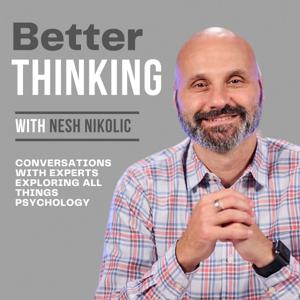


In this episode of Better Thinking, Nesh Nikolic speaks with Professor Stephen Hinshaw about his work on developmental psychopathology, clinical interventions with young people and addressing mental illness stigma in the community.
Stephen Hinshaw is Distinguished Professor of Psychology at the University of California, Berkeley, where he was Department Chair from 2004-2011. He is also Professor of Psychiatry and Behavioral Sciences at the University of California, San Francisco. He received his B.A. from Harvard (summa cum laude) and, after directing school programs and residential summer camps, his doctorate in clinical psychology from UCLA, before performing a post-doctoral fellowship at the Langley Porter Institute of UC San Francisco.
His work focuses on developmental psychopathology, clinical interventions with children and adolescents (particularly mechanisms underlying therapeutic change), and mental illness stigma. He has directed research programs and conducted clinical trials and longitudinal studies for boys and—more recently—for girls with inattention and impulse-control problems (who often express many comorbid disorders), having received over $20 million in NIH funding and an equal amount in foundation funding.
He has been Principal Investigator of the Berkeley site for the Multimodal Treatment Study of Children with ADHD (MTA) since 1992. He is co-director of the UCSF-UC Berkeley Schwab Dyslexia and Cognitive Diversity Center, and he directs the UCLA -UC Berkeley Awareness and Hope (stigma reduction) component of the UCLA Depression Grand Challenge. He is also co-director of the Child Teen and Family Center at the UCSF Department of Psychiatry and Behavioral Sciences.
Episode link at https://neshnikolic.com/podcast/stephen-hinshaw
See omnystudio.com/listener for privacy information.
In this episode of Better Thinking, Nesh Nikolic speaks with Dr Christopher Hunt about gambling addiction, gambling treatment, and clinical phenomena observed in gambling clients.
Dr Christopher John Hunt is the Senior Clinical Supervisor at the University of Sydney'sGambleAware clinics, which are responsible for co-ordinating government-funded gambling treatment throughout Central, Western and South-Western Sydney, operating out of the University's Brain and Mind Centre.
Dr Hunt first began work at the University in the then-titled Gambling Treatment Clinic in early 2007. Since then, he has gained wide recognition for his work with problem gamblers. He has published work on clinical phenomena observed in gambling clients, has been asked to testify before both federal and state parliamentary committees on gambling, has been extensively quoted on gambling in local, national and international media, and has written several pieces on gambling for lay audiences.
He is also responsible for co-ordinating clinical supervision to psychologists and counsellors who are working in the gambling field throughout Sydney ,and organises training seminars for mental health practitioners working in the field of problem gambling and information seminars for the general public.
Episode link at https://neshnikolic.com/podcast/christopher-hunt
See omnystudio.com/listener for privacy information.
In this episode of Better Thinking, Nesh Nikolic speaks with Alina Morawska about promoting positive family relationships as an early intervention tool to promote lifelong health and wellbeing.
Alina Morawska is the Deputy Director (Research) at the Parenting and Family Support Centre, The University of Queensland. Her research focuses on behavioural family intervention as a means for promoting positive family relationships, and the prevention and early intervention for young children at risk of developing behavioural and emotional problems.
In particular, her focus is on improving the health and overall wellbeing of children and families. She completed her PhD in Clinical Psychology at the University of Queensland in 2004, for which she received the Australian Psychological Society’s Excellent PhD Thesis in Psychology Award.
She has published extensively in the field of parenting and family intervention and has received numerous grants to support her research. She is a Director of the Australian Association for Cognitive and Behaviour Therapy Ltd.
Episode link at https://neshnikolic.com/podcast/alina-morawska
See omnystudio.com/listener for privacy information.
In this episode of Better Thinking, Nesh Nikolic speaks with Blake McKimmie about the influence of gender-based stereotypes and the influence of different modes of evidence presentation in jury decision-making.
Blake McKimmie joined the School of Psychology at UQ in 2007 having previously been a lecturer at Queensland University of Technology. Blake won a Faculty Teaching Excellence Award in 2010 and a University of Queensland Teaching Excellence Award in 2016. He led a team that won the AAUT Higher Education Teacher of the Year award in 2019, and received the edX Prize in 2018. He currently teaches a second year elective about psychology and law.
His research focuses on jury decision-making including the influence of gender-based stereotypes and the influence of different modes of evidence presentation. He is also interested in group membership and attitude-behaviour relations and how group membership influences thinking about the self.
He is a leading instructor of the award-winning course: CRIME101x and the PSYC1030x Introduction to Developmental, Social & Clinical Psychology XSeries Program of four courses on edX.org.
Episode link at https://neshnikolic.com/podcast/blake-mckimmie
See omnystudio.com/listener for privacy information.
In this episode of Better Thinking, Nesh Nikolic speaks with Fiona White about the development of effective strategies to promote equity, diversity, and inclusion.
Fiona White was awarded her PhD in 1997 by the University of Sydney. She is now a Professor of Social Psychology at the University of Sydney, and the Director of the Sydney University Psychology of Intergroup Relations (SUPIR) Lab. She is recognized internationally for advancing new and effective strategies such as cooperative contact, dual identity recategorization and perspective tacking to promote positive intergroup relations in the short- and long-term.
Across her career, Fiona has published over 90 peer-reviewed publications and her work has been cited over 4000 times. One of Fiona’s most significant research contributions has been the development of the E-contact intervention, a synchronous online tool that has been found to reduce anxiety, prejudice and stigma. E-contact has been shown to successfully improve intergroup relations between: Muslims and Christians in Australia; Protestants and Catholics in Northern Ireland; Turkish and Kurdish peoples; people who identify as homosexual vs heterosexual; people who identify as transgender vs cisgender; and mentally healthy people and people with schizophrenia.
In our technological age, and especially during a time of COVID-19 induced social distancing, Fiona’s E-contact interventions will play an increasingly significant role in advancing intergroup relations research, especially in situations where outgroup anxiety is high and/or there is continued physical intergroup separation. Her prejudice reduction research has a strong ‘intergroup’ focus, where the voices from both groups are encouraged to be expressed in an equal, cooperative interaction, that works toward achieving a common goal.
In recognition of her successes Fiona has received an Office of Learning and Teaching (OLT) Excellence Award and two Vice Chancellor’s awards for Excellence in Teaching and Mentoring. In acknowledgement of her impact on the field of intergroup relations, she accepted a funded invitation by the Society for Research in Child Development (SRCD) to Washington DC, as the Australian representative, alongside nine other world leading experts, to coauthor a State of the Science paper on intergroup relations (2020). In acknowledgement of her extensive 20-years of work in the field of racism reduction, Rotary invited Fiona to give the 2022 Royce Abbey Peace Oration which was titled ‘The many forms of peace and regeneration: Promoting a prejudice-free society for all’.
Episode link at https://neshnikolic.com/podcast/fiona-white
See omnystudio.com/listener for privacy information.
In this episode of Better Thinking, Nesh Nikolic speaks with Dr Frankie Fong about overimitation and the role of social learning in the development of scientific and religious beliefs and behaviours.
Dr Frankie Fong is a postdoctoral researcher in the School of Psychology at UQ. His research interests lie broadly in social learning and overimitation, with a particular focus on factors that modulate children's conformity vs eschewal of normative approaches.
Frankie is actively involved in cross-cultural research and has established a fieldsite for developmental psychology research in East Malaysia. His current research focuses on the role of social learning in the development of scientific and religious beliefs and behaviours. He is also developing a series of studies that compares children's learning and perception of information conveyed across different presentation mediums (e.g., digital-screens, books and in-person).
Episode link at https://neshnikolic.com/podcast/frankie-fong
See omnystudio.com/listener for privacy information.
In this episode of Better Thinking, Nesh Nikolic speaks with Renee Adair about End of Life Doulas and how their services provide support, options, and education assisting the needs of those who are facing death.
Renee Adair is the founder and director of the Australian Doula College, the Groundwork Program and the ADC’s charity-arm Doula Heart Network. She first began working with women and babies in 1994 as a massage and Aromatherapist and Reiki Practitioner and in 1998 after the home births of her two biological children she began studying and working as a Doula and Childbirth and Early Parenting Educator.
Renee then worked for the Australian Red Cross at a young women’s health program/refuge in Sydney’s East, setting up both the outreach and childbirth and early parenting education programs for that service.
Working In collaboration, Renee helped produce the first research on Doulas in Australia which was published in the Journal of Perinatal Education in 2013. She has spoken on a variety of radio programmes, at conferences and seminars and is a regular contributor for a range of publications, websites and podcasts.
Renee has worked to change the way we think about Doula support launching an End of Life Doula Training for the College in 2021 with a view for the wider community to see Doula support though a broader lens, supporting all major life transitions, not just in the birthing space.
In 2019 Renee proudly partnered with Charles Darwin University to co facilitate Accredited Doula training for Indigenous women in the remote First Nations community of Galiwin’ku. She now sits on the official Galiwin’ku steering committee to restore Birthing on Country. Renee has sat on the Consumer Advisory Board of the Australian College of Midwives, trained thousands of Doulas and supported hundreds of women, their partners and families through pregnancy, birth, early parenting and end of life over the course of her career.
A fierce advocate for human rights, the proud mother of three adult children and three grandkids, blends her life’s work, spending downtime with her family, friends and fur babies.
Episode link at https://neshnikolic.com/podcast/renee-adair
See omnystudio.com/listener for privacy information.
In this episode of Better Thinking, Nesh Nikolic speaks with Michael Duhig about medicinal cannabis trials and research for treating various symptoms in children.
Michael Duhig is an Educational and Developmental Psychologist who has completed post-graduate training in Psychology and Health Management. While completing his studies, Michael developed his clinical skills in government and non-government sectors specifically focused on Child and Youth Mental Health. Michael has experience in counselling children and adolescents experiencing a range of difficulties including anxiety, depression, emotional and behavioural regulation, trauma, and relationship issues.
Being heavily involved in sport and a former international rugby union player, Michael is able to weave physical activity into therapy to engage and benefit clients. Michael is also proficient in academic and cognitive assessments. When not practising clinically, Michael is the Clinical Research Manager for the Centre for Clinical Trials in Rare Neurodevelopmental Disorders (CCTRND) at the Queensland Children’s Hospital. Within this role Michael and the team work to provide novel therapies to clients with rare-genetic conditions.
Outside of these roles, Michael is regularly invited to guest lecture at UQ where he holds an adjunct appointment and also QUT. Michael’s research interests have led to publishing several articles related to Autism, childhood trauma and readmission to inpatient units. Michael is also a panel member of the Mental Health Scholarships Scheme for Allied Health Professionals and serves as the Chair of the APS College of Educational and Developmental Psychologists for Queensland.
Episode link at https://neshnikolic.com/podcast/michael-duhig
See omnystudio.com/listener for privacy information.
In this episode of Better Thinking, Nesh Nikolic speaks with Professor Alex Haslam about identity leadership and its implications in social and organisational settings.
Alex Haslam is Professor of Social and Organizational Psychology and Australian Laureate Fellow at the University of Queensland. His research focuses on the study of group and identity processes in organizational, social, and clinical contexts.
Together with colleagues, Alex has written and edited 15 books and published over 300 peer-reviewed articles on these topics. His most recent books are The New Psychology of Health: Unlocking the Social Cure (with Catherine Haslam, Jolanda Jetten, Tegan Cruwys and Genvieve Dingle, Routledge, 2018),The New Psychology of Leadership: Identity, Influence and Power (2nd Ed. with Stephen Reicher & Michael Platow, Psychology Press, 2020), and Social Psychology: Revisiting the Classic Studies (2nd Ed. with Joanne Smith, Sage, 2017).
Alex is a former Chief Editor of the European Journal of Social Psychology and currently Associate Editor of The Leadership Quarterly. In 2005 he won the European Association of Social Psychology's Kurt Lewin Medal for outstanding scientific contribution; in 2013 he won the International Leadership Association's Outstanding Leadership Book Award for The New Psychology of Leadership (with Steve Reicher and Michael Platow); in 2016 he won the British Psychology Society Presidents' Award for distinguished contributions to psychological knowledge; in 2017 he won the International Society for Political Psychology's Sanford Prize for distinguished contributions to political psychology, and the Australian Psychological Society's Workplace Excellence Award for Leadership Development (with Nik Steffens & Kim Peters); in 2018 he won the Australian Psychological Society's Award for Distinguished Contribution to Psychological Science.
In 2019 and 2020 Alex was recognised by Publons as a highly-cited cross field researcher. In 2022 he was appointed a Member of the Order of Australia "for significant service to higher education, particuarly psychology, through research and mentoring".
Episode link at https://neshnikolic.com/podcast/alex-haslam
See omnystudio.com/listener for privacy information.
In this episode of Better Thinking, Nesh Nikolic speaks with Dr Gwen Adshead about the psychological mechanisms that give rise to violence and life threatening behaviour toward others.
Dr. Gwen Adshead is one of the UK’s leading forensic psychiatrists and psychotherapists. She has spent thirty years working in Broadmoor, England’s largest secure psychiatric hospital, with groups and individual patients convicted of serious violent offences, as well as with people in prisons and in the community.
Gwen has a Master’s degree in medical law and ethics and has published several academic books and over one hundred papers and commissioned articles on forensic psychotherapy, moral reasoning and ethics, and attachment theory.
She is a founder member of the International Association for Forensic Psychotherapy and has been a visiting professor at Yale University and Gresham College in the UK.
Episode link at https://neshnikolic.com/podcast/gwen-adshead
See omnystudio.com/listener for privacy information.
From the publisher's feed

2,512 Listeners
1,381 Listeners

124 Listeners

558 Listeners
325 Listeners

8,307 Listeners
1,347 Listeners

11,949 Listeners

4,064 Listeners

27,962 Listeners

386 Listeners

29,171 Listeners

11 Listeners

859 Listeners
117 Listeners