
Sign up to save your podcasts
Or

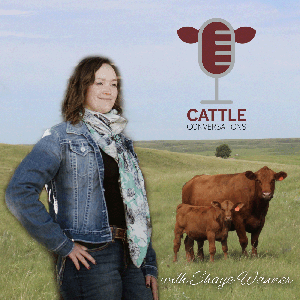


Today on the Casual Cattle Conversations podcast, Shaye talks with veterinarian Dr. Paige Schmidt-Rios about bovine respiratory disease (BRD), its impact across the cattle supply chain, and key prevention strategies for ranchers. Dr. Paige explains BRD (also called pneumonia or shipping fever) as a complex syndrome involving multiple viruses and bacteria, often triggered when stress and environment compromise immunity; she lists common pathogens and notes BRD is a major cause of post-weaning illness.
They discuss treatment limits, including supportive care for viral cases and five antibiotic classes for bacterial pneumonia, highlighting mycoplasma’s lack of a cell wall and fluoroquinolone restrictions, plus the role and timing of diagnostics and the need for a VCPR. Prevention focuses on colostrum within 12 hours, clean/dry calving environments, proper vaccine handling, and timely boosters, including considerations around preconditioning versus vaccinating at weaning.
Learn more about Noble here: https://bit.ly/3DD7uG0
Learn more about Vence here: https://bit.ly/4kfWrCG
Learn more abou Elanco here: https://farmanimal.elanco.com/us/beef
Catch more conversations like this one and learn more at https://www.casualcattleconversations.com/
01:16 4-H Memories
This week, Shaye Wanner interviews Haley Potter from the Ambrook team about how artificial intelligence can support ranch profitability and long-term continuity when used responsibly. Potter, who has North Dakota ranching roots and splits time between ranches in Dell and Alder, Montana, says AI fits best for producers who need help with information gathering and admin tasks while keeping humans in control of decisions and fact-checking outputs.
She shares examples such as using Claude to summarize bull sale catalogs based on EPD parameters, building grazing plans, and analyzing financials for expansion scenarios, plus customer examples like an AI-assisted ordering/lead tool for direct-to-consumer beef and a “ranch command center” dashboard. Potter explains Ambrook’s AI-assisted bookkeeping features (tagging, invoice matching, receipt scanning) and emphasizes data quality, transparency, and privacy, including choosing trusted services and requiring approval for data use.
See what Ambrook can do for your operation here: ambrook.com/casualcattle
Learn more about Noble here: https://bit.ly/3DD7uG0
Learn more about Vence here: https://bit.ly/4kfWrCG
This week, Shaye sits down with Chance, a ranch manager at the Noble Research Institute, about extending grazing seasons to cut winter feeding and hay costs. Chance describes Noble’s 5,100-acre native-grass operation running about 200 cows, using intensive rotational grazing (moving daily to every few days) and aiming to remove only the top third to half of forage during the growing season so enough standing grass remains for winter.
He stresses producers often plan too late, and recommends measuring pasture forage monthly to guide stocking decisions, destocking, or hay purchasing. Winter management includes protein supplementation (cubes/cake) for four to five months and occasional hay during heavy snow. They discuss other options such as cover crops (noting weather risk), rye winter pasture, crop residue grazing, and bale grazing/unrolling or pre-unwrapped bales to improve soil and return nutrients.
Learn more about resources from the Noble Research Institute here: http://noble.org/find-a-course
Catch more conversations like this one and learn more at https://www.casualcattleconversations.com
00:00 Cutting Input Costs
This week, Shaye Wanner welcomes Chris Rawley of Harvest Returns to discuss what makes ranches “investable” and why it matters for operators seeking outside investors or bank financing to expand herds, land, or infrastructure. Raleigh explains Harvest Returns’ model of pooling investor capital and investing as a single partner via loans, notes, or equity, and says investable operations have a solid plan, clear financial statements, defined marketing/sales strategy, and a realistic path to investor returns.
He outlines that key first steps include transparency and documentation across complex land and entity structures, accurate balance sheets reflecting assets and debts, and building a team for missing functions like finance, bookkeeping, accounting, and sales. Common mistakes include poor herd tracking/accountability (amid “phantom cattle” scams) and attempting to raise public capital without proper SEC-compliant legal help. Raleigh emphasizes getting herd and financial numbers in order, including hiring professionals.
Catch more conversations like this one and learn more at https://www.casualcattleconversations.com/
00:00 Is Your Ranch Investible
This week, Shaye Wanner interviews NDSU livestock development specialist Jon Biermacher about the economics of buying weaned/backgrounded heifers in spring, breeding them, and selling them about a year later as long-bred heifers or as pairs, using an Excel-based enterprise budget tool developed from a student producer’s plan.
The model includes key costs (heifer purchase, pasture/feed/hay/mineral, health, breeding, transport, interest, marketing) and compares AI plus cleanup bulls versus natural service, finding about a $55/head advantage to not using AI (not counting added labor) and little observed revenue premium for AI’d breds. In their projections, pairs returned about $100/head more than bred heifers. Results show costs are dominated by heifer purchase and feed, with profit highly sensitive to purchase price; a ~$0.20/lb increase can erase roughly $200/head projected net return. This conversation is helpful for anyone looking to create projections on their operation with resources from the NDSU team.
Join Rising Ranchers Here: https://www.facebook.com/groups/risingranchers
Catch more conversations like this one and learn more at https://www.casualcattleconversations.com/
01:31 Meet John Biermacher
04:54 Defining the Enterprise
06:08 Building the Budget Tool
13:03 Markets and Assumptions
15:04 AI Versus Bulls
19:48 Where the Costs Sit
22:26 Breds Versus Pairs
25:35 Break Evens and Risk
31:47 Tools Beyond Spreadsheets
In a solo episode of the Casual Cattle Conversations podcast, host Shaye Wanner shares her background growing up on a ranch that evolved into a registered Red Angus seedstock operation and now living on her husband’s centennial family farm, to frame three key transition planning tips.
First, she urges producers to honestly ask whether they truly want to be on the family farm or would rather farm/ranch independently while staying close to family, noting legacy isn’t limited to land ownership and that not all family members work well together. Second, she advises financially planning for the unknown by saving and working with bankers and financial professionals even without a clear transition timeline, since taking over must still be a sound business decision. Third, she emphasizes, “You don’t get to change what’s not yours,” encouraging respect for older generations and clarity about one’s current role.
Join Rising Ranchers Here: https://www.facebook.com/groups/risingranchers
Catch more conversations like this one and learn more at https://www.casualcattleconversations.com/
00:08 Welcome and Ways to Connect
01:45 My Ranching Background
05:20 Three Tips Overview
05:41 Family Farm or Nearby
10:01 Plan for the Unknown
13:27 You Cant Change It
Today on the Casual Cattle Conversations podcast, Shaye Wanner talks with ag tech consultants Chelsea Good (Good & Associates) and Jared Wareham (Horizon Venture Management) about how cow-calf producers can decide which technologies are worth adopting. They stress that many tools enter agriculture from outside the industry and may be “solutions looking for a problem,” so ranchers should evaluate technology like a toolbox and demand ROI, especially in an asset-rich, cash-poor business.
Examples include mismatched expensive tags for sale barns versus value-based traceability programs, strategic uses of GPS and estrus-detection tags (often for herd bulls or specific heifer programs), virtual fencing’s geography-dependent economics, and emerging biometrics, camera applications, and gene-edited pest control. They also discuss digital recordkeeping and payment systems as adoption challenges without policy drivers, and encourage producers to share pain points and explore tech that supports long-term generational sustainability.
Catch more conversations like this one and learn more at https://www.casualcattleconversations.com/
Learn more about Chelsea and Good & Associates here: https://www.goodandassoc.com/
Learn more about Jared and Horizon Venture Management here: https://www.horizonventuremanagement.com/
00:00 Tech That Pays Off
Today, Shaye Wanner interviews Jamie Courter, a University of Missouri assistant professor and genetics extension specialist, about research and producer use of cattle hair shedding scores. Corder explains hair shedding’s link to heat stress—especially in the Southeast with endophyte-infected fescue—and summarizes findings that earlier-shedding cows wean heavier calves, including Simmental data showing hair shed score 1 cows weaned calves 45 pounds heavier than score 5 cows.
She describes the 1–5 scoring system, typical shedding pattern, and recommends scoring the whole herd on the same day when variation is greatest, noting bulls shed earlier and younger cows score higher than mature cows within a year. She discusses recent genomic work suggesting shedding relates more to changing daylight than temperature, notes variation exists within all breeds, and points listeners to University of Missouri Extension publications for scoring guidance and research details.
Catch more conversations like this one and learn more at https://www.casualcattleconversations.com/
Learn more about hair shedding research at https://extension.missouri.edu/publications/g2049
Sign up for the upcoming RancherMind with Jasper here: https://www.casualcattleconversations.com/ranchermind-events
00:51 Jamie’s background
From the publisher's feed
Cattle Conversations is the podcast for beef cattle producers and ranchers to explore new ideas and hear stories that will help them improve their current operations and lifestyles. Shaye Wanner…

84 Listeners
425 Listeners

123 Listeners

378 Listeners
23 Listeners

1,313 Listeners

112 Listeners

32 Listeners

227 Listeners

73 Listeners
1,681 Listeners

199 Listeners

22 Listeners

29 Listeners

270 Listeners