
Sign up to save your podcasts
Or



Based on Podcast App listening data
Gustav Söderström has worked at Spotify for a long time; his first big project was leading the launch of its mobile app back in 2009. That makes him the perfect company leader to talk to about Spotify’s recent redesign, which introduces a visual, TikTok-like feed for discovering new content on the app’s homepage. As his boss CEO Daniel Ek put it last week, it’s “the biggest change Spotify has undergone since we introduced mobile.”
With the title of co-president and chief product and technology officer, Söderström is responsible for not only how Spotify looks and feels but also all the AI work happening behind the scenes to power its increasingly important recommendations. According to Söderström, it turns out that improving those recommendations is actually at the heart of the big redesign. “I think companies that don’t have an efficient user interface for a machine learning world are not going to be able to leverage machine learning,” he told Alex Heath on the newest episode of Decoder.
Links:
https://en.wikipedia.org/wiki/Napster
Spotify is laying off 6 percent of its global workforce, CEO announces
Spotify’s new design turns your music and podcasts into a TikTok feed
Alex Heath's Tweet
Functional versus Unit Organizations
Two-Pizza Teams
Transcript:
https://www.theverge.com/e/23402123
Credits:
Decoder is a production of The Verge and part of the Vox Media Podcast Network.
It was produced by Creighton DeSimone and Jackie McDermott and it was edited by Callie Wright.
The Decoder music is by Breakmaster Cylinder. Our Editorial Director is Brooke Minters and our Executive Director is Eleanor Donovan.
Learn more about your ad choices. Visit podcastchoices.com/adchoices
Intro:
Steve Bandrowczak, the CEO of Xerox, an iconic company that got started all the way back in 1906 as a manufacturer of photo paper and is, of course, best known for pioneering the copy machine. Here in 2023, Xerox has moved well beyond paper. It now works with companies large and small to provide IT services: it optimizes workflows, manages data, automates parts of businesses, and yes, still fixes the printers.
Steve insists there’s still a lot in the world to print, and selling and servicing printers continues to be where Xerox begins its relationships with most customers. And fixing printers is getting high tech: Steve is excited about his new AR app that walks you through getting the copy machine working again so you don’t have to wait for a technician to come fix it.
We also talked about the future of Xerox’s legendary Palo Alto Research Center, or PARC, whether Xerox wants more consolidation, and we even spitball some ideas about how to get Gen Z excited about printers.
Links:
John Visentin, Xerox C.E.O., Dies at 59
Xerox Ousts CEO In Deal With Icahn
Carl Icahn Makes Case for Xerox-HP Union
Xerox abandons $35 billion hostile bid for HP
Apple Lisa: the ‘OK’ Computer
About PARC, a Xerox Company
Transcript:
https://www.theverge.com/e/23394156
Credits:
Decoder is a production of The Verge and part of the Vox Media Podcast Network.
It was produced by Creighton DeSimone and Hadley Robinson and it was edited by Jackson Bierfeldt.
The Decoder music is by Breakmaster Cylinder. Our Editorial Director is Brooke Minters and our Executive Director is Eleanor Donovan.
Learn more about your ad choices. Visit podcastchoices.com/adchoices
Pali Bhat joined Reddit from Google about a year ago — he’s actually Reddit’s first-ever chief product officer, which is pretty surprising considering that Reddit is a series of product experiences: the reading experience, the writing experience, and importantly, the moderation experience. One thing we always say on Decoder is that the real product of any social network is content moderation, and Reddit is maybe the best example of that: every subreddit is shaped by volunteer moderators who use the tools Reddit builds for them. So Pali has a big job bringing all these products together and making them better, all while trying to grow Reddit as a platform.
This was a really deep conversation, and it touched on a lot of big Decoder themes. I think you’re going to like it. Okay, Pali Bhat, the chief product officer of Reddit. Here we go.
Links:
New features aimed at making Reddit easier to use: an update on our product priorities focussed on simplification
Reddit’s new features include a TikTok-style video feed
Reddit is bringing back r/Place, its April Fools’ Day art experiment
How to buy a social network, with Tumblr CEO Matt Mullenweg
Microsoft thinks AI can beat Google at search — CEO Satya Nadella explains why
AI-generated fiction is flooding literary magazines — but not fooling anyone
Transcript:
https://www.theverge.com/e/23390325
Credits:
Decoder is a production of The Verge and part of the Vox Media Podcast Network.
It was produced by Creighton DeSimone and Jackie McDermott and it was edited by Callie Wright.
The Decoder music is by Breakmaster Cylinder. Our Editorial Director is Brooke Minters and our Executive Director is Eleanor Donovan.
Learn more about your ad choices. Visit podcastchoices.com/adchoices
We taped this episode live at Hot Pod Summit. That’s our conference for the podcast industry. We have a whole newsletter for podcasters. It’s called Hot Pod, written by our very own Ariel Shapiro. Hot Pod Summit is where we bring that community of creators, trendsetters and decision-makers together to explore the latest developments in podcasting, audiobooks, and more. It was a packed house and a great time.
We ended the day by recording our first-ever live Decoder with Conal Byrne, CEO of iHeartMedia’s digital audio group. Conal oversees podcasting at a giant radio company, and his group accounts for a quarter of iHeart’s revenue, which was $1 billion last quarter alone. His team makes some of the biggest podcasts around, with huge talent like Will Ferrell, Shonda Rhimes, and Charlamagne tha God, who you’ll hear Conal talk about quite a lot.
Conal and iHeart Digital earned that success by doing some unconventional things. Whereas other big podcasting players like Spotify and Apple have tried to boost revenue through subscriptions or platform exclusivity, Conal shunned those approaches and said he’s going for big audience reach, made possible in part by his ability to run ads and even shows on iHeart’s huge network of traditional radio stations.
But that maverick approach has included some controversial steps as well. Last year, Verge alumni and Bloomberg reporter Ashley Carman reported that iHeart worked with a firm called Jun Group to essentially buy podcast downloads through video games. To many in the industry, that seemed pretty disingenuous. So of course I asked Conal about that and lots more. He was a great guest, super game to answer the questions, especially in front of a live audience.
Links:
iHeartMedia Buys Stuff Media for $55 Million - WSJ
Podcasters Are Buying Millions of Listeners Through Mobile-Game Ads
Cost Per Thousand (CPM) Definition and Its Role in Marketing
Spotify reportedly paid $200 million for Joe Rogan’s podcast - The Verge
Chris Dixon thinks web3 is the future of the internet — is it? - Decoder, The Verge
Decoder with Nilay Patel (@decoderpod) Official | TikTok
Transcript:
https://www.theverge.com/e/23381445
Credits:
Decoder is a production of The Verge and part of the Vox Media Podcast Network.
It was produced by Creighton DeSimone and Jackie McDermott and it was edited by Callie Wright.
The Decoder music is by Breakmaster Cylinder. Our Editorial Director is Brooke Minters and our Executive Director is Eleanor Donovan.
Learn more about your ad choices. Visit podcastchoices.com/adchoices
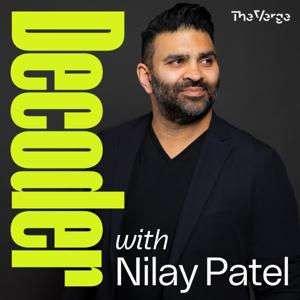
Hello and welcome to Decoder. I’m Nilay Patel, editor in chief of The Verge, and Decoder is my show about big ideas, and other problems.
Today, I'm talking to Mitchell Baker, the chairwoman and CEO of Mozilla, the organization behind the Firefox browser, the Thunderbird email client, the Pocket newsreader, and a bunch of other interesting internet tools.
Now as you all know, Decoder is secretly a podcast about org charts – maybe not so secretly, and Mozilla’s structure is really interesting. Mozilla itself is a nonprofit foundation, but it contains within it something called the Mozilla Corporation, which actually makes Firefox and the rest. Mitchell is the chairwoman of the foundation, and the CEO of the corporation. And the Mozilla Corporation, which they charmingly call MoCo, can make a profit - or it can least be taxed, which is an important distinction you’ll hear Mitchell talk about.
I bring this up because Mozilla has been around since 1994 in a variety of structures and business models – it started as a company called Netscape, and Mitchell was one of the first employees in the legal department. Netscape’s product was Netscape Navigator, the first commercial web browser, which of course changed the consumer internet and scared Microsoft so much it did a bunch of anticompetitive things that led to the famous antitrust case. In the meantime, Netscape got sold to AOL, and along the way Mitchell led the somewhat renegade Mozilla Project inside the company which eventually lead to Mozilla the non-profit foundation that eventually launched Firefox. It’s a lot!
But now Mitchell is trying to live up to Mozilla’s nonprofit ideals of protecting the open internet while still trying to compete and cooperate with tech giants like Apple and Google. And these are complicated relationships: Google still accounts for a huge percentage of Mozilla’s revenue – it pays hundreds of millions of dollars to be the default search engine in Firefox. And Apple restricts what browser engines can run on the iPhone – Firefox Focus on the iPhone is still running Apple’s webkit engine, something that regulators, particularly in Europe want to change.
On top of all that, some big foundational pieces of the web are changing: Microsoft is aggressively rolling out its chatGPT-powered Bing search engine in an effort to displace Google and get people to switch to the Edge browser, and Twitter’s implosion means that Mitchell sees Mastodon as one of Mozilla’s next big opportunities.
So how does Mozilla get through this period of change while staying true to itself? And will anyone actually switch browsers again? Turns out – it might be easier to get people to switch on phones, than on desktops. That’s Mozilla’s belief, anyway.
Links:
Netscape - Wikipedia
The State of Mozilla: 2021 — 2022 Annual Report
The future of computers is only $4 away, with Raspberry Pi CEO Eben Upton
Firefox drops Google as default search engine, signs five-year deal with Yahoo
Microsoft thinks AI can beat Google at search — CEO Satya Nadella explains why
Microsoft announces new Bing and Edge browser powered by upgraded ChatGPT AI
A beginner’s guide to Mastodon, the hot new open-source Twitter clone
Transcript: https://www.theverge.com/e/23362385
Credits:
Decoder is a production of The Verge and part of the Vox Media Podcast Network.
It was produced by Creighton DeSimone and Jackie McDermott and it was edited by Callie Wright.
The Decoder music is by Breakmaster Cylinder. Our Editorial Director is Brooke Minters and our Executive Director is Eleanor Donovan.
Learn more about your ad choices. Visit podcastchoices.com/adchoices
I’m coming to you from Microsoft’s campus in Redmond, where just a few hours ago, Microsoft announced that the next version of the Bing search engine would be powered by OpenAI, the company that makes ChatGPT. There’s also a new version of the Edge web browser with OpenAI chat tech in a window that can help you browse and understand web pages.
The in-depth presentation showed how OpenAI running in Bing and Edge could radically increase your productivity. They demo’d it making a travel itinerary, posting to LinkedIn, and rewriting code to work in a different programming language.
After the presentation, I was able to get some time with Microsoft CEO Satya Nadella. Nadella has been very bullish on AI. He’s previously talked about AI as the next major computing platform. I wanted to talk about this next step in AI, the partnership with OpenAI, and why he thought now was the best time to go after Google search.
This is a short interview, but it’s a good one. Okay, Satya Nadella, CEO of Microsoft. Here we go.
Watch this interview as a video
Microsoft announces new Bing and Edge browser powered by upgraded ChatGPT AI
All the news from Microsoft’s February AI event
Transcript:
https://www.theverge.com/e/23354035
Credits:
Decoder is a production of The Verge and part of the Vox Media Podcast Network.
Today's episode was produced by Creighton DeSimone, Jackie McDermott, Vjeran Pavic and Becca Farsace and it was edited by Callie Wright.
The Decoder music is by Breakmaster Cylinder. Our Editorial Director is Brooke Minters and our Executive Director is Eleanor Donovan.
Learn more about your ad choices. Visit podcastchoices.com/adchoices
HBO started as an experiment. It was a way to get people to switch from getting TV over broadcast antennas to cable by offering events you’d otherwise need tickets to see: boxing, plays, movies. That’s where the name Home Box Office comes from.
But it grew from there in surprising ways: HBO was a major innovator in satellite distribution, in working with cable operators around the country, and of course in programming. The company’s taste and style has influenced and shaped culture for a generation now. And importantly, HBO did it without any real data: the cable companies owned all the subscribers, so HBO made decisions through instinct and experience.
The amazing thing about HBO is that it has stayed true to itself through an absolutely tumultuous set of ownership changes and strategy shifts. If you’re a Decoder listener you know about the chaos of AT&T and HBO Max and the sale to Discovery to create Warner Brothers Discovery, but it’s so much twistier than that.
I talked through all of those twists with Felix Gillette and John Koblin, authors of the terrific book It’s Not TV: The Spectacular Rise, Revolution, and Future of HBO. Felix and John also peeled back the curtain on your favorite HBO shows from Sex and the City to Game of Thrones.
Before we get into the episode, I have to do our usual set of disclosures: I’m a Netflix executive producer. We made a Netflix show called The Future Of. You should watch it. I’m hopelessly biased in favor of the show we made. Also, Vox Media has a minority investment from Comcast. They don’t like me very much. And I worked at AOL Time Warner. I quit to start The Verge.
Ok that’s that. Let’s get into the interview—it’s a good one.
Transcript: https://www.theverge.com/e/23352141
Credits:
Decoder is a production of The Verge and part of the Vox Media Podcast Network.
It was produced by Creighton DeSimone and Jackie McDermott and it was edited by Callie Wright.
The Decoder music is by Breakmaster Cylinder. Our Editorial Director is Brooke Minters and our Executive Director is Eleanor Donovan.
Learn more about your ad choices. Visit podcastchoices.com/adchoices
A few weeks ago, President Biden was in the Netherlands, where he asked the Dutch government to restrict export from a company called ASML to China. ASML is the only company in the world that makes a specific machine needed to make the most advanced chips. Apple couldn’t make iPhone chips without this one machine from the Netherlands’ biggest company. ASML doesn’t just shape the Dutch economy—it shapes the entire world economy. How did that happen?
Chris Miller, Tufts professor and author of Chip War: The Fight For The World’s Most Critical Technology walked me through a lot of this, along with some deep dives into geopolitics and the absolutely fascinating chip manufacturing process. This one has everything: foreign policy, high powered lasers, hotshot executives, monopolies, the fundamental limits of physics, and, of course, Texas. Here we go.
Links:
US issues sweeping restrictions on chip sales to China
Japan and the Netherlands join US with tough chip controls on China
Pat Gelsinger came back to turn Intel around — here’s how it’s going
Transcript:
https://www.theverge.com/e/23342471
Credits:
Decoder is a production of The Verge and part of the Vox Media Podcast Network.
It was produced by Creighton DeSimone and Jackie McDermott and it was edited by Callie Wright.
The Decoder music is by Breakmaster Cylinder. Our Editorial Director is Brooke Minters and our Executive Director is Eleanor Donovan.
Learn more about your ad choices. Visit podcastchoices.com/adchoices
I have this theory that music is usually about five years ahead of the rest of media in terms of its relationship to tech—whether that’s new formats based on new tech, like vinyl to CDs; new business models like streaming; or simply being disrupted by new kinds of artists who use new forms of promotion like TikTok in unexpected ways. I’ve always thought that if you can wrap your head around what’s happening to the music industry, you can pretty much see the future of TV or movies or the news or whatever it is, because the music industry just moves that fast.
I was talking about this with my friend Charlie Harding, the co-host of Switched on Pop, and he said that he thinks the upcoming Taylor Swift Eras Tour is itself the end of an era in music — that the age of cheap streaming services is coming to an inevitable conclusion, and that something has to change in order for industry to sustain itself in the future.
So, in this episode, Charlie and I walk through a brief history of the music business—which, despite its ever-changing business models, is permanently trying to find something to sell you for $20 whether that’s the music itself, all-access streaming, merch, and even NFTs—using Taylor Swift as a case study. We map her big moves against the business of music over time to try to see if this really is the end of an era. And maybe more importantly, to try and figure out if the music industry can sustain and support artists who are not Taylor Swift, because streaming, all by itself, definitely cannot.
Links:
Switched on Pop
Charlie’s first appearance on Decoder: Good 4 who? How music copyright has gone too far - The Verge
Why Amazon VP Steve Boom just made the entire music catalog free with Prime - The Verge
Spotify launching in the US at 8AM tomorrow, open to all pre-registered users - The Verge
Metallica sued Napster 15 years ago today - The Verge
Taylor Swift calls Apple Music free trial 'shocking, disappointing' in open letter - The Verge
Taylor Swift versus Ticketmaster: the latest on the tour that may break up a giant - The Verge
The DOJ has reportedly opened an antitrust investigation into Ticketmaster's owner
How fandom built the internet as we know it, with Kaitlyn Tiffany - The Verge
Steve Aoki on the blockchain, the metaverse, and the business of music - The Verge
Transcript:
https://www.theverge.com/e/23322720
Credits:
Decoder is a production of The Verge, and part of the Vox Media Podcast Network.
Today’s episode was produced by Hadley Robinson, Creighton DeSimone and Jackie McDermott and it was edited by Callie Wright.
The Decoder music is by Breakmaster Cylinder. Our Editorial Director is Brooke Minters. Our Sr. Audio Director is Andrew Marino and our Executive Producer is Eleanor Donovan.
Learn more about your ad choices. Visit podcastchoices.com/adchoices
Last year I spoke with Cory Doctorow and Rebecca Giblin about their new book, Chokepoint Capitalism. It’s a book about artists and technology and platforms, and how different kinds of distribution and creations tools create chokepoints for different companies to capture value that might otherwise go to artists and creators.. In other words, it’s a lot of Decoder stuff.
As we were prepping this episode, the Decoder team realized it previews a lot of things we’re going to talk about in 2023: antitrust law. Ticketmaster. Spotify and the future of the music industry. Amazon and the book industry. And, of course, being a creator trying to make a living on all these platforms.
This episode is longer than normal, but it was a really great conversation and I'm glad we are sharing it with you.
Links:
What is Mixer, Ninja’s new exclusive streaming home?
Ninja returns to Twitch
This was Sony Music's contract with Spotify
Transcript:
https://www.theverge.com/e/23311918
Credits:
Decoder is a production of The Verge and part of the Vox Media Podcast Network.
It was produced by Creighton DeSimone and Jackie McDermott and it was edited by Callie Wright.
The Decoder music is by Breakmaster Cylinder. Our Editorial Director is Brooke Minters and our Executive Director is Eleanor Donovan.
Learn more about your ad choices. Visit podcastchoices.com/adchoices
From the publisher's feed
Ranked by our users in the last 21 days

7,846 Listeners

10,719 Listeners

2,678 Listeners

9,615 Listeners

3,644 Listeners
3,713 Listeners

1,091 Listeners
3,143 Listeners
555 Listeners

2,146 Listeners

507 Listeners
1,461 Listeners

10,265 Listeners

2,163 Listeners
40 Listeners
23,550 Listeners
732 Listeners
555 Listeners

512 Listeners
5,557 Listeners

6,478 Listeners

2,319 Listeners

1,217 Listeners

189 Listeners

3,442 Listeners

1,780 Listeners

1,438 Listeners

452 Listeners
26 Listeners
51 Listeners