
Sign up to save your podcasts
Or

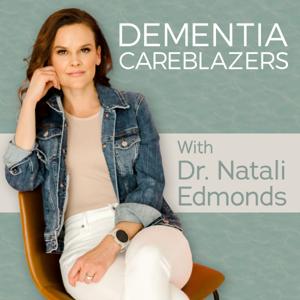
By Dr. Natali Edmonds


4.9
4444 ratings


The podcast currently has 202 episodes available.
The most played episodes among Podcast App listeners.
Some dementia behaviors can make absolutely no sense from the outside. It can look like your loved one is being lazy, stubborn, rude, in denial, or even lying to you. But there's often a brain-based reason for what you're seeing. In this episode, I break down 5 strange dementia behaviors, apathy, anosognosia, apraxia, disinhibition, and confabulation — and explain what may actually be happening in the brain when they occur. Because when you understand why a behavior is happening, it can completely change the way you see it. If you'd like to see this episode on video, you can hop on over to my YouTube channel here. And if your next question is, "Okay, but what do I DO when this happens?" I have two resources that can help: → Learn about the Care Collective: https://tinyurl.com/podcast-cc → My new book, The Dementia Care Toolkit is officially available for pre-order. ➡️ Preorder your copy here: https://careblazers.com/toolkit ⏱ CHAPTERS 0:00 - Why these behaviors are almost never a choice 1:31 - Apathy and the broken motivation switch 3:51 - Anosognosia and why they do not believe they have dementia 6:12 - Apraxia and why simple tasks stop working 8:26 - Disinhibition and what the frontal lobes control 10:11 - Confabulation and why it is not lying --- Hi, I'm Dr. Natali Edmonds, a board-certified geropsychologist specializing in dementia care. Whether your loved one has Alzheimer's, frontotemporal, Lewy body, vascular, or mixed dementia, we believe that to create a dementia-friendly world, we must first create a caregiver-friendly world. This content is for educational purposes only and is not a substitute for professional medical advice. Always consult with a healthcare provider for medical guidance.

When someone with dementia knows they're struggling, they may start doing less and less. They might get frustrated, say things like "I can't do anything right," or stop doing things they used to enjoy. In this episode, I'm talking about why this can happen and, more importantly, how you can help. I'll share some simple ways to support their confidence and adapt activities as their abilities change. If you'd like to see this episode on video, you can hop on over to my YouTube channel here. → Learn about the Care Collective: https://tinyurl.com/podcast-cc ⏱ CHAPTERS 0:00 - A Careblazer's question: is he losing motivation, or does he know he's struggling 1:23 - What anosognosia actually is, and why this is something different 3:10 - Practical ways to support someone who's aware they're struggling 3:42 - A real story: adapting a beloved hobby instead of giving it up 6:01 - What to watch for, and when to loop in the doctor → My new book, The Dementia Care Toolkit is officially available for pre-order. ➡️ Preorder your copy here: https://careblazers.com/toolkit → Get free weekly tools and tips in my newsletter, The Dementia Dose: https://tinyurl.com/dementiadose-podcast --- Hi, I'm Dr. Natali Edmonds, a board-certified geropsychologist specializing in dementia care. Whether your loved one has Alzheimer's, frontotemporal, Lewy body, vascular, or mixed dementia, we believe that to create a dementia-friendly world, we must first create a caregiver-friendly world. This content is for educational purposes only and is not a substitute for professional medical advice. Always consult with a healthcare provider for medical guidance.
Have you ever noticed your loved one with dementia is calm, nothing seems to be wrong, and then the moment you shift your attention to someone else they completely change? They get demanding, upset, anxious, or jealous that you are not there giving them attention. It can feel like they cannot stand not being the center of your attention, and understandably that leaves you feeling frustrated, resentful, and confused. It is not jealousy. It is not manipulation. In this episode I share two real life examples of this, explain what is happening in the brain that causes it, and walk you through what actually helps when your attention has to go somewhere else. If you'd like to see this episode on video, you can hop on over to my YouTube channel here. → Learn about the Care Collective: https://tinyurl.com/podcast-cc ⏱ CHAPTERS 0:00 - When your attention shifts and everything changes 1:16 - Two real life examples from Careblazers 2:52 - Why this is attachment distress, not jealousy 5:07 - Why it feels so personal, and a reframe that helps 5:54 - What actually helps when you have to step away → My new book, The Dementia Care Toolkit is officially available for pre-order. ➡️ Preorder your copy here: https://careblazers.com/toolkit → Get free weekly tools and tips in my newsletter, The Dementia Dose: https://tinyurl.com/dementiadose-podcast --- Hi, I'm Dr. Natali Edmonds, a board-certified geropsychologist specializing in dementia care. Whether your loved one has Alzheimer's, frontotemporal, Lewy body, vascular, or mixed dementia, we believe that to create a dementia-friendly world, we must first create a caregiver-friendly world. This content is for educational purposes only and is not a substitute for professional medical advice. Always consult with a healthcare provider for medical guidance.
Caring for someone with dementia can feel overwhelming, especially when you're not sure where to turn for help. In this episode, I'm sharing several places dementia caregivers can go for support, guidance, and resources, plus one important step families often wait too long to think about. You do not have to wait until there's a crisis to start getting help. The Dementia Care Toolkit is officially available for pre-order. This book was written for the real-life moments of dementia caregiving, the moments when you're overwhelmed, unsure what to do, and need something practical to reach for. ➡️ Preorder Your Copy Here: https://careblazers.com/toolkit ⏱ CHAPTERS 0:00 - Two questions from a recent podcast interview 0:38 - Why you don't need to wait until you need help to ask for it 1:01 - Four places to turn for help after a dementia diagnosis 3:37 - What to do the very next day if your loved one was just diagnosed #dementia #dementiacaregiver #caregiverburnout #dementiacare --- Hi, I'm Dr. Natali Edmonds, a board-certified geropsychologist specializing in dementia care. Whether your loved one has Alzheimer's, frontotemporal, Lewy body, vascular, or mixed dementia, we believe that to create a dementia-friendly world, we must first create a caregiver-friendly world. This content is for educational purposes only and is not a substitute for professional medical advice. Always consult with a healthcare provider for medical guidance.
If you have taken the car keys, stepped in on the checkbook, or said no to something your loved one with dementia badly wanted, you already know what comes next. They are hurt. They are angry. And they are angry at you. I want you to hear this first. Their unhappiness is not a report card on your caregiving. This is one of the hardest parts of dementia caregiving, because it does not just feel hard. It feels like proof you are getting it wrong. And that is exactly what it is not. In this episode I explain why trying to keep your loved one happy all the time puts their safety at risk, what it costs you on the days you have nothing left to give, and the one response almost every Careblazer skips, because we are so busy looking for the dementia response when what we really need is the human response. The Dementia Care Toolkit is officially available for pre-order. This book was written for the real-life moments of dementia caregiving, the moments when you're overwhelmed, unsure what to do, and need something practical to reach for. ➡️ Preorder the Dementia Care Toolkit Here: https://careblazers.com/toolkit → Join the Care Collective: https://tinyurl.com/podcast-cc → Get free weekly tools and tips in my newsletter, The Dementia Dose: https://tinyurl.com/dementiadose-podcast ⏱ CHAPTERS 0:00 - Why them being upset with you does not mean you failed 1:27 - Reason one: the things you take away to keep them safe 3:36 - Reason two: what saying yes every time costs you 5:23 - Reason three: the human response we skip 8:03 - What it means when they are sad and you cannot fix it #dementia #dementiacaregiver #caregiverburnout #dementiacare --- Hi, I'm Dr. Natali Edmonds, a board-certified geropsychologist specializing in dementia care. Whether your loved one has Alzheimer's, frontotemporal, Lewy body, vascular, or mixed dementia, we believe that to create a dementia-friendly world, we must first create a caregiver-friendly world. This content is for educational purposes only and is not a substitute for professional medical advice. Always consult with a healthcare provider for medical guidance.
The podcast currently has 202 episodes available.
6,692 Listeners
2,014 Listeners

2,584 Listeners

4,874 Listeners
169 Listeners

8,031 Listeners
41 Listeners

1,086 Listeners

58 Listeners

23 Listeners

19,066 Listeners

1,421 Listeners
24 Listeners

2,238 Listeners

7 Listeners