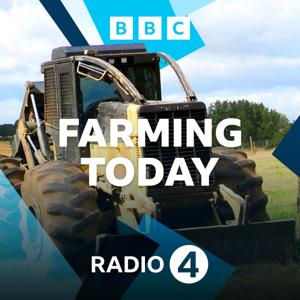
Farming Today

Farming Today

By BBC Radio 4Science
Download on the App Store
  • Favorites

    227

    Followers

  • Typical duration

    14 min

    per episode

Based on Podcast App listening data

Farming Today episodes

  • 15/06/23 Tree planting targets; Environmental Land Management Schemes; Gamekeeping
    England has missed the government's tree planting targets for every year of this parliament, and is expected to miss them again when figures are published later today. The government aims to plant 7,500 hectares a year which is 90 to 120 million trees. However a report from the National Audit office last year pointed out tree-planting rates have not reached Defra’s 7,500 hectare per year target in the past 50 years and rates have only been above 6,000 hectares a year for three of the past 50 years.
    The Woodland Trust describes progress as 'glacial at best' but Sir William Worsley Chair of the Forestry Commission says things are improving.
    Farmers should be able to make a profit from public money when they're providing public goods - so says the former Environment Secretary George Eustice. He argues that increasing the payments for things like planting hedgerows would be more effective than compensating farmers for revenue they've lost. The Farming Minister says payment rates are being set at a level to encourage widespread participation.
    All week we've been exploring the different aspects of running a large agricultural estate, juggling farming with conservation and tourism. Today we speak to the head gamekeeper. The estate in Norfolk has five gamekeepers and runs a number of shoots, most are private but some are commercial and they fund the work that the gamekeepers do.
    Presenter = Charlotte Smith
    Producer = Rebecca Rooney
    14 min
  • 14/06/23 Antibiotic use in pigs; Dual purpose sheep; Estate livestock and conservation
    Pig farmers across the UK have reduced their use of antibiotics in their herds by 75% over the last eight years. That's according to figures released by the Agriculture and Horticulture Development Board. A 30% reduction target in total antibiotic had been set by a Targets Task Force (TTF) between 2020 and 2024, so this has now been passed. We asked the Pig Veterinary Society, whether the reduction was large, because farmers had been using too much antibiotic in the past.
    Wales is famous for its lamb, which has protected geographical status and is exported across the world. The same can’t be said for its wool however, in fact the fleece from a typical Welsh mountain sheep can fetch less than thirty pence, it costs far more than that to shear the animal. Work has now started to breed a variety of sheep that's good for its lamb and its wool.
    All week we've been visiting a big country estate, where farming, tourism and conservation have to work hand in hand. The Holkham National Nature Reserve is managed by Natural England and the estate itself. It's an internationally recognised site for breeding birds, but it's also part of the estate's grazing area for their 800 beef cattle. Getting the balance right, on sensitive marshland just behind the dunes on the coast, is crucial.
    Presenter = Anna Hill
    Producer = Rebecca Rooney
    14 min
  • 13/06/23 Small abattoirs, Cereals, Farm accounts
    Farmers are hoping for an announcement soon on more help for small abattoirs, which have been in decline for many years. This means farmers have fewer options when they sent animals for slaughter, and the animals themselves have to make longer journeys. Farming Minister Mark Spencer promised to do something about it in his speech at the National Farmers Union Conference back in February. Since then, no specific announcements have been made, although the recent Rural Action Plan launched by DEFRA mentions consultation. We speak to Marisa Heath who set up a cross-party Parliamentary inquiry into small abattoirs.
    Hundreds of farmers are gathering at the Cereals event in Nottinghamshire and after one of the most volatile years arable farmers can remember there'll be a lot to discuss. Some figures calculate that UK arable farmers are facing more than a 50% drop in profits from harvest 2023.
    All week we're taking a look at what it takes to run a big estate and how they juggle farming with tourism and conservation. Today we speak to the accountants in the office who manage all the money for the farm business.
    Presenter = Anna Hill
    Producer = Rebecca Rooney
    14 min
  • 12/06/23 Pheasant shoots taking legal action against government, Holkham Estate, solar farms for bees
    The shooting organisation BASC says itis taking legal action against the government over gamebird licences in England. Following a legal challenge by campaigners Wild Justice, since 2021 the release of birds like pheasants has been licensed by Natural England. Because of concerns about avian flu, this year the licence doesn't cover protected areas. Anyone wanting to release red legged partridge or pheasants within 500 m of a Special Protection Area, which protects rare, vulnerable and migratory birds, must get permission from Natural England. BASC says there has been no consultation on the change and it was announced too late to give shoots time to adapt.
    We start our theme for this week: agricultural estates. They are complicated businesses, with farming often at the heart but diversifications from holiday homes to shoots and micro-breweries helping to pay the bills. This week we're going to take a tour round the Holkham Estate in North Norfolk, owned by the Earl of Leicester.
    The estate covers 3500 hectares, growing salad potatoes, malting barley for beer, wheat and sugar beet, and maize for a biodigester. It includes forestry, a national nature reserve on the coast, grazes 900 beef cattle and 600 breeding ewes. It's also a tourist attraction.
    And a Leicestershire beekeeper says he has noticed a forty percent increase in honey production from hives near a solar farm.
    Presented by Charlotte Smith and produced by Beatrice Fenton.

    12 min
  • 10/06/23 Farming Today This Week; Ukraine dam breach; Combine harvester challenge; Gene editing; Insect decline.
    The breaching of a major dam on the Dneipro river in southern Ukraine is unfolding as a human, environmental and economic tragedy for thousands of people who live downstream. But there are global implications too. Ukraine is one of the world’s biggest wheat producers.
    A group of farmers have driven from John O’ Groats to Land’s End in a large green combine harvester to raise awareness of suicide and mental health. The National Farmers Union has this week published a survey showing that the soaring costs of energy, fuel and fertiliser along with increased market volatility over the last year have all had a negative impact on farmers’ mental health.
    The government launched a rural action plan this week. The initiatives include: improving rural broadband; relaxing planning rules around developing farm buildings; new strategies for rural transport; a fund for smaller abattoirs; and higher penalties for fly tipping. Some campaigners say the plans need to be underpinned by fairer funding for rural areas.
    All week on Farming Today we looked at gene editing. The government in England has changed the law to allow the development and marketing of gene edited crops. In Scotland, Wales and Northern Ireland the law hasn't changed. Gene Editing is not the same as genetic modification - GE allows researchers to make a specific edit to a plant's DNA, no new genes are added as they would be in GM plants.
    An EFRA committe inquiry has been told the reduction in the number and variety of insects in the UK and around the world is a risk to food security. Scientists have given evidence to MPs are examining the reasons for the decline and the impact on food security and the environment.
    Presenter = Charlotte Smith
    Producer = Rebecca Rooney
    26 min
  • 08/06/23 Insect declines and food security, combine challenge, quick-cook gene edited potatoes
    A reduction in the number and variety of insects in the UK and around the world is a risk to food security, a committee of MPs heard yesterday from some of the leading scientists in the field. An EFRA committee inquiry is examining the latest evidence for insect decline in the UK, as well as the key drivers of insect loss, and the potential impacts on food security and the environment.
    A group of farmers are driving from John O’ Groats to Land’s End in a large green combine harvester to raise awareness of suicide and mental health. The National Farmers Union has this week published a survey showing that the soaring costs of energy, fuel and fertiliser along with increased market volatility over the last year have all had a negative impact on farmers’ mental health, so it’s a timely roadtrip.
    All this week we're looking at gene editing and the implications of the UK Government's new Genetic Technology Act. A change in the law, which only applies in England, means the development and marketing of gene edited crops is now legal. Earlier in the week we heard from GM Freeze who told us the safeguards surrounding gene edited crops aren’t strong enough, and unforeseen consequences could arise if they’re introduced. In Scotland, the Holyrood Government has made it clear that its stance on genetic technology has not changed. So what does that mean for Scotland-based scientists who work on gene editing?
    Presented by Caz Graham and produced by Beatrice Fenton.

    14 min
  • 07/06/23 Future countryside conference; gene-edited wheat.
    At the Future Countryside Conference in Hertfordshire policy makers and farmers, land owners, conservationists and campaigners have been discussing how to make the countryside inclusive and meaningful for everyone. How can it deliver food, cleaner rivers and air, store carbon and offer people a place to visit and enjoy? We hear how this vision relies on a combination of personal will and public policy-making
    All week we're discussing gene editing - also known as precision breeding. It’s been just over two months since The Genetic Technology (Precision Breeding) Act passed into law in England (but not in Wales, Northern Ireland or Scotland). The government says it's a major step in innovation and will help ensure food security in the face of climate change. The change in the law comes just as the results of Europe’s first-ever field trial of a gene-edited wheat, are published. We report from the trial site at Rothamsted Research in Hertfordshire where scientists are developing a variety that will produce less harmful acyrilamide
    Presenter = Anna Hill
    Producer = Rebecca Rooney
    14 min
  • 06/06/23 Government rural action plan; gene editing
    The government has launched a Rural Action Plan, which it says will help grow the rural economy and support people living in remoter communities. The initiatives include improving rural broadband, relaxing planning legislation on developing farm buildings, new strategies for rural transport, a fund for smaller abattoirs and higher penalties for fly tipping. However, some of the ideas are consultation processes, rather than action. Anna Hill asks the rural affairs minister Lord Benyon about the plans.
    This week we're discussing gene editing - the technique for breeding crops with specific traits by editing a plant's DNA. In England, legislation has been brought in to enable gene editing in crops, but this has not been introduced in Scotland, Wales or Northern Ireland. Scientists and many, but not all, farmers have welcomed the move. Campaigners at GM Freeze say the safeguards surrounding gene edited crops are not strong enough, and unforeseen consequences could arise from their introduction.
    Presenter = Anna Hill
    Producer = Rebecca Rooney
    14 min
  • 05/06/23 Water scarcity in Scotland; food safety inspections; gene editing
    Farmers are being asked to conserve water as it is currently 'scarce in most of Scotland' according to SEPA, the Scottish Environment Protection Agency. It says 12 areas in the Northwest and Southern Central regions have been put on alert and businesses extracting water are being urged to put their water scarcity plans into action now to reduce pressure on the environment and preserve water resources. 
    When we left the EU, the government delayed introducing a new system for checking food imported from the EU, although UK exporters to the EU have faced checks since the beginning of 2021. The new UK system will be phased in from October meaning big changes for food inspection teams at our ports. More than double the amount of food and live animals are imported from the EU than the rest of the world. A 100-strong team works at Felixstowe port in Suffolk to keep the food on our plates safe to eat and we hear from some of the staff on the front line.
    All week we're looking at gene editing. It was promoted as a Brexit benefit and the government in England has changed the law to allow the development and marketing of gene edited crops. In Scotland, Wales and Northern Ireland the law hasn't changed. Gene Editing is not the same as genetic modification - GE allows researchers to make a specific edit to a plant's DNA, no new genes are added as they would be in GM plants. This week we'll hear what impact the change in the English regulations is having and discuss some of the concerns that are being raised. We start off by hearing from Jim Dunwell professor of plant bio-technology at Reading University.
    Presenter = Charlotte Smith
    Producer = Rebecca Rooney
    12 min
  • 03/06/23 Farming Today This Week: Trade Deals; Drones; Pharma; Awards
    This week the first Trade Deals made since the UK left the EU came into force - with Australia and New Zealand. Some farmers are concerned the deals will lead to the UK being flooded with cheaper imported meat. We hear from the Agriculture and Horticulture Development Board (AHDB) which has been using modelling developed by Harper Adams and Exeter Universities to asses the potential impact on UK agriculture.
    For the first time the UK Government has given permission for commercial drones to be used for the aerial spraying of weeds with pesticides. At this stage it will only be used on railway bridges where working at height can be dangerous. But using drones in British Agriculture is gathering pace, as our reporter Sarah Falkingham has been finding out.
    And a question from a listener about the porcine products in her medicine leads the team to take a look at how products reared and grown on farms are used in the pharmaceutical industry.
    Presented by Charlotte Smith
    Produced in Bristol for BBC Audio by Natalie Donovan
    25 min

More shows like Farming Today

Global News Podcast by BBC World Service

Global News Podcast

7,599 Listeners

The Archers by BBC Radio 4

The Archers

1,111 Listeners

From Our Own Correspondent by BBC Radio 4

From Our Own Correspondent

374 Listeners

More or Less by BBC Radio 4

More or Less

880 Listeners

Newshour by BBC World Service

Newshour

1,048 Listeners

Wake Up to Money by BBC Radio 5 Live

Wake Up to Money

55 Listeners

Money Box by BBC Radio 4

Money Box

42 Listeners

The Martin Lewis Podcast by BBC Radio 5 Live

The Martin Lewis Podcast

119 Listeners

In Our Time by BBC Radio 4

In Our Time

5,527 Listeners

The Documentary Podcast by BBC World Service

The Documentary Podcast

1,803 Listeners

6 Minute English by BBC Radio

6 Minute English

1,807 Listeners

Learning English Conversations by BBC Radio

Learning English Conversations

1,041 Listeners

Last Word by BBC Radio 4

Last Word

49 Listeners

Gardeners' Question Time by BBC Radio 4

Gardeners' Question Time

284 Listeners

The Food Programme by BBC Radio 4

The Food Programme

262 Listeners

Scotland Outdoors by BBC Radio Scotland

Scotland Outdoors

246 Listeners

Ramblings by BBC Radio 4

Ramblings

162 Listeners

The Bottom Line by BBC Radio 4

The Bottom Line

36 Listeners

The Plodcast by Our Media

The Plodcast

110 Listeners

Gardening with the RHS by Royal Horticultural Society

Gardening with the RHS

257 Listeners

You're Dead to Me by BBC Radio 4

You're Dead to Me

3,338 Listeners

The Missing Cryptoqueen by BBC Sounds

The Missing Cryptoqueen

1,004 Listeners

Americast by BBC News

Americast

822 Listeners

The Farmers Weekly Podcast by Farmers Weekly

The Farmers Weekly Podcast

14 Listeners

The Bomb by BBC World Service

The Bomb

1,005 Listeners