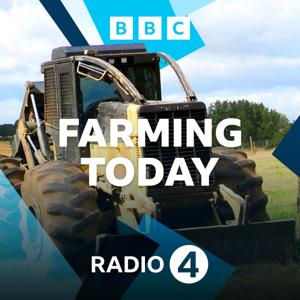
Farming Today

Farming Today

By BBC Radio 4Science
Download on the App Store
  • Favorites

    227

    Followers

  • Typical duration

    14 min

    per episode

Based on Podcast App listening data

Farming Today episodes

  • 02/06/23 Proposed cow cull in Ireland; seasonal workers from central Asia; Eggs in vaccines.
    Nearly 200,000 cows could be culled to meet emissions targets in Ireland - farming has to reduce emissions by 25% by 2025 and Department of Agriculture plans say that means 65,000 cows need to be culled every year for the next three years, at a cost of two hundred million euros a year. This is a bit of an about turn as over the past few years Irish governments have encouraged the expansion of dairy farming - a decline in the beef herd means that target has already been met.
    The governments of Uzbekistan and Kyrgyzstan will in effect recruit workers for UK farms. They've signed new Agreements with the UK's Gangmasters and Labour Abuse Authority to improve protections for seasonal workers coming to work here. There have been concerns that workers are vulnerable and some have said they were made to pay for a contract here - which isn't allowed and left them in debt. Between them Uzbekistan and Kyrgyzstan supplied 6,000 seasonal workers last year... but are expected to provide tens of thousands more over the next few years
    All week we're talking about farming pharma - the medicines we grow on farm either as by-products or as dedicated crops. We speak to a business which uses millions of eggs every week - but not for food. CSL Sequris, based in Liverpool, produces flu vaccines for use all over the world - using about 600,000 eggs a day.
    Presenter = Charlotte Smith
    Producer = Rebecca Rooney
    14 min
  • 01/06/23 Dartmoor farming, water shortages, poppies for medicine
    There's been a truce in the row over sheep on Dartmoor. Farmers were told they must radically reduce the number of sheep and other livestock on common land if they wanted to remain in government schemes. Natural England wrote to commons associations which cover much of Dartmoor, offering rollovers of existing Higher Level Stewardship Schemes, farmers said the new agreements would not allow winter grazing, and the number of animals on the land in the summer had to be reduced, on some commons by an average of 75 percent. Farmers said that wasn’t viable and protested, others called it re-wilding by the backdoor and the Farming Minister agreed to an Independent Review. Now, following a parliamentary debate and some meetings, Natural England is proposing a one-year extension to existing stewardship agreements with no reduction in livestock numbers in most areas and then further four year agreements which will take into account the results of the review.
    Farmers in the East of England have faced water shortages for some time, but now there's a pilot project to try and tackle shortages in the West. South West Water and the Westcountry Rivers Trust are looking at paying farmers to store water on their land to help reduce demand during droughts.
    All week we're looking at farming pharma - the pharmaceutical products which are produced on farm, some as by-products and others as a crop in their own right. Poppies were grown here for medicine until the UK's only processing plant was closed back in 2016. Now farmers need a licence to send poppies to be processed for medicine abroad. They say they've been asking the Home Office for one for years, but still can't grow their crops for the medicinal market.
    Presenter = Charlotte Smith
    Producer = Rebecca Rooney
    14 min
  • 31/05/06 Australia trade deal; drone spraying; medicinal cannabis
    The first of the UK’s post Brexit trade deals are coming into force from 1 June. Some farmers are concerned the deals with Australia and New Zealand will lead to the UK being flooded with cheap imported meat, but analysis say markets with Japan and China are far more important for Australian beef farmers and New Zealand isn't using up all its existing quotas for exporting lamb. We speak to the Agriculture and Horticulture Development Board which has been looking at the impact of these deals on UK agriculture.
    For the first time the Government has given permission for the aerial spraying of weeds with pesticides by commercial drones. It’s not on farms at this stage, only on railway bridges and it’s been sanctioned by the Health and Safety Executive. However using drones in British Agriculture is gathering pace. Our reporter has been to watch a practical demonstration at an international conference near York.
    All week we're looking at a niche sector of the agricultural world - farming crops and using animal products for medical purposes. Since 2018 it’s been legal to use cannabis under prescription in the UK, for certain conditions including epilepsy, and around 25,000 patients are thought to be using it. A few companies have been working through complex and demanding regulations to produce the drug for the UK market. We visit one of them - Hilltop Leaf in southern Scotland.
    Presenter = Caz Graham
    Producer = Rebecca Rooney
    14 min
  • 30/05/23 Shaun the Sheep to promote Countryside Code, indoor salmon farm, animal products in medicine
    Aardman Animation's world famous animated sheep is being adopted by Natural England to teach children how to behave in the countryside, in a new campaign which aims to teach how to 'respect, protect and enjoy' it.
    The UK's first indoor salmon farm could be built in Cleethorpes. The company behind it says it's a safe and efficient way to produce fish and avoids the potential problems of sea lice, pollution and escapes faced by farms at sea or in lochs. Opponents say it's factory farming.
    All week we're looking at growing the ingredients for medicines. Today we hear about animal products in pharmaceuticals.
    Presented by Charlotte Smith and produced by Beatrice Fenton.
    14 min
  • 29/05/23 Young Farmers Clubs come together for the highlight of the year - the county rally.
    All year long, Young Farmers' Clubs prepare for a big competition - the county rally. We join young farmers from across Wiltshire as they vie for the trophy. Activities range from practical skills, like fence erecting, cooking, tractor reversing and flower arranging, to the silly - like making cocktails in costume or hooking ducks with a mini digger. This year's theme is "a day at the races" and it coincides with the 90th anniversary of Malmesbury YFC who are hosting the rally at Aquetong Farm near Malmesbury.
    Produced and presented by Rebecca Rooney.
    12 min
  • 27/05/23 Farming Today This Week: Animal welfare bill; Tenant farmers; Uplands; Wine; Global farming.
    The Government has dropped the Kept Animals Bill. It would have banned the live export of animals from the UK, the bill would also have brought in new measures to tackle dogs worrying livestock and puppy farming. The Farming Minister Mark Spencer told the House of Commons the bill "risked being extended" beyond its original commitments and was being dropped. Compassion in World Farming has condemned the move.
    Some English farmers are celebrating a government u-turn on payments to hill farms. We find out what the changes are and what they could mean for farmers.
    Tenant farmers in England criticise the Government response to a review of the sector.
    Defra says it plans to get rid of EU regulations, a move which it claims will release £180 million into the the UK's wine industry. Plans would enable growers to import hybrid vines, adding new grape varieties into higher quality wines grown in England and Wales. The changes would also include new labelling to show where the grapes are from, and not where the wine was bottled.
    This week the World Farmers Organisation has been meeting in South Africa and Farming Today has been looking at some of the challenges facing farmers around the world. We report from the Netherlands, where there are radical proposals to reduce the number of farms. Also we speak to a farmer in Ukraine about farming in a war zone and hear from fruit growers in Ghana where there's a glut of watermelons.
    Presenter = Charlotte Smith
    Producer = Rebecca Rooney
    25 min
  • 26/05/23 Bill dropped which bans animal exports; Increased payments for upland farmers; Dutch farmers
    The government has dropped the Kept Animals Bill. It would have banned the live export of animals from the UK . The commitment to banning the export of live animals for slaughter was made in the Conservative Party's election manifesto in 2019 and the bill would also have brought in new measures to tackle dogs worrying livestock and puppy farming. The Farming Minister Mark Spencer told the House of Commons the bill "risked being extended" beyond its original commitments and was being dropped. Compassion in World Farming has long campaigned against live exports and has condemned the move.
    Some English farmers are celebrating a government u-turn on payments to hill farms. Charlotte Smith finds out what the changes are and what they could mean for farmers.
    This week the World Farmers Organisation has been meeting in South Africa and so all this week Farming Today is looking at some of the challenges facing farmers around the world. Today we report from the Netherlands, where there are radical proposals to reduce the number of farms.
    Presented by Charlotte Smith and produced by Beatrice Fenton.
    14 min
  • 25/05/23 Tenant farmers to get a new forum, wool prices down, farming in Ukraine
    Tenant farming groups in England have criticised the Government response to a review of the sector. The review by Baroness Kate Rock was published last year and made 74 recommendations, including a tenancy forum, a tenant farming commissioner and improvements to tenancies, as well as making the new Environmental Land Management schemes more accessible to people who don't own the land they farm. The Government has responded by announcing a new Farm Tenancy Forum and will consult on a commissioner. Tenant Farmers Association's chief executive, George Dunn says “the last thing we need is a review of the review".
    The price UK farmers will be paid for wool this year is going down, and won't cover the cost of shearing. British Wool has annouced it'll pay around 30 pence a kilo, which means many farmers will get less than £1 per fleece. Shearing costs about £1.65 per sheep according to the National Association of Agricultural Contractors.
    This year's wool price is a drop from last year when farmers got around 36 pence a kilo, prices vary according to the type and quality of the wool.
    All this week as world farmers meet in South Africa we're looking at some of the challenges faced by farmers around the globe. Farming in a war zone is obviously difficult, both the day to day stresses but also the bigger picture as Ukrainian farmers struggle to export their produce. They have been big exporters of grain and oilseeds and as we've reported the war has impacted both availability and prices across the world.
    Presented by Charlotte Smith and produced by Beatrice Fenton.
    14 min
  • 24/05/2023 Food prices and supply chain; new marine & wildlife code; ammonia in Northern Ireland; fruit glut in Ghana
    Food companies and retailers have been in talks with the chancellor Jeremy Hunt about addressing issues with the food supply chain. An investigation has already been carried out by DEFRA into the pig supply chain and its report, back in April, said new regulation for written contracts would be brought in, to provide 'fairness and certainty'. One of the largest pig processing companies, Cranswick, has just announced a rise in profits, while at the same time another large pig processor Pilgrims has closed its plant at Ashton in Manchester.
    The government's launched a new Marine and Coastal Wildlife Code in England, which encourages people visiting coastal areas to respect marine mammals and birds. The guidelines include not approaching wildlife on beaches, including seals, and taking care when swimming or using craft such as jet skis.
    The Office for Environmental Protection is to investigate the Department for Agriculture in Northern Ireland - or DAERA - after concerns that it breached environmental law on ammonia guidance. Ammonia from cattle slurry can be damaging to the environment and air quality, and has been an issue in agriculture in Northern Ireland for some time.
    We often talk about food loss and waste in the UK market, and as part of our World Farming Focus week we are putting a spotlight on the excess production of fruit in Ghana. Every year the country’s farmers produce a glut of fruit like watermelon, mango and oranges, with no ready market, meaning it’s left to rot on farms and along roadsides. Research estimates that some 3.2 million tons of food is either lost or wasted along the supply chain in Ghana.
    Presenter - Anna Hill
    Producer - Rebecca Rooney

    14 min
  • 23/05/2023 Wine regulations; Agricultural universities; Brazilian beef production
    The government says it plans to get rid of EU regulations, a move which it claims will release £180 million into the the UK's wine industry. The plans mean growers would be able to import hybrid vines, adding new grape varieties into higher quality wines grown in England and Wales, which have PDO (Protected Designation of Origin) - a status which protects food products with a unique regional character. The changes would also include new labelling to show where the grapes are from, and not where the wine was bottled.
    Brazil has come under global pressure to stop deforestation, as the demand for beef rises. Deforestation has long been linked to agricultural activities, including cattle ranching. With the global demand for beef rising, the pressure on Brazil's forests has intensified. We find out what's being done to change the way farmers produce beef in Brazil and how that might reduce deforestation.
    There are sixteen agricultural universities in the UK which are members of the Agricultural Universities Council. They teach degrees in agriculture-related subjects but also carry out research into a wide range of rural and farming subjects. Now the council has decided to do more to join up the research the universities undertake, so that it has more relevance to farmers and answers the questions they are asking.
    Presenter: Anna Hill
    Producer: Rebecca Rooney

    14 min

More shows like Farming Today

Global News Podcast by BBC World Service

Global News Podcast

7,599 Listeners

The Archers by BBC Radio 4

The Archers

1,111 Listeners

From Our Own Correspondent by BBC Radio 4

From Our Own Correspondent

374 Listeners

More or Less by BBC Radio 4

More or Less

880 Listeners

Newshour by BBC World Service

Newshour

1,048 Listeners

Wake Up to Money by BBC Radio 5 Live

Wake Up to Money

55 Listeners

Money Box by BBC Radio 4

Money Box

42 Listeners

The Martin Lewis Podcast by BBC Radio 5 Live

The Martin Lewis Podcast

119 Listeners

In Our Time by BBC Radio 4

In Our Time

5,527 Listeners

The Documentary Podcast by BBC World Service

The Documentary Podcast

1,803 Listeners

6 Minute English by BBC Radio

6 Minute English

1,807 Listeners

Learning English Conversations by BBC Radio

Learning English Conversations

1,041 Listeners

Last Word by BBC Radio 4

Last Word

49 Listeners

Gardeners' Question Time by BBC Radio 4

Gardeners' Question Time

284 Listeners

The Food Programme by BBC Radio 4

The Food Programme

262 Listeners

Scotland Outdoors by BBC Radio Scotland

Scotland Outdoors

246 Listeners

Ramblings by BBC Radio 4

Ramblings

162 Listeners

The Bottom Line by BBC Radio 4

The Bottom Line

36 Listeners

The Plodcast by Our Media

The Plodcast

110 Listeners

Gardening with the RHS by Royal Horticultural Society

Gardening with the RHS

257 Listeners

You're Dead to Me by BBC Radio 4

You're Dead to Me

3,338 Listeners

The Missing Cryptoqueen by BBC Sounds

The Missing Cryptoqueen

1,004 Listeners

Americast by BBC News

Americast

822 Listeners

The Farmers Weekly Podcast by Farmers Weekly

The Farmers Weekly Podcast

14 Listeners

The Bomb by BBC World Service

The Bomb

1,005 Listeners