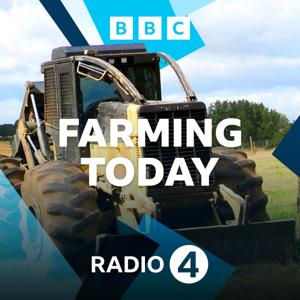
Farming Today

Farming Today

By BBC Radio 4Science
Download on the App Store
  • Favorites

    227

    Followers

  • Typical duration

    14 min

    per episode

Based on Podcast App listening data

Farming Today episodes

  • 08/05/23 - The Crown and the Countryside
    As a new King is crowned, Vernon Harwood looks at the role Charles III has played in shaping and supporting farming in the UK. From his first major speech on the environment as a young Prince of Wales in 1970, to his unconventional and often criticised organic farming methods in the 1980s, he continues to be concerned about the future for upland farmers and the profitability of small family businesses.
    We hear insights from the King’s former Farm Manager in Gloucestershire, the Cumberland Bed-and-Breakfast owners who formed a lasting friendship with the monarch and the fifth-generation Exmoor farmer who sees first-hand the impact the Prince’s Countryside Fund has on isolated communities.
    For decades Charles was a passionate and sometimes forthright voice supporting everything from traditional country crafts to Britain’s native farm breeds. But with new responsibilities as sovereign, what now for the man dubbed ‘Britain’s most famous farmer’?
    Produced and Presented for BBC Audio in Bristol by Vernon Harwood
    Archive material used in this programme:
    Conservation Year Speech in Cardiff; BBC Radio 4 Wales, 19/02/1970
    Rethinking Food & Farming – Farming Today; BBC Radio 4, 26/06/2020
    Royal visit to Cumberland – Six O’Clock News; BBC Radio 4, 25/09/2001
    Highgrove event – Country Matters; BBC Radio Gloucestershire, 26/07/2015
    12 min
  • 06/05/23 Farming Today This Week: Beef and climate, horticulture strategy scrapped by Government
    The Climate Change Committee, the independent body which advises all of the UK governments on climate change, says that to meet targets on lowering emissions, we need to eat and farm less beef.
    We hear how researchers and farmers have been working to reduce the carbon footprint of beef.
    There will not be a government horticulture strategy in England. One was promised last June as part of the Government Food Strategy, which committed to developing a 'world-leading horticulture strategy for England’.  But despite recent shortages of some vegetables in the supermarkets, this week the Farming Minister confirmed it would "not be developing a published strategy...as originally envisaged".
    Presented by Charlotte Smith and produced by Beatrice Fenton.
    26 min
  • 05/05/2023: Climate change and beef, Rare Breed cattle
    The Climate Change Committee - the independent body which advises all of the UK governments on climate change - says that to meet targets on lowering emissions we need to eat and farm less beef.
    The Committee Chair Lord Deben explains why, and Tom Bradshaw from the NFU tells Caz Graham that UK beef production could actually help reduce global beef emissions.
    Gloucester cattle have been categorised by the Rare Breeds Survival Trust as a 'priority breed'. Farming Today has been to visit a farm to hear how the Gloucester Cattle Society is helping maintain and improve the breed.
    Presenter: Caz Graham
    Producer: Alun Beach
    14 min
  • 03/05/2023: Carbon footprint of beef production; Lowland peat lands
    Anna has joined academics from Cambridge University and a group of farmers to see how they are hoping to tackle the dilemma of growing vegetables without drying out lowland peat lands, which can release carbon into the atmosphere.
    And staying on this theme, an agricultural university is experimenting with methods of raising beef with the lowest possible carbon footprint.
    Nick Allen the Chief Executive of the British Meat Processors Association gives his view on whether the resulting meat will be welcomed by supermarkets, or not.
    Presented by Anna Hill
    Produced by Alun Beach
    14 min
  • 02/05/2023 Airport's impact on rivers, native oysters in the Solent, grass-fed beef
    The runways impacting rivers: people living in villages near the East Midlands Airport are concerned local water courses are being contaminated by de-iced aircraft.
    Thousands of native oysters are being reintroduced into the Solent more than 30 years after stocks there declined.
    This week we'll be looking at the business of beef. Edward Hawkins from Somerset is striving to improve his farm's carbon footprint, working to improve the grass, soils and the efficiency of his farm.
    Presented by Charlotte Smith and produced by Beatrice Fenton.
    14 min
  • 01/05/23 - Deer Management
    The number of Red Deer in the Scottish Highlands has doubled in the past 50 years. It's great news for wildlife-watchers, but it's also causing problems because the deer are damaging woodlands and other fragile habitats.
    So what's the solution? Richard Baynes investigates.
    12 min
  • 29/04/23 Jersey cattle deaths; Love Island farmer; Payments to improve the environment; seed potatoes; wheat robot.
    An investigation into the death of more than 100 cows on Jersey has found that the most likely cause of death was botulism in cattle feed. The farm has now told the BBC that rebuilding its herd will take seven years, and they face particular challenges because of the island’s ban on importing Jersey cows to protect the national herd’s genetic purity.
    He has millions of followers on social media, but manages to get up at the crack of dawn to help with lambing: Will Young, also known as Farmer Will on ITV's Love Island. He's now back in Buckinghamshire on the family farm, joined by his TV partner, Jessie.
    The 'nature markets framework' has been published by the government outlining how farmers will be able to have multiple payments if several different environmental improvements are made on one piece of land, it's known as stacking. It's to do with the Environmental Land Management Schemes or ELMS - which are coming in in England and will pay farmers public money for environmental work.
    A glimmer of hope for Scottish seed potato growers, as Defra minister confirms exports to Northern Ireland will be allowed again from the autumn.
    Engineers have developed a unique burrowing robot which ‘swims’ through grain stores to ensure the seeds are kept properly. The t-shaped robot has been launched by an agritech developer at Scotland's National Robotarium, based at Heriot-Watt University in Edinburgh. It's designed to help farmers look after their grain more efficiently, without having to carry out labour-intensive checks.
    The teenage farmer who's got the tenancy for a 600 acre farm in the Outer Hebrides.
    Presenter = Charlotte Smith
    Producer = Rebecca Rooney

    25 min
  • 27/04/23 Scottish seed potatoes to NI, seed processing, seagrass restoration
    A glimmer of hope for Scottish seed potato growers, as Defra minister confirms exports to Northern Ireland will be allowed again from the autumn.
    On the Humber Estuary conservationists are encouraging seagrass to return by planting tens of thousands of seeds by hand.
    The agricultural industry spends millions of pounds a year on seeds for cereals, but where do farmers get them from and what happens to them before they’re sold?
    Presented by Caz Graham and produced by Beatrice Fenton.
    14 min
  • 25/04/23 Payments to improve the environment; water bosses and river pollution; grass trials
    The Government's confirmed that landowners and farmers will be able to have multiple payments if several different environmental improvements are made on one piece of land, it's known as stacking and an expert explains how it works.
    After a Herefordshire farmer was jailed for wrecking the River Lugg as it ran through his land, water companies have come under renewed criticism for failing to stop sewage polluting rivers. Wessex Water is paying a total of more than £200,000 to executives, despite discharges of foul water into its rivers after heavy rain. Wessex Water has defended the bonuses, saying the company has exceeded its targets.
    This week we're looking at seeds, and we visit a trial site where one of the UK's largest grass seed breeders plants thousands of different grasses to develop new varieties.
    Presenter = Anna Hill
    Producer = Rebecca Rooney

    14 min

More shows like Farming Today

Global News Podcast by BBC World Service

Global News Podcast

7,599 Listeners

The Archers by BBC Radio 4

The Archers

1,111 Listeners

From Our Own Correspondent by BBC Radio 4

From Our Own Correspondent

374 Listeners

More or Less by BBC Radio 4

More or Less

880 Listeners

Newshour by BBC World Service

Newshour

1,048 Listeners

Wake Up to Money by BBC Radio 5 Live

Wake Up to Money

55 Listeners

Money Box by BBC Radio 4

Money Box

42 Listeners

The Martin Lewis Podcast by BBC Radio 5 Live

The Martin Lewis Podcast

119 Listeners

In Our Time by BBC Radio 4

In Our Time

5,527 Listeners

The Documentary Podcast by BBC World Service

The Documentary Podcast

1,803 Listeners

6 Minute English by BBC Radio

6 Minute English

1,807 Listeners

Learning English Conversations by BBC Radio

Learning English Conversations

1,041 Listeners

Last Word by BBC Radio 4

Last Word

49 Listeners

Gardeners' Question Time by BBC Radio 4

Gardeners' Question Time

284 Listeners

The Food Programme by BBC Radio 4

The Food Programme

262 Listeners

Scotland Outdoors by BBC Radio Scotland

Scotland Outdoors

246 Listeners

Ramblings by BBC Radio 4

Ramblings

162 Listeners

The Bottom Line by BBC Radio 4

The Bottom Line

36 Listeners

The Plodcast by Our Media

The Plodcast

110 Listeners

Gardening with the RHS by Royal Horticultural Society

Gardening with the RHS

257 Listeners

You're Dead to Me by BBC Radio 4

You're Dead to Me

3,338 Listeners

The Missing Cryptoqueen by BBC Sounds

The Missing Cryptoqueen

1,004 Listeners

Americast by BBC News

Americast

822 Listeners

The Farmers Weekly Podcast by Farmers Weekly

The Farmers Weekly Podcast

14 Listeners

The Bomb by BBC World Service

The Bomb

1,005 Listeners