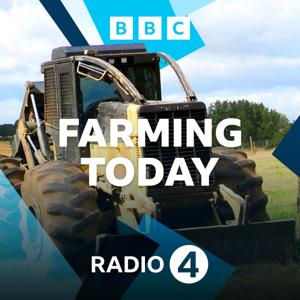
Farming Today

Farming Today

By BBC Radio 4Science
Download on the App Store
  • Favorites

    227

    Followers

  • Typical duration

    14 min

    per episode

Based on Podcast App listening data

Farming Today episodes

  • 17/03/23 Sheep numbers on Dartmoor to be drastically reduced: Private finance carbon capture
    Farmers on Dartmoor say they've been told they must radically reduce the number of livestock on common land if they want to remain in government schemes. Natural England has written to commons associations, which cover much of Dartmoor, offering rollovers of existing Higher Level Stewardship Schemes, but only if they stop winter grazing, and drastically reduce the number of animals on the land in the summer - on some commons by an average of 75 percent. We speak to a farmer who's got to reduce his livestock by 91 per cent and the area manager for Natural England.
    Who should pay to restore biodiversity in the UK? Governments are keen to encourage private money to work alongside their schemes and Scotland's government nature agency, NatureScot, has announced a £2 billion private finance pilot designed to secure landscape scale restoration of native woodlands. Critics are concerned that carbon credit markets are unregulated and don't incentivise companies to reduce emissions.
    Presenter = Charlotte Smith
    Producer = Rebecca Rooney
    14 min
  • 16/03/23 Budget response: from a farming and environmental perspective; Plant Atlas.
    Experts have been unpicking the budget and what it means for farming and the rural economy. Chancellor Jeremy Hunt billed it as a growth budget, to set the UK up as an enterprise economy. Agricultural advisors say tax breaks will encourage big farming companies to invest in new machinery and technology but smaller farms, that aren't limited companies may not benefit in the same way. There's no mention of support with energy bills for the horticulture or poultry sector.
    There was a £20 billion pledge to invest in carbon capture and storage over the next 20 years. The Green Alliance says a similar commitment was pulled in 2014, and say the scheme outlined in the budget is not focused on the kind of carbon sequestration farmers are involved with in Environmental Land Management Schemes, by planting cover crops, hedgerows and trees.
    A twenty year research project into the health of British and Irish plant species concludes there’s been a devastating loss of native flora. Not only have half of our native plants like heather and harebell declined, they say that non native plants now outnumber native British ones in the wild. The Botanical Society of Great Britain and Ireland says its newly published Plant Atlas 2020 is the most in-depth survey of British and Irish flora ever undertaken.
    Presenter = Caz Graham
    Producer = Rebecca Rooney
    14 min
  • 15/03/23 Rural poverty; biodiversity credits; tree disease
    Farmers and countryside communities are asking for more support in the budget, and a new book by academics specialising in rural affairs says "The needs of the poorest and most vulnerable people in rural areas, are ignored by the Government in a way that would not be acceptable in urban centres". The group of academics from Newcastle University, Scotland’s Rural College (SRUC) and Inverness Impact-Hub, have written a new book called Rural Poverty Today. For instance, it shows that those living in rural areas face energy costs 15-30 per cent higher than those in towns. We speak to one of the authors, Professor Mark Shucksmith from Newcastle University
    Improving bio-diversity and sequestering carbon, and getting paid for it. That's an increasingly attractive proposition for farmers. But a growing number of them aren't applying for government money via Defra - public money for public goods. They're teaming up with the private sector. Brewood Park Farm near Wolverhampton is part of a group called "The Green Collective" - half a dozen farms are working with a local company called YourPact to get investment from businesses in the Midlands. Their money's helping to improve habitats for birds, improve the soil and plant cover crops.
    Tens of thousands of trees in the Forest of Dean in Gloucestershire are being removed because of the tree disease Phytophthora ramorum and re-planting schemes are getting underway. Larch, which are widely grown for the timber market, are particularly susceptible to the disease, which has been in the UK for nearly 15 years. It can be spread on plant material, or in waterways and through the air.
    Presenter = Anna Hill
    Producer = Rebecca Rooney
    14 min
  • 14/04/23 Nepalese workers exploited; re-introducing sea eagles; new wetlands
    An investigation by the Gangmasters and Labour Abuse Authority, or the GLAA says that hundreds of workers in meat processing, recruited from Nepal, were exploited and found to have paid 12 thousand pounds to find a job. Such fees are illegal in the UK. The company, Adept and Agile, has lost its licence and the two directors - one based in Surrey, the other in Nepal, have been handed an interim Slavery and Trafficking Risk Order. We speak to Nicola Ray, head of regulation at the GLAA.
    Conservationists in Wales hope to reintroduce white-tailed eagles. It's been done in Scotland, but NFU Cymru says farmers in Wales are concerned the birds of prey would hunt newborn lambs.
    All week we're looking at biodiversity. Wetlands are precious areas for particular species, and in Buckinghamshire a new project is creating a ten hectare site which will provide a home for wetland plants, aquatic and semi-aquatic invertebrates, amphibians and fish. Thousands of tonnes of topsoil had to be removed from the site on the Waddeston Estate which is managed by the Rothschild Foundation. The underlying clay will form the base for a series of ponds, and the plan is to allow nature to re-colonise the site.
    Presenter = Anna Hill
    Producer = Rebecca Rooney
    14 min
  • 13/03/23 Fruit growers giving up on apples, the Precision Breeding Act, Wild Isles.
    The rising cost of food production is hitting farmers and growers all over the UK, from salad producers to livestock farmers and the fruit growers cancelling orders for new trees. Now some orchard owners say contracts to grow apples for supermarket chains are so uneconomic they're forced to destroy their existing trees.
    Later this week it's expected that the law on gene editing will officially change as the Precision Breeding Act gets Royal Assent. The Act allows the use of gene editing technology to create new plant varieties.
    Last night the UK got the big glossy nature programme treatment with the first episode of Sir David Attenborough's Wild Isles. With that in mind, all this week here on Farming Today we'll be talking about biodiversity.
    Presented by Charlotte Smith and produced by Beatrice Fenton.
    12 min
  • 11/03/2023 Farming Today This Week: food fraud, imported beef sold as British; upland farm incomes; drought
    Imported meat labelled as British has been sold by a retailer which advertises that it sells only British meat. The National Food Crime Unit is investigating after discovering that one of the retailers' suppliers has been selling it what's described as 'large volumes' of pre-packed South American and European beef, labelled as British. Ten years after the horse meat scandal, we ask how this sort of fraud can happen.
    Hill farmers describe new government payment scheme as "the greatest catastrophe for nature and farming in a lifetime". New figures from DEFRA show payments for upland farmers will be down 65% under the new Environmental Land Management Scheme or ELMS, compared to previous payments under the old EU system. Author and hill farmer James Rebanks says it will force farmers to increase the number of livestock they keep - the opposite of what the government says it wants. Farming minister Mark Spencer defends DEFRA's plans.
    As parts of the country struggle with snow, farmers in the east of England are hoping for more rain. East Anglia has had the driest February since 1959 - the third driest on record. We find out how farms are changing what they grow, to cope with a lack of water.
    Presenter = Charlotte Smith
    Producer = Rebecca Rooney
    25 min
  • 10/03/2023 Food fraud: imported beef sold as British
    Imported meat labelled as British has been sold by a retailer which advertises that it sells only British meat. The National Food Crime Unit is investigating after discovering that one of the retailers' suppliers has been selling it what's described as 'large volumes' of pre-packed South American and European beef, labelled as British. Ten years after the horse meat scandal, we ask how this sort of fraud can happen.
    All this week we've been talking about dairy farming. One of their big challenges has been what to do with male dairy calves. Obviously only females produce milk and in the past thousands of male or ‘bobby’ calves were killed soon after birth. But the Red Tractor assurance scheme, which covers 95% of UK milk production, has banned routine euthanasia of calves from this year. We meet a farmer rearing male calves for veal.
    Presented by Charlotte Smith and produced by Beatrice Fenton.
    14 min
  • 09/03/2023 Anger at drop in income for hill farmers, dairy welfare tech, new register for backyard hens
    "The greatest catastrophe for nature and farming in a lifetime". That's the verdict of the lake district hill farmer and writer James Rebanks on the Government's payments to upland farmers. Figures from Defra that show incomes for upland farmers are facing a massive hit, as payments under the new post-Brexit scheme in England do not come up to the level of previous payments under the old EU system. Mr Rebanks tells us that will force farmers to increase the number of livestock they keep - the opposite of what the Government says it wants.
    A cow mattress, lameness monitoring or a cattle handling system - just some of the things farmers in England can now get a grant for as part of the Government's Sustainable Farming Incentive. Livestock farmers in England can now access grants of up to £25,000 to improve the welfare of their animals. This week we're focusing on dairy farming and so those grants might help buy ball toys for calves or a computer programme for monitoring lameness, and some of the available options were on display at this year's Dairy Tech event.
    Should everyone keeping hens have to register with the Government? At the moment only people who keep a flock of more than 50 has to register with the Animal and Plant Health Agency, but Defra is consulting on plans to extend that in an attempt to control the spread of avian flu. This would also cover birds of prey and pigeons but not pet birds kept inside. As we've reported, the past few years have seen the biggest outbreak of bird flu here and across Europe with tens of millions of poultry birds culled and a big impact on wild bird populations too. We hear from the Cheif Vet, Christine Middlemiss.
    Presented by Charlotte Smith and produced by Beatrice Fenton.
    14 min
  • 08/08/2023 - Poultry energy costs; drought; dairy farms and environmental permits.
    Poultry farmers are appealing to the government to include them on a list of industries which would get help paying their energy costs. The Energy Bill Relief Scheme is being replaced by the Energy and Trade Intensive Industry Scheme - but agricultural producers are not included in either. Poultry production has declined recently, partly due to avian flu but also because of the huge rise in the cost of heating, ventilating and feeding indoor chickens for meat. The indoor vegetable industry is also asking the government for help with energy costs.
    While Scotland is battling with the snow, farmers in East Anglia and the South West are still hoping for more rain. East Anglia in particular had the driest February since 1959 and the third driest on record, and for a region where three quarters of the land produces grain and vegetables, lack of rain can have a serious impact nationwide. We visit the Euston Estate near Thetford to hear how low water levels have changed what they are growing.
    One of the big issues facing the dairy farming sector is pollution. Slurry that's not stored properly can pollute both air and rivers. Last year two thirds of dairy and beef farms in one region of England were found to be causing pollution, when the Environment Agency inspected 187 farms in Devon between 2016 and 2020. The EA report concluded that dairy farmers were taking a calculated business risk not to invest to stop pollution because the chances of being fined are so tiny. The Environment Agency has committed to introducing a system of environmental permits for dairy and beef farms to clamp down on pollution incidents, but the industry is worried. We visit a dairy farmer in Somerset.
    Presenter: Anna Hill
    Producer: Rebecca Rooney
    14 min
  • 07/03/23 - Upland farm incomes; DEFRA net zero policies; Indoor dairy herds.
    New figures show incomes for upland farmers are facing a massive hit, as payments under the new ELMs scheme do not come up to the level of previous payments under the old EU system. The expected income for upland farm businesses, published by DEFRA, for 2022/23 is just £16,300 - that's a 65 per cent reduction. Hill farmers have always relied more heavily on subsidies, and the EU system of paying per hectare underpinned their income. It was hoped that post-Brexit, the new Environmental Land Management scheme or ELMs would pay farmers for providing public goods, such as carbon sequestration, wildlife habitat and flood mitigation, but upland farmers say they are getting less money for providing public benefits than lowland producers.
    A leaked document is said to show that the Department for Environment Food and Rural Affairs, DEFRA, is lagging behind its official target of implementing green policies to combat climate change, and that it is in danger of missing a legal deadline to submit a climate plan for agriculture by the end of this month. DEFRA has faced criticism by government advisers on the climate change committee. We speak to the journalist who's seen the leaked documents, and hear from the chair of Climate Change Committee, Lord Deben.
    Most dairy farmers graze their herds outdoors on pasture for most of the year, only bringing them in during the winter. However, around a fifth of UK dairy farmers keep some or all of their cows indoors, all year round. We speak to a farmer in Staffordshire who's made the switch. He's built a new shed to house his animals all year round and says the livestock are healthier and the milk yields higher.
    Presenter: Anna Hill
    Producer: Rebecca Rooney

    14 min

More shows like Farming Today

Global News Podcast by BBC World Service

Global News Podcast

7,599 Listeners

The Archers by BBC Radio 4

The Archers

1,111 Listeners

From Our Own Correspondent by BBC Radio 4

From Our Own Correspondent

374 Listeners

More or Less by BBC Radio 4

More or Less

880 Listeners

Newshour by BBC World Service

Newshour

1,048 Listeners

Wake Up to Money by BBC Radio 5 Live

Wake Up to Money

55 Listeners

Money Box by BBC Radio 4

Money Box

42 Listeners

The Martin Lewis Podcast by BBC Radio 5 Live

The Martin Lewis Podcast

119 Listeners

In Our Time by BBC Radio 4

In Our Time

5,527 Listeners

The Documentary Podcast by BBC World Service

The Documentary Podcast

1,803 Listeners

6 Minute English by BBC Radio

6 Minute English

1,807 Listeners

Learning English Conversations by BBC Radio

Learning English Conversations

1,041 Listeners

Last Word by BBC Radio 4

Last Word

49 Listeners

Gardeners' Question Time by BBC Radio 4

Gardeners' Question Time

284 Listeners

The Food Programme by BBC Radio 4

The Food Programme

262 Listeners

Scotland Outdoors by BBC Radio Scotland

Scotland Outdoors

246 Listeners

Ramblings by BBC Radio 4

Ramblings

162 Listeners

The Bottom Line by BBC Radio 4

The Bottom Line

36 Listeners

The Plodcast by Our Media

The Plodcast

110 Listeners

Gardening with the RHS by Royal Horticultural Society

Gardening with the RHS

257 Listeners

You're Dead to Me by BBC Radio 4

You're Dead to Me

3,338 Listeners

The Missing Cryptoqueen by BBC Sounds

The Missing Cryptoqueen

1,004 Listeners

Americast by BBC News

Americast

822 Listeners

The Farmers Weekly Podcast by Farmers Weekly

The Farmers Weekly Podcast

14 Listeners

The Bomb by BBC World Service

The Bomb

1,005 Listeners