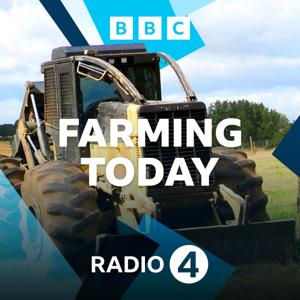
Farming Today

Farming Today

By BBC Radio 4Science
Download on the App Store
  • Favorites

    227

    Followers

  • Typical duration

    14 min

    per episode

Based on Podcast App listening data

Farming Today episodes

  • 20/02/23 - Seasonal worker scheme, species re-introductions and global food trade
    The Government needs to 'go back to the drawing board' and re-design the visa system for seasonal workers in food and farming. That's according to researcher, Dr Lydia Medland from the University of Bristol, who says the current scheme leaves both workers and operators vulnerable. 45,000 visas are available this year for people to come to the UK to work on farms or in food processing. Last week we reported that one of the 6 firms which operates the scheme has had its licence revoked - the Home Office wouldn't tell us why and the company says the revocation is unjust and is considering appealing.
    We hear how species re-introductions can be used to restore ecosystem services like pollination or nutrient cycling.
    And Asia and North Africa are the most exciting emerging export markets for British livestock farmers over the next decade - according to a new report published today by the industry body AHDB.
    Presented by Charlotte Smith
    Produced for BBC Audio in Bristol by Heather Simons
    12 min
  • 18/03/23 Farming Today This Week: Seasonal Labour; Environment Agency delays; Space tech used in food and farming; Lambing
    One of the firms which operates the Government’s visa scheme for seasonal workers in food and farming has had its licence revoked. AG Recruitment was one of six companies which brought temporary workers from Europe and around the world to work on UK farms. We ask British Growers what this means for a sector which is already struggling to find workers to pick their fruit and veg this summer.
    A farmer who lost all his ducks through bird flu, says delays with paperwork could jeopardize his plans to produce chickens instead. Tom McVeigh wants to house broilers on his farm in Suffolk after 95,000 ducks died because of avian influenza. He needs the Environment Agency to sign off on the the change of use but says they've told him staff shortages mean instead of taking six weeks to process the paperwork, it'll take six months.
    All week we are boldly going beyond our world to talk about how food and farming can benefit from our exploration of space. From satellites guiding tractors and scouting for illegal fishing operations, to zero gravity crops. We speak to: the UK Space Agency about how space exploration already has an impact on farms; an Israeli company which has produced lab-grown meat in space; a tech start-up which is taking technology designed for exploring Mars to weed organic crops; and a campaign group which is using images from space to keep tabs on illegal fishing.
    Early lambing's started, which means late nights and early mornings on some sheep farms. We join one couple who breed Texel rams in the lambing shed on their farm in Gloucestershire.
    Presenter = Charlotte Smith
    Producer = Rebecca Rooney
    25 min
  • 17/02/23 - Seasonal workers, Mars rover tech and lambing
    One of the firms which operates the Government’s visa scheme for seasonal workers in food and farming has had its licence revoked. AG Recruitment was one of six companies which brought temporary workers from Europe and around the world to work on UK farms.
    Technology originally developed to explore Mars is now being used on farms, to weed. We find out more as trials commence in Spain.
    And Devon Closewools are classed as "At Risk" by the Rare Breeds Survival Trust - with only around 3,000 breeding ewes, all concentrated in North Devon and Exmoor. We visit a flock at lambing time.
    Presented by Charlotte Smith
    Produced for BBC Audio in Bristol by Heather Simons
    14 min
  • 16/02/23 - Monitoring fishing from space, lambing and ammonia emissions
    Illegal fishing is being monitored from space. Global Fishing Watch, a non profit organisation, uses information from a variety of tracking sources to work out which boat is which, where they are and what they're doing.
    There is a definite feeling of spring in the air - and fields - as early lambing is underway. We visit a lambing shed in Gloucestershire.
    And there are calls for farmers - and consumers - to do more to tackle air pollution. Figures released this week by DEFRA show 87% of ammonia emissions in 2021 came from agriculture - mainly from the spreading of manures, slurries and fertilisers. Ammonia by itself can damage sensitive habitats, but when it mixes with other gases in the atmosphere, like nitrogen oxides and sulphur dioxide, it can also form particulate matter, which can cause health problems when breathed in.
    Presented by Charlotte Smith
    Produced for BBC Audio in Bristol by Heather Simons
    14 min
  • 15/02/23 Environment Agency delays; Meat in space; Seabirds
    A Suffolk farmer who invested in growing ducks but got hit by bird flu, is trying to switch to chickens instead but says his plan is being jeopardized because of labour shortages at the Environment Agency. Tom McVeigh from Kenton Hall lost 95,000 ducks to avian flu. He now wants to rear broilers but needs the Environment Agency to sign off the change of use. However, he says there are big delays to the paper work and it could stop the project going ahead.
    DEFRA Secretary Terese Coffey is in America and will be speaking at the National Association of State Departments of Agriculture Winter Conference. It's the first time a foreign minister has addressed the gathering. Dr Coffey is expected to talk about forging a sustainable future and US/UK co-operation.
    All week we're getting a very different perspective on farming and finding out how space research and exploration could impact agriculture now, and in the future. What do astronauts eat for lunch? Well if it's been pouches of pre-prepared meals they might like a change. How about steak? A company called Aleph Farms based in Israel has made lab-grown meat in space.
    Conservationists say offshore windfarms in the North Sea need to reduce the impact they’re having on seabirds. The warning comes as the latest windfarm, Hornsea 4, has been delayed, following concerns about the Kittiwake – an endangered species of gull. Hornsea 4’s developers say they’re working hard to ensure green energy and seabird populations can co-exist.
    Presenter = Anna Hill
    Producer = Rebecca Rooney

    14 min
  • 14/02/23 - Scottish agricultural policy reform and monitoring forests from space
    Farmers and crofters in Scotland have criticised the Scottish Government's lack of detail about future payments and the structure of farm support. The Cabinet Secretary for Rural Affairs and Islands, Mairi Gougeon, announced a long-awaited 'roadmap' for agricultural reform at the National Farmers Union for Scotland conference, at the end of last week.
    And if you can't see the wood for the trees then a satellite might provide a much better perspective! We hear from a company monitoring forests, natural capital and carbon capture from space.
    Presented by Anna Hill
    Produced for BBC Audio in Bristol by Heather Simons
    14 min
  • 13/02/2023 - Shellfish deaths, Mental health, Farming from space
    The Government says there will be no further investigation of what caused the mass die-off of shellfish on England's North East coast in 2021. Environment Secretary, Therese Coffey, says "given the extent of the analytical work already undertaken... I have decided it is highly unlikely we will ever find the cause, so no further analysis will be undertaken by the government". She also says there is no question of the government providing compensation. We get reaction from fishing crews.
    Poor mental health is one of the biggest hidden problems facing farmers - that's according to the Farm Safety Foundation. This week the foundation is running its 'Mind Your Head' campaign - highlighting what it says are deteriorating levels of mental wellbeing in agriculture over the past three years and the impact that can have on safety.
    And we boldly go beyond our world to talk about how food and farming can benefit from our exploration of space. From satellites guiding tractors and scouting for illegal fishing operations, to zero gravity crops!
    Presented by Charlotte Smith
    Produced for BBC Audio in Bristol by Heather Simons
    12 min
  • 10/02/23 - NFU Scotland conference, Peat, Right to roam
    Scottish farmers say they need to know details of plans for direct payments - and fast. The National Farmers Union Scotland is having its annual conference and its president, Martin Kennedy, says his members need details of the new scheme which will replace CAP - and soon, or it will have a serious impact on food producers, processors and the whole Scottish economy. He says at the moment farmers still don't know how it will work, or what the budget will be.
    Horticultural peat will be banned next year, but peat is still being extracted from the largest remaining wetland in England - the Somerset Levels. Peat has been taken from the area for burning and for use as compost for over 2000 years – but the Government has now stopped granting licences for peat extraction in England as it's valuable for carbon sequestration and biodiversity. Extraction on the Levels will end when the current licences expire, so the company removing small amounts of peat from the Levels near Glastonbury is re-thinking the future.
    The right to roam is controversial topic, the Labour party says if it wins the election it will introduce the right in England. In Scotland there is a right to roam and wild camp. Richard Baynes visits a Scottish farming family which relies on tourism. The Duncan family farm beef cattle and sheep on three farms and one of them is on the edge of the Loch Lomond and the Trossachs National park. The family have two glamping pods, but they say some tourists can be problematic.
    Presenter: Charlotte Smith
    Producer: Rebecca Rooney
    14 min
  • 09/02/23 Right to roam on farms, peat training, pests' genomes.
    The debate about where people can and can't go in the English and Welsh countryside is back on. The Labour Party says if it wins the next election it'll introduce a right to roam and will re-introduce wild camping on Dartmoor too, after a high court decision banned it. What do farmers think?
    We're talking about peat all this week on Farming Today and the Scottish Government wants to restore a quarter of a million hectares of degraded peat by 2030, under its Peatland Action programme. But it’s reckoned 1,500 more peat restorers are needed, so Scotland's first course in peatland restoration has been launched.
    The genome of 19 insects which damage crops have been mapped by scientists at Rothamsted Research and their work has been made public. They hope it will lead to more targeted pesticides and other non-chemical methods of controlling crop pests.
    Presented by Charlotte Smith and produced by Beatrice Fenton.
    14 min
  • 08/02/23 TB vaccine trials; Government reshuffle; Rewetting peatlands
    The DEFRA programme to pilot a vaccine for cattle against Bovine Tuberculosis is about the enter its second stage. This will involve five farms with 600 cattle. The trial combines the BCG vaccine and the DIVA test, which shows clearly which cattle have been vaccinated and which have been challenged by the disease, and it's hoped both together could work to identify where the disease is and also protect cattle at risk.
    There's been a re-organisation of government departments. Grant Shapps is the new Energy Security and Net Zero Secretary; Michelle Donelan becomes the Science, Innovation and Technology Secretary. Both of those roles will have to liaise closely with DEFRA - on the future of land use for energy, and innovations including gene editing.
    All week we’re taking a look at the future of our peatlands. In many parts of the country lowland peat is drained and used to grow vegetables and other crops but this degrades the peat and emits carbon. Farmers in Germany are developing something called ‘paludiculture’, using re-wetted peat lands to grow water tolerant vegetation, which also has a market. A company called Wetland Products is growing bulrushes in water-covered peat and turning it into housing insulation, takeaway food packaging, and compost for commercial growers. Bulrushes and reeds also clean up the excess nutrients in the water where they grow. Also in the Fens, a group of farmers and scientists are working together to see if they can change the way farming food is done on peatlands. A collaboration called Fenland Soil has been set to try out new wetter farming techniques.
    Presenter = Anna Hill
    Producer = Rebecca Rooney
    14 min

More shows like Farming Today

Global News Podcast by BBC World Service

Global News Podcast

7,599 Listeners

The Archers by BBC Radio 4

The Archers

1,111 Listeners

From Our Own Correspondent by BBC Radio 4

From Our Own Correspondent

374 Listeners

More or Less by BBC Radio 4

More or Less

880 Listeners

Newshour by BBC World Service

Newshour

1,048 Listeners

Wake Up to Money by BBC Radio 5 Live

Wake Up to Money

55 Listeners

Money Box by BBC Radio 4

Money Box

42 Listeners

The Martin Lewis Podcast by BBC Radio 5 Live

The Martin Lewis Podcast

119 Listeners

In Our Time by BBC Radio 4

In Our Time

5,527 Listeners

The Documentary Podcast by BBC World Service

The Documentary Podcast

1,803 Listeners

6 Minute English by BBC Radio

6 Minute English

1,807 Listeners

Learning English Conversations by BBC Radio

Learning English Conversations

1,041 Listeners

Last Word by BBC Radio 4

Last Word

49 Listeners

Gardeners' Question Time by BBC Radio 4

Gardeners' Question Time

284 Listeners

The Food Programme by BBC Radio 4

The Food Programme

262 Listeners

Scotland Outdoors by BBC Radio Scotland

Scotland Outdoors

246 Listeners

Ramblings by BBC Radio 4

Ramblings

162 Listeners

The Bottom Line by BBC Radio 4

The Bottom Line

36 Listeners

The Plodcast by Our Media

The Plodcast

110 Listeners

Gardening with the RHS by Royal Horticultural Society

Gardening with the RHS

257 Listeners

You're Dead to Me by BBC Radio 4

You're Dead to Me

3,338 Listeners

The Missing Cryptoqueen by BBC Sounds

The Missing Cryptoqueen

1,004 Listeners

Americast by BBC News

Americast

822 Listeners

The Farmers Weekly Podcast by Farmers Weekly

The Farmers Weekly Podcast

14 Listeners

The Bomb by BBC World Service

The Bomb

1,005 Listeners