
Sign up to save your podcasts
Or



Based on Podcast App listening data
Imagine if you could reverse ageing and cognitive decline and improve your brain health purely through your mindset and approach to life.
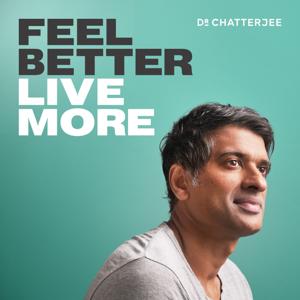
Feel Better Live More Bitesize is my new weekly podcast for your mind, body and heart. Each week I’ll be featuring inspirational stories and practical tips from some of my former guests.
This week’s guest is Daniel Levitin, a neuroscientist, cognitive psychologist and bestselling author. He explains why what we do day-to-day affects not just our short-term health, but also how our brain changes with age.
Daniel describes 3 personality traits, or mindsets, that are the key ingredient to longterm health and happiness. By cultivating a mindset of conscientiousness, curiosity & gratitude we can slow the ageing process.
These are simple and fun things we can do now to live a live a healthy and fulfilling life both today and into our old age.
Show notes and the full podcast are available at drchatterjee.com/112
Follow me on instagram.com/drchatterjee/
Follow me on facebook.com/DrChatterjee/
Follow me on twitter.com/drchatterjeeuk
DISCLAIMER: The content in the podcast and on this webpage is not intended to constitute or be a substitute for professional medical advice, diagnosis, or treatment. Always seek the advice of your doctor or other qualified health care provider with any questions you may have regarding a medical condition. Never disregard professional medical advice or delay in seeking it because of something you have heard on the podcast or on my website.
Learn more about your ad choices. Visit podcastchoices.com/adchoices
In times of uncertainty, anxiety and stress, taking care of your wellbeing is more important than ever and no one knows this better than my guest on today’s episode. Arianna Huffington is author and businesswoman who founded the original ‘internet newspaper’, The Huffington Post. She’s also one of Time magazine’s 100 Most Influential People in the World and on Forbes’ Most Powerful Women list.
After collapsing at her desk from sleep deprivation and exhaustion in 2007, Arianna became more passionate about the connection between wellbeing and performance. She therefore launched a company called Thrive Global with a mission of ending the stress and burnout epidemic by offering individuals, companies and communities sustainable, science-based solutions to wellbeing.
Arianna and I share a desire to show millions of people globally that habit change and healthy living doesn’t have to be hard. We are both passionate that tiny ‘microsteps’ that we can all take each day, can have a dramatic impact on our health and the quality of our lives.
Arianna talks me through her Thrive app, which is like a ‘health coach in your pocket’ and how it uses the concept of ‘microsteps’ to show that behaviour change doesn’t have to be a huge commitment. Small things you can do that, if regular and consistent, will add up to significant and lasting benefits.
We discuss the idea of ‘compassionate directness’ as a way of resolving tensions both at home and at work. Arianna shares her wisdom on sleep, motherhood, on creating boundaries when working from home, and on having rituals to mark the end of the day. We also speak about the importance of solitude and discuss how modern life is sending many of us back to ancient wisdom and texts such as the Bhagavad Gita.
This conversation is full of brilliant tips and I hope you enjoy it as much as I did.
Show notes available at drchatterjee.com/136
Follow me on instagram.com/drchatterjee/
Follow me on facebook.com/DrChatterjee/
Follow me on twitter.com/drchatterjeeuk
DISCLAIMER: The content in the podcast and on this webpage is not intended to constitute or be a substitute for professional medical advice, diagnosis, or treatment. Always seek the advice of your doctor or other qualified health care provider with any questions you may have regarding a medical condition. Never disregard professional medical advice or delay in seeking it because of something you have heard on the podcast or on my website.
Learn more about your ad choices. Visit podcastchoices.com/adchoices
The power to achieve anything you want in life is within you - whether it’s improving your health, starting a business or getting a relationship back on track.
Feel Better Live More Bitesize is my new weekly podcast for your mind, body and heart. Each week I’ll be featuring inspirational stories and practical tips from some of my former guests.
This week’s guest is Marie Forleo, a US entrepreneur, writer, philanthropist and an unshakeable optimist.
Marie explains why a growth mindset is so important and how comparing ourselves to the curated lives of others online can be toxic. She suggests practical ways we can counteract this by choosing to create before we consume.
Marie has interviewed many successful and influential people and she reveals the one thing that they all have in common.
She believes you should do everything you can to follow your dreams. Your contribution and voice matter and your gift is unique - there never has been or ever will be another you.
Show notes and the full podcast are available at drchatterjee.com/86
Follow me on instagram.com/drchatterjee/
Follow me on facebook.com/DrChatterjee/
Follow me on twitter.com/drchatterjeeuk
DISCLAIMER: The content in the podcast and on this webpage is not intended to constitute or be a substitute for professional medical advice, diagnosis, or treatment. Always seek the advice of your doctor or other qualified health care provider with any questions you may have regarding a medical condition. Never disregard professional medical advice or delay in seeking it because of something you have heard on the podcast or on my website.
Learn more about your ad choices. Visit podcastchoices.com/adchoices
CAUTION ADVISED: this podcast contains swearing.
When I started these podcasts, back in January 2018, my aim was to connect with people who had new and exciting views on how we can feel better and get more out of life. Little did I know that would lead me to today’s episode, where I chat to one of the world’s most famous Hollywood actors.
Matthew McConaughey might not immediately spring to mind as a self-help guru. Yet for his 2014 Oscar acceptance speech he memorably shared some of the tenets by which he lives his life and to which he owes his success. And Matthew now shares his wisdom in his new book, ‘Greenlights: Raucous stories and outlaw wisdom’, which has already become a bestseller all over the globe. Based on the journals he’s kept since he was a teenager, it’s part autobiography, part guide to living – and 100 per cent inspiration.
I was so pleased to learn Matthew wanted to come on the podcast and was prepared to give me 90 minutes of his time, something almost unheard of in stars of his magnitude. But as you’ll hear in this episode, Matthew isn’t your typical movie star.
Authenticity is very important to Matthew, as is his quest to, in his words, “Be more me.” And that starts with eliminating what is not you. In Matthew’s own life, key examples include his decision to leave law school and become an actor, and later to turn down vast sums of money to leave the rom-com genre behind. Whilst he acknowledges the financial privilege that allowed him to take these risks, his lesson is about being true to yourself and your values, which is relevant for all of us. He says we should make sure we are feeding our soul account as well as our bank account, investing spiritually as well as financially.
We cover so many topics during this entertaining chat, from our favourite U2 album to the current state of society as well as the incredible value of journaling. Whilst Matthew’s approach isn’t to give advice, there’s plenty of wisdom in the colourful stories and examples from his life that he shares. The beautiful thing about living, he says, is that you’re the author of your life’s story. So be cool to your future self. That’s some pretty awesome A-list advice I think we can all benefit from.
Show notes available at drchatterjee.com/134
Follow me on instagram.com/drchatterjee/
Follow me on facebook.com/DrChatterjee/
Follow me on twitter.com/drchatterjeeuk
DISCLAIMER: The content in the podcast and on this webpage is not intended to constitute or be a substitute for professional medical advice, diagnosis, or treatment. Always seek the advice of your doctor or other qualified health care provider with any questions you may have regarding a medical condition. Never disregard professional medical advice or delay in seeking it because of something you have heard on the podcast or on my website.
Learn more about your ad choices. Visit podcastchoices.com/adchoices
Every act of kindness is significant and has more impact than you can imagine.
Feel Better Live More Bitesize is my new weekly podcast for your mind, body and heart. Each week I’ll be featuring inspirational stories and practical tips from some of my best former guests. This week’s guest is pharmacist-turned-author Dr David Hamilton.
David explains why kindness is contagious and how just one small act of kindness is proven to have a ripple effect that reaches over 100 more people.
When you’re kind to someone, it’s not just that person who benefits. Kindness makes you happier. It’s good for your heart and helps support your immune system. It slows ageing and it also improves relationships. He explains why your kindness matters and how you can take up the 7 Day Kindness Challenge. Kindness is important now more than ever – let’s help it spread.
Show notes and the full podcast are available at drchatterjee.com/104
Follow me on instagram.com/drchatterjee/
Follow me on facebook.com/DrChatterjee/
Follow me on twitter.com/drchatterjeeuk
DISCLAIMER: The content in the podcast and on this webpage is not intended to constitute or be a substitute for professional medical advice, diagnosis, or treatment. Always seek the advice of your doctor or other qualified health care provider with any questions you may have regarding a medical condition. Never disregard professional medical advice or delay in seeking it because of something you have heard on the podcast or on my website.
Learn more about your ad choices. Visit podcastchoices.com/adchoices
Do you find it hard to resist the ping of a new email, the urge to scroll on social media, or watch the next episode when streaming? Do you wish you could stop checking, clicking, liking and sharing? Then put down your phone and listen to this episode.
My guest today is Adam Alter, an associate professor of marketing and psychology, bestselling author of ‘Irresistible: The Rise of Addictive Technology and The Business of Keeping Us Hooked’ and an expert on the compulsive nature of technology. Adam explains how tech companies make it their business to know exactly how to keep us engaged for hours on end. He shares some of the hooks embedded in products to ‘catch’ us, such as variable reinforcement (those likes and shares on social media), goals and rewards, and a lack of stopping cues (there’s always another video cued up, another game level to play…). And how do they know all these techniques work? Big data. They simply look at what makes us click.
Tech giants prey on our capacity for ‘behavioural addiction’, which like other addictions can undermine our mental health and relationships. Playing with a phone is not just trivial distraction it can have real consequences, especially for our children – something that as a parent really concerns me. Adam suggests we should be teaching our kids ‘digital hygiene’ in schools and I couldn’t agree more.
Of course, there are many positive uses of tech, like education, admin, communicating with loved ones we can’t see in person. But when screen time starts to harm our wellbeing, Adam says we need to look at what psychological needs it’s meeting. What’s lacking in our lives that leads us to numb the discomfort by picking up that phone or tablet?
But it’s not all doom and gloom. Adam says, it is possible to live a rich, meaningful, healthy life in our tech-driven age. And we discuss some of the solutions we’re both using to wean ourselves and our families off screens. We agree it’s about intention, using tech where we need and enjoy it, but making a conscious decision to do without it at other times. Starting with an hour or two a day when you put your phone out of sight is a great example.
If, like me, you’ve recently watched The Social Dilemma, Netflix’s fascinating (and scary) take on persuasive technologies and surveillance capitalism, I think you’ll really appreciate Adam’s insights – and his reassurance that tech addiction is not a human failing.
Show notes available at drchatterjee.com/132
Follow me on instagram.com/drchatterjee/
Follow me on facebook.com/DrChatterjee/
Follow me on twitter.com/drchatterjeeuk
DISCLAIMER: The content in the podcast and on this webpage is not intended to constitute or be a substitute for professional medical advice, diagnosis, or treatment. Always seek the advice of your doctor or other qualified health care provider with any questions you may have regarding a medical condition. Never disregard professional medical advice or delay in seeking it because of something you have heard on the podcast or on my website.
Learn more about your ad choices. Visit podcastchoices.com/adchoices
It’s a bold claim: that (almost) everything you’ve been told about food is wrong. But by the end of today’s conversation, I think you’ll be questioning what you previously thought was true and embarking on a new way of eating that’s right for you.
My guest, Tim Spector, is a Professor of Genetic Epidemiology and Head of the Department of Twin Research at King’s College London. He’s a leading expert on the gut microbiome whose work has transformed what we know about nutrition and health.
Tim’s latest work highlights how much we really don’t know about food. Aside from the consensus that plant foods are good for us, ultra-processed junk foods are not, there’s very little evidence or expert agreement on anything else. So there’s most definitely not a one-size-fits-all ‘correct’ way to eat.
During our chat we cover calorie counting, artificial sweeteners, the dangers of ultra-processed foods and how poor science lets the food industry maintain that its products are healthy, simply because they’ve not been proven to be harmful. We discuss the benefits of fasting, and the perception that you need to graze all day. The diet industry perpetuates the myth that if we don’t have a snack to hand at all times, we’ll have an energy dip, lack focus and we might even faint! For most of us, it’s actually the reverse that’s true.
With this in mind, we agree that nutrition should be at the heart of the curriculum in schools. Our children can cope at school without mid-morning and afternoon snacks. I share Tim’s passion that we should be teaching our children how to recognise real versus fake food with the same enthusiasm that we teach them to read and write.
I find the concept of personalised nutrition hugely empowering. As Tim states in his most recent book, ‘You are very unlikely to be average’. I’ve seen it first-hand with my patients, many of whom respond completely differently to the same ways of eating. It’s why I describe my approach as ‘diet agnostic’ and, like Tim, I’d actively encourage you to start experimenting with what, how and when you eat. I hope this conversation inspires you to explore what makes you thrive.
Show notes available at drchatterjee.com/131
Follow me on instagram.com/drchatterjee/
Follow me on facebook.com/DrChatterjee/
Follow me on twitter.com/drchatterjeeuk
DISCLAIMER: The content in the podcast and on this webpage is not intended to constitute or be a substitute for professional medical advice, diagnosis, or treatment. Always seek the advice of your doctor or other qualified health care provider with any questions you may have regarding a medical condition. Never disregard professional medical advice or delay in seeking it because of something you have heard on the podcast or on my website.
Learn more about your ad choices. Visit podcastchoices.com/adchoices
My goal with the podcast is to have conversations that matter. And as part of that process, I want to push and challenge myself, and by doing so, hopefully do the same for you. Today's guest is someone who entirely fits the bill. It is the one and only Dr. Deepak Chopra.
Deepak is a medical doctor, a world-renowned pioneer in integrative medicine and personal transformation and Time magazine has described him as ‘one of the top 100 heroes and icons of the century’. He recently published his 91st book called ‘Total Meditation’, which offers an exploration of the physical, mental and spiritual benefits that a practice of meditation can bring.
In our conversation today, we touch on a whole variety of different subjects, including the problem of instant gratification. We delve into how much of what we do and think is influenced by those around us. Many of us as we get older, or even in response to challenging life circumstances, whether it be grief, loss or heartache, are grappling with the eternal existential questions – Who am I? And why am I here? Deepak provides some really practical tools to help us answer these questions for ourselves. And he also shares some tried and tested techniques to help us get started with meditation.
Deepak believes that most of us sleep walk through life and are not in control of our thoughts and feelings. The underlying theme throughout this conversation is how we can wake up to our full potential by accessing new levels of awareness that will ultimately cultivate a clear vision and help us rediscover who we really are. I found this conversation stimulating and felt my mind very much expanded afterwards. I hope it does the same for you.
Show notes available at drchatterjee.com/130
Follow me on instagram.com/drchatterjee/
Follow me on facebook.com/DrChatterjee/
Follow me on twitter.com/drchatterjeeuk
DISCLAIMER: The content in the podcast and on this webpage is not intended to constitute or be a substitute for professional medical advice, diagnosis, or treatment. Always seek the advice of your doctor or other qualified health care provider with any questions you may have regarding a medical condition. Never disregard professional medical advice or delay in seeking it because of something you have heard on the podcast or on my website.
Women's brain health remains one of the most under researched, under diagnosed and under undertreated fields of medicine. Women are twice as likely as men to develop Alzheimer’s and twice as likely to become anxious or depressed. They are four times more likely to suffer with headaches and migraines and they are more prone to brain tumours and strokes than men. Today’s guest says this is a clear indication of functional differences between female and male brains. And she’s made it her life’s work to learn more about it.
Neuroscientist Dr Lisa Mosconi is director of the Women’s Brain Initiative and works at the Alzheimer’s Prevention Clinic at Weill Cornell Medical College, US, where she studies how genetics, lifestyle and nutrition shape brain health, particularly in women.
Lisa describes her frustration at constantly being told by peers that the reason Alzheimer’s was more prevalent in women was simply because they live longer, and it’s a disease of ageing. We discuss her ground-breaking research that has exposed this bias, finding dementia brain changes can actually begin in midlife, triggered by declining oestrogen during perimenopause. Worrying as that might sound, this discovery will enable women to take control of their risk at a much earlier age. Lisa goes on to share plenty of practical, evidence-based advice to help you do that.
I was really moved hearing Lisa talk about the beautiful changes that happen in the female brain during pregnancy and post-partum. It’s a new take on the idea of ‘Mummy brain’ and will be validating for all mothers out there to hear. She also gives a clear and candid explanation of how perimenopause alters brain function. So many of my patients in their 40s and 50s are scared by changes like forgetfulness, brain fog and anxiety. If that’s you or someone you know, Lisa’s insights and advice will be really empowering.
I’m a passionate advocate for women’s health equality. Yet chatting with Lisa made me realise how much more work we all have to do to get topics like these out there and understood. This conversation is relevant to all of us, women and men alike. I hope it gets you thinking and talking more.
Show notes available at drchatterjee.com/129
Follow me on instagram.com/drchatterjee/
Follow me on facebook.com/DrChatterjee/
Follow me on twitter.com/drchatterjeeuk
DISCLAIMER: The content in the podcast and on this webpage is not intended to constitute or be a substitute for professional medical advice, diagnosis, or treatment. Always seek the advice of your doctor or other qualified health care provider with any questions you may have regarding a medical condition. Never disregard professional medical advice or delay in seeking it because of something you have heard on the podcast or on my website.
Learn more about your ad choices. Visit podcastchoices.com/adchoices
Today’s episode will change the way you feel about exercise – and yourself. Do you ever feel guilty for taking the lift instead of the stairs? For swapping that workout for a lie in, or for having zero desire to run a marathon? If so, my guest has some reassuring words on why an aversion to exercise is completely natural. And some valuable advice on how we can overcome that to reap the multiple health benefits.
Dr Daniel Lieberman is a paleoanthropologist and Professor of Human Evolutionary Biology at Harvard University. He has studied evolution and researched cultures all over the globe, to explain the science of how and why we move today. Whether you struggle to exercise or you’re a committed fitness fan, I think you’ll find his new perspectives on physical activity absolutely fascinating.
Among the many topics we cover in this conversation, Daniel addresses the following questions:
Can exercise really help you lose weight?
Does running ruin your knees?
Should we be running barefoot?
Is sitting the new smoking?
Do you need eight hours’ sleep a night?
Should activity levels decline with age?
I think some of his answers might really surprise you. I hope this conversation helps you feel better about the role of exercise in your life and have more compassion for yourself. I think it might just inspire you to move more, too.
Show notes available at drchatterjee.com/128
Follow me on instagram.com/drchatterjee/
Follow me on facebook.com/DrChatterjee/
Follow me on twitter.com/drchatterjeeuk
DISCLAIMER: The content in the podcast and on this webpage is not intended to constitute or be a substitute for professional medical advice, diagnosis, or treatment. Always seek the advice of your doctor or other qualified health care provider with any questions you may have regarding a medical condition. Never disregard professional medical advice or delay in seeking it because of something you have heard on the podcast or on my website.
Learn more about your ad choices. Visit podcastchoices.com/adchoices
From the publisher's feed
Ranked by our users in the last 21 days
11,781 Listeners
21,054 Listeners
230 Listeners

8,527 Listeners
587 Listeners

915 Listeners
3,419 Listeners
27,826 Listeners
266 Listeners
122 Listeners

2,024 Listeners

19,273 Listeners
668 Listeners
157 Listeners

100 Listeners