
Sign up to save your podcasts
Or

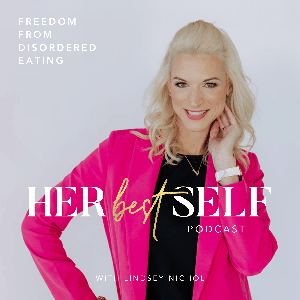


Lately I’ve been hearing the same thing from so many of my clients, and maybe you’ve whispered it too: “Lindsey, I have a really hard time eating when I’m not hungry.” Sis, I get it — for the longest time, the eating disorder had me convinced of one specific lie: that I had to be hungry to be allowed to eat. Today, we’re busting that wide open.
The myth: You have to be hungry to eat. For years that was gospel to me — if I wasn’t hungry, I hadn’t “earned” it. But here’s the truth: hunger is only one of many reasons we eat, and you do not need to be hungry to nourish your body. We eat because it’s time, because food is connection, because something’s delicious, to fuel our day, to steady our energy, to be in the moment. Hunger is just one seat at the table — it was never meant to be the bouncer at the door.
Why this matters in recovery: When you’ve spent years in a disordered relationship with food, your hunger cues are often silent — your body stopped asking because it learned you wouldn’t answer. So if you’re waiting to feel “hungry enough,” you could be waiting a long time while under-fueling the very body that’s trying to heal. This is why, especially in recovery, we eat by structure, not just by signal — regular meals and snacks, on a schedule, whether or not hunger has shown up. That’s not ignoring your body. That’s rebuilding trust with it.
When hunger feels scary: For some of you, hunger doesn’t feel like nothing — it feels foreign, even panic-inducing as your cues wake back up. Hear me: hunger is not an emergency and it’s not something to fear. It’s your body coming back online — a sign of healing, not danger. It feels foreign because it’s new, not because it’s wrong.
The reframe: Food is not a reward you unlock with hunger. It’s your medicine, your fuel, your body’s most basic right — not something you qualify for. You don’t make your car prove it’s empty before you give it gas. Your body deserves that same steady care, because it’s yours, and it carries you through this whole beautiful life.
Your comeback arsenal — one-liners to say right back to that voice when it tells you that you don’t “need” to eat:
Pick the one or two that hit hardest, and put them where you’ll see them — a sticky note, your phone, the pantry door.
“You don’t have to be hungry to be worthy of nourishment. You never did.”
Your one thing this week: Eat your meals and snacks on schedule — hungry or not — and notice what comes up without judging it. If hunger is quiet, feed yourself anyway. If hunger feels scary, feed yourself anyway, gently. You’re rebuilding trust one meal at a time.
Come join our free community at www.herbestselfsociety.com — Lindsey would love to get to know you and walk with you through this.
I believe you belong recovered — not just because I'm recovered, but because if I can do this, so can you. If this episode blessed you, follow the show, leave a rating and review, and share it with someone you love. 💛
🌟 Website: www.herbestself.co 🌟 Instagram: @thelindseynichol 🌟 Free FB Community: www.herbestselfsociety.com 🌟Client Application: HBS Co. Recovery Coaching - Client Application - Google Forms
💕 Share it with a woman who might need to hear this message 💕 Leave a review on Apple Podcasts - it helps other women find the show 💕 Screenshot and tag @thelindseynichol if any of these steps help you this week!
Remember, beautiful: Your worth is not measured by how perfectly you do recovery. Healing isn't linear, progress over perfection always, and you are exactly where you need to be right now.
Her Best Self with Lindsey Nichol is a podcast for women in eating disorder recovery who are ready to break free from perfectionism, people-pleasing, and diet culture to live authentically and wholeheartedly.
*While I am a certified health coach, anorexia survivor & eating disorder recovery coach, I do not intend the use of this message to serve as medical advice. Please refer to the disclaimer here in the show & be sure to contact a licensed clinical provider if you are struggling with an eating disorder.
Sis, recovery isn’t one straight line. It has ups, it has downs, moments of progress, and periods where you feel like you simply cannot go another day. If you’re in a slump right now — stuck, depleted, back in your own head with that voice — this episode is your gentle but powerful reset.
No complicated protocols. No overwhelming strategies. Just a return to your most basic human needs, because sometimes the most healing thing you can do isn’t pushing harder — it’s tending gently to the fundamentals.
Think of a struggling plant. Before exotic fertilizers or complicated routines, a good gardener checks the basics first: water, sunlight, soil. Often that’s enough to bring it back to full vitality. The same is true for you, girl. When you’re slipping into old patterns, step back and check your foundation.
The 8 basics to reset when you’re stuck:
How to actually use this (without judgment):
“Recovery isn’t about becoming a different person. It’s about reclaiming the person you were always meant to be. Simplicity is the ultimate sophistication.”
If your slump is telling you that you need more support, that’s not failure — it’s wisdom. I’d love to walk with you.
Come join our free community at www.herbestselfsociety.com — Lindsey would love to get to know you and walk with you through this.
I believe you belong recovered — not just because I'm recovered, but because if I can do this, so can you. If this episode blessed you, follow the show, leave a rating and review, and share it with someone you love. 💛
🌟 Website: www.herbestself.co 🌟 Instagram: @thelindseynichol 🌟 Free FB Community: www.herbestselfsociety.com 🌟Client Application: HBS Co. Recovery Coaching - Client Application - Google Forms
💕 Share it with a woman who might need to hear this message 💕 Leave a review on Apple Podcasts - it helps other women find the show 💕 Screenshot and tag @thelindseynichol if any of these steps help you this week!
Remember, beautiful: Your worth is not measured by how perfectly you do recovery. Healing isn't linear, progress over perfection always, and you are exactly where you need to be right now.
Her Best Self with Lindsey Nichol is a podcast for women in eating disorder recovery who are ready to break free from perfectionism, people-pleasing, and diet culture to live authentically and wholeheartedly.
*While I am a certified health coach, anorexia survivor & eating disorder recovery coach, I do not intend the use of this message to serve as medical advice. Please refer to the disclaimer here in the show & be sure to contact a licensed clinical provider if you are struggling with an eating disorder.
Sis, let’s talk about a place that can feel like a full-on battlefield — and nope, not a restaurant, which is also terrifying - today we are talking about the grocery store. The fluorescent lights, the endless labels, the hundred little decisions, that low hum of anxiety the second you grab a cart. If the store has ever made you want to cry, freeze, or turn around and walk right back out, you are not broken, and you are so not alone.
Today I’m sharing my own story and a handful of tangible tools to make grocery shopping feel safer, easier, and a whole lot less scary.
My story (because I lived this):
There was a season where I’d walk into the store and just get stuck. I’d spend hours in there — not shopping, scanning. Up and down every aisle, picking things up and putting them back, flipping over every package, reading every label, doing the math in my head over and over, paralyzed by the next decision. I’d leave one of two ways: empty-handed and defeated, or clutching something I grabbed in a panic that would sit untouched in my pantry until I threw it away weeks later.
That’s what the eating disorder does — it turns a basic human errand into hours of dread. If that’s you right now, stuck scanning labels or avoiding the store altogether, I see you. I was you. And it doesn’t have to stay this way.
The reframe: The store isn’t the problem, and the labels aren’t the problem. The eating disorder has turned shopping into a test — of willpower, discipline, being “good.” But you’re not there to pass a test. You’re there to feed the woman you love — and that woman is you.
5 tangible tools to make the grocery store easier:
The heart of it: Every time you walk in and put nourishment in your cart — even shaking, even scared — you cast a vote for the recovered version of you. The woman who used to scan the aisles for hours and leave with an empty cart isn’t free because she got it perfect. She’s free because she kept showing up, one brave, ordinary trip at a time.
“You’re not going to the grocery store to pass a test. You’re going to feed the woman you love — and that woman is you.”
Your one thing this week: Take the list, set the timer, and go get the food your body needs. Messy, scared, imperfect — all of it counts.
You don’t have to white-knuckle recovery alone. If the grocery store — or any of this — feels too heavy to carry by yourself, that’s exactly what I’m here for.
🌟 Website: www.herbestself.co 🌟 Instagram: @thelindseynichol 🌟 Free FB Community: www.herbestselfsociety.com 🌟Client Application: HBS Co. Recovery Coaching - Client Application - Google Forms
💕 Share it with a woman who might need to hear this message 💕 Leave a review on Apple Podcasts - it helps other women find the show 💕 Screenshot and tag @thelindseynichol if any of these steps help you this week!
Remember, beautiful: Your worth is not measured by how perfectly you do recovery. Healing isn't linear, progress over perfection always, and you are exactly where you need to be right now.
Her Best Self with Lindsey Nichol is a podcast for women in eating disorder recovery who are ready to break free from perfectionism, people-pleasing, and diet culture to live authentically and wholeheartedly.
*While I am a certified health coach, anorexia survivor & eating disorder recovery coach, I do not intend the use of this message to serve as medical advice. Please refer to the disclaimer here in the show & be sure to contact a licensed clinical provider if you are struggling with an eating disorder.
Sis, here’s the truth: most of us wake up and immediately go into reaction mode. You react to how your body feels. You react to the number on the scale. You react to what you see in the mirror, to the anxiety about what you’re going to eat today. You’re constantly reacting to life like it’s happening to you — and when you’re in recovery, living in reaction mode keeps you right where the eating disorder wants you, because it feeds off the panic, the fear, the overwhelm.
Today I’m handing you a simple 5-minute ritual that interrupts that pattern and shifts you from reaction to intention. Grab your journal — this one’s a keeper.
Why this works (it’s not just woo):
When you shift from reacting to practicing intention and mindfulness, you’re literally changing your brain — moving out of the amygdala (the fear-based, reactive part the eating disorder hijacks) and into the prefrontal cortex, where you make conscious, value-based decisions. Research in positive psychology also shows gratitude practices meaningfully reduce anxiety and depression and build real well-being. This little ritual puts the power back in your hands.
The ritual — three questions to ask yourself:
1. What am I grateful for? Not toxic positivity — evidence of goodness, even on hard days. And get specific to recovery: “I’m grateful my body digested food yesterday without me obsessing.” “I’m grateful I sat through dinner with friends and was present.” “I’m grateful for the energy I had because I nourished myself.” You’re training your brain to find proof that your recovery is working. On the really hard days, start tiny: I’m grateful I woke up. I’m grateful for this breath. I’m grateful I get to show up even when I don’t want to.
2. What am I focused on gaining? This is the game changer — shifting from avoidance motivation (I’m scared to gain weight, I don’t want to lose control) to approach motivation (moving toward something). Instead of “I’m trying not to restrict,” ask “What am I gaining by nourishing my body?” — freedom from food thoughts, energy for your kids, mental clarity, peace in your own skin. We’re not running away from fear. We’re running toward our best self.
3. What am I choosing to release? You can’t gain what you named in question two while gripping the old beliefs and behaviors. Releasing might sound like: “I’m releasing the belief that my worth is tied to the scale.” “I’m releasing the need to know every calorie.” “I’m releasing comparison to how I looked five years ago.” “I’m releasing the expectation that recovery should look perfect.” Naming what you release creates awareness — and awareness gives you the power to say, “No, I already put that down,” every time it tries to sneak back in.
The heart of it: When you live with intention instead of reaction, recovery stops being something you’re just trying to survive and becomes something you’re actively creating.
“You’re not white-knuckling your way through recovery anymore. You’re intentionally choosing what you want to gain. We are going toward our very best self.”
Your work this week: Use the ritual — at the start of your week, in the morning, when you’re triggered, or when you feel yourself slipping into old patterns. Five minutes. Write down one thing for each: what you’re grateful for, what you’re gaining, what you’re releasing. Intention over reaction.
You don’t have to do this alone. This ritual is even more powerful in community — which is exactly why I created the Recovery Collective, where we gather to ask these intentional questions together, celebrate the wins, and tell the truth when the lies get loud. Find more: www.herbestself.co/recoverycollective
🌟 Website: www.herbestself.co 🌟 Instagram: @thelindseynichol 🌟 Free FB Community: www.herbestselfsociety.com 🌟Client Application: HBS Co. Recovery Coaching - Client Application - Google Forms
💕 Share it with a woman who might need to hear this message 💕 Leave a review on Apple Podcasts - it helps other women find the show 💕 Screenshot and tag @thelindseynichol if any of these steps help you this week!
Remember, beautiful: Your worth is not measured by how perfectly you do recovery. Healing isn't linear, progress over perfection always, and you are exactly where you need to be right now.
Her Best Self with Lindsey Nichol is a podcast for women in eating disorder recovery who are ready to break free from perfectionism, people-pleasing, and diet culture to live authentically and wholeheartedly.
*While I am a certified health coach, anorexia survivor & eating disorder recovery coach, I do not intend the use of this message to serve as medical advice. Please refer to the disclaimer here in the show & be sure to contact a licensed clinical provider if you are struggling with an eating disorder.
Sis, we’re heading into the season of triggers — and if you’re already spiraling about how you’ll handle all the food, all the people, and all the comments about bodies and what’s on your plate, this episode is your armor.
You know the moment: you sit down at the table, and your aunt says “you look so healthy, are you eating more?” or “wow, you’ve lost so much weight!” — and just like that, your chest tightens, your throat closes, and before you even realize it, you’re making plans to restrict tomorrow or add an extra workout this week. I’ve been there (Thanksgiving was the trigger for me). So today I’m handing you the real-time game plan I walk through with my clients — including one, “Allison,” who texted me mid-panic from a family gathering this week.
The 6-step plan for when you’re triggered:
The heart of it — act as if you’re already her. Your future, recovered self already knows how to move through this. So ask: would she leave the table and restrict? Would she over-exercise tomorrow to “make up” for tonight? Or would she trust her body, rest, and know this trigger is just a blip? You have to stop operating from an unhealed place if you want healed results. Wounds cannot make decisions. She’s not so distant, sis. She’s you — making the choice right now.
“Triggers just bring you toward your testimony. Keep showing up for yourself, and one day you’ll look back and barely recognize that those things ever triggered you. That recovered version of you is going to wrap her arms around you and say, ‘See, sis? You did it. You made it.’”
Don’t head into the holidays white-knuckling it alone. This is exactly the work we do together — walking through real triggers with live coaching, tools, and a community of women who get it in the Recovery Collective. And if you know you need deeper, one-on-one support, I have a few limited private coaching spots. Find both at www.herbestself.co (and the Recovery Collective at www.herbestself.co/recoverycollective.
Come join our free community at www.herbestselfsociety.com — Lindsey would love to get to know you and walk with you through this.
I believe you belong recovered — not just because I'm recovered, but because if I can do this, so can you. If this episode blessed you, follow the show, leave a rating and review, and share it with someone you love. 💛
🌟 Website: www.herbestself.co 🌟 Instagram: @thelindseynichol 🌟 Free FB Community: www.herbestselfsociety.com 🌟Client Application: HBS Co. Recovery Coaching - Client Application - Google Forms
💕 Share it with a woman who might need to hear this message 💕 Leave a review on Apple Podcasts - it helps other women find the show 💕 Screenshot and tag @thelindseynichol if any of these steps help you this week!
Remember, beautiful: Your worth is not measured by how perfectly you do recovery. Healing isn't linear, progress over perfection always, and you are exactly where you need to be right now.
Her Best Self with Lindsey Nichol is a podcast for women in eating disorder recovery who are ready to break free from perfectionism, people-pleasing, and diet culture to live authentically and wholeheartedly.
*While I am a certified health coach, anorexia survivor & eating disorder recovery coach, I do not intend the use of this message to serve as medical advice. Please refer to the disclaimer here in the show & be sure to contact a licensed clinical provider if you are struggling with an eating disorder.
If recovery from an eating disorder feels so hard right now that you're white-knuckling your way through it — "why do I have to do this? why me?" — sis, I've been exactly where you are. But there's a blind spot keeping you stuck in that fight, and one shift in how you see it can make the whole thing feel lighter. Not because the work changes. Because you do.
In this episode:
Your work this week: Every time "this is so hard" shows up, pause and ask the flip question — What if this isn't a punishment? What if this is a privilege? The meal, the rest, the fear food, the hard conversation. Not because it's easy — but because every one of those things is giving you your life back.
"The women who find freedom aren't the ones for whom it was easier. They're the ones who decided to see it differently — who stopped believing recovery was happening TO them, and started believing it was happening FOR them. You get to recover, sis. That's not a punishment. That's the greatest privilege of your life."
Your turn: Head to our free community at www.herbestselfsociety.com and share your True Up Tuesday — what are you tuning up this week? What do you want more of, and less of?
Ready for personalized support? I'm opening a waitlist — fill out a client application at www.herbestself.co so we can get you scheduled for a quick connect and see how I can help you.
If this blessed you, follow the show, leave a rating and review, and share it with a woman who needs this shift in perspective today. 💛
🌟 Website: www.herbestself.co 🌟 Instagram: @thelindseynichol 🌟 Free FB Community: www.herbestselfsociety.com 🌟Client Application: HBS Co. Recovery Coaching - Client Application - Google Forms
💕 Share it with a woman who might need to hear this message 💕 Leave a review on Apple Podcasts - it helps other women find the show 💕 Screenshot and tag @thelindseynichol if any of these steps help you this week!
Remember, beautiful: Your worth is not measured by how perfectly you do recovery. Healing isn't linear, progress over perfection always, and you are exactly where you need to be right now.
Her Best Self with Lindsey Nichol is a podcast for women in eating disorder recovery who are ready to break free from perfectionism, people-pleasing, and diet culture to live authentically and wholeheartedly.
*While I am a certified health coach, anorexia survivor & eating disorder recovery coach, I do not intend the use of this message to serve as medical advice. Please refer to the disclaimer here in the show & be sure to contact a licensed clinical provider if you are struggling with an eating disorder.
Sis, let's start with something true, and a little bit hard.
When we first start down the long road of an eating disorder, we could never have imagined what we'd give up to become the smallest version of ourselves. It doesn't happen all at once — it's a slow sacrifice, one tiny concession at a time, until one day you look up and wonder, how did I ever let it get this far?
And then, when you finally get out of denial, you ask the two questions: Will this ever change? And how do I change it?
Today I'm answering that — with five things recovery taught me. And they're probably not the five you'd expect. Because recovery was never flashy. It wasn't the compliments or the "what do you do to be so skinny?" It was quiet. It was ordinary. It was doing the right thing when no one was watching and no one was clapping.
The 5 things recovery taught me:
The heart of it: Living in recovery means living in this moment — not the future one you're so afraid of. Not the "what if it's too hard, what if I can't do it" moment that hasn't even happened. Just this one. The meal in front of you. The rest you need right now. The ordinary choice, today.
"Recovery was never going to be flashy. It was always going to be built quietly, in the mundane, when no one was watching — one ordinary, extraordinary choice at a time. You are only as happy as your heart allows you to be. So let it."
Ready to find your own freedom? If you saw yourself in this conversation, I'd love to walk with you. Find coaching and community at www.herbestself.co or come join our free community at www.herbestselfsociety.com
If this episode blessed you, follow the show, leave a rating and review, and share it with a woman — or a daughter — who needs to hear it. 💛
🌟 Website: www.herbestself.co 🌟 Instagram: @thelindseynichol 🌟 Free FB Community: www.herbestselfsociety.com 🌟Client Application: HBS Co. Recovery Coaching - Client Application - Google Forms
💕 Share it with a woman who might need to hear this message 💕 Leave a review on Apple Podcasts - it helps other women find the show 💕 Screenshot and tag @thelindseynichol if any of these steps help you this week!
Remember, beautiful: Your worth is not measured by how perfectly you do recovery. Healing isn't linear, progress over perfection always, and you are exactly where you need to be right now.
Her Best Self with Lindsey Nichol is a podcast for women in eating disorder recovery who are ready to break free from perfectionism, people-pleasing, and diet culture to live authentically and wholeheartedly.
*While I am a certified health coach, anorexia survivor & eating disorder recovery coach, I do not intend the use of this message to serve as medical advice. Please refer to the disclaimer here in the show & be sure to contact a licensed clinical provider if you are struggling with an eating disorder.
How's your week starting off, sis? Because mine? My Monday was a blur. The weekend was crazy, I got thrown into the week, and I needed a level set — a true up. So if you're feeling that too, this episode is your reset.
Today I'm sharing a simple, repeatable weekly check-in — I call it True Up Tuesday — that realigns your goals with your authentic self so one chaotic Monday doesn't hijack your whole week (or your recovery). Because freedom doesn't happen overnight, but it also doesn't happen without tangible tools you actually use.
The truth at the heart of this episode:
In a recent therapy session, my therapist told me something that stopped me cold: "Lindsey, you have a faulty notion that you can get everything done. You can't be everything to everybody." And listen — I'm the doer, Miss High Standards (I know you are too, or you wouldn't be here). But here's what I had to hear, and what you might need today: you can do hard things, but you can't do all things.
The True Up Tuesday check-in:
Grab your journal and fill in the blanks:
If you get stuck on the more/less part, here are mine to spark yours: more connection, less isolation. More gratitude, less comparison. More joy, less negativity. More intention, less habituation. More self-love, less judgment. More peace, less chaos. More belief, less doubt. More creating, less procrastinating.
Why this works:
The reminder you might need today: You're allowed to heal and to grow. You're allowed to forgive, to grieve the time this disorder has taken, to let go, let be, and let in. You're allowed to love other people while also honoring yourself. You are the boss of your week — the question is just how you want to show up in it.
"You can do hard things. You just can't do all things. Narrow your focus, and I promise you'll see what you want come to fruition."
Your turn: Head to our free community at www.herbestselfsociety.com and share your True Up Tuesday — what are you tuning up this week? What do you want more of, and less of?
Ready for personalized support? I'm opening a waitlist — fill out a client application at www.herbestself.co so we can get you scheduled for a quick connect and see how I can help you.
If this blessed you, follow the show, leave a rating and review, and share it with a woman who needs this reset today. 💛
Today I'm sitting down with Crysanne and Coryn, the mother-daughter duo behind the Her Healthy Body podcast — a show where faith and health meet. This conversation went places I didn't expect, and I'm so glad it did. We talk honestly about body image, self-worth, the generational patterns we pass down (and the healing we can pass down instead), and the truth about the GLP-1 era we're living in.
If you've ever wondered "did I cause this for my daughter?" or "is it too late for me?" — this one's for you.
In this episode:
"When you realize you're a daughter of the Most High — worth taking care of, worth loving — you walk differently. And whether you're an extra-extra small or an extra-extra large, it doesn't make a difference, because God doesn't view you as a label."
Go follow Crysanne and Coryn — the Her Healthy Body podcast is on all platforms. They keep it real, raw, and rooted in faith, and we need more of that.
Ready to find your own freedom? If you saw yourself in this conversation, I'd love to walk with you. Find coaching and community at www.herbestself.co or come join our free community at www.herbestselfsociety.com
If this episode blessed you, follow the show, leave a rating and review, and share it with a woman — or a daughter — who needs to hear it. 💛
🌟 Website: www.herbestself.co 🌟 Instagram: @thelindseynichol 🌟 Free FB Community: www.herbestselfsociety.com 🌟Client Application: HBS Co. Recovery Coaching - Client Application - Google Forms
💕 Share it with a woman who might need to hear this message 💕 Leave a review on Apple Podcasts - it helps other women find the show 💕 Screenshot and tag @thelindseynichol if any of these steps help you this week!
Remember, beautiful: Your worth is not measured by how perfectly you do recovery. Healing isn't linear, progress over perfection always, and you are exactly where you need to be right now.
Her Best Self with Lindsey Nichol is a podcast for women in eating disorder recovery who are ready to break free from perfectionism, people-pleasing, and diet culture to live authentically and wholeheartedly.
*While I am a certified health coach, anorexia survivor & eating disorder recovery coach, I do not intend the use of this message to serve as medical advice. Please refer to the disclaimer here in the show & be sure to contact a licensed clinical provider if you are struggling with an eating disorder.
Let's start with a question that might sting a little: What are you missing out on right now because you don't believe you deserve it?
Because here's the truth, girl — your mind has so much power. What you believe, you become. And so many women are stuck, not because recovery isn't possible for them, but because deep down they don't believe they belong recovered. Today we're changing that.
In this episode:
Your work this week: Write a list. What do I want? What am I missing out on because I don't believe I deserve it? What does my dream of freedom actually look like? The more your brain becomes acquainted with your dream, the more you'll believe you belong in it.
"You won't ever be somewhere your brain doesn't believe you belong. Your past is not your potential — you belong in your dream. That's why you're here."
Ready to condition your mind alongside women who get it?
Come join our free community at www.herbestselfsociety.com — Lindsey would love to get to know you and walk with you through this.
And if you're ready for personalized support, coaches help you with the here and now. Find out how you can partner together at www.herbestself.co
I believe you belong recovered — not just because I'm recovered, but because if I can do this, so can you. If this episode blessed you, follow the show, leave a rating and review, and share it with someone you love. 💛
🌟 Website: www.herbestself.co 🌟 Instagram: @thelindseynichol 🌟 Free FB Community: www.herbestselfsociety.com 🌟Client Application: HBS Co. Recovery Coaching - Client Application - Google Forms
💕 Share it with a woman who might need to hear this message 💕 Leave a review on Apple Podcasts - it helps other women find the show 💕 Screenshot and tag @thelindseynichol if any of these steps help you this week!
Remember, beautiful: Your worth is not measured by how perfectly you do recovery. Healing isn't linear, progress over perfection always, and you are exactly where you need to be right now.
Her Best Self with Lindsey Nichol is a podcast for women in eating disorder recovery who are ready to break free from perfectionism, people-pleasing, and diet culture to live authentically and wholeheartedly.
*While I am a certified health coach, anorexia survivor & eating disorder recovery coach, I do not intend the use of this message to serve as medical advice. Please refer to the disclaimer here in the show & be sure to contact a licensed clinical provider if you are struggling with an eating disorder.
From the publisher's feed
Her Best Self with Lindsey Nichol is the eating disorder recovery podcast for women who are completely exhausted from food noise and food restriction. If you are ready to finally break free from food obsession, body anxiety, and the mental prison of ED - this show is for you.
Hosted by Lindsey Nichol, former figure skater, recovering perfectionist, and eating disorder recovery coach who has lived this herself. Lindsey built Her Best Self Co. for the woman who has tried therapy, treatment programs, and going it alone — and is still trapped. She gets it because she's been there. If you've been struggling for 10, 20, or 30+ years — here is your personal invitation to do recovery for real this time!
This podcast is for you if: You can't stop thinking about food. You're tired of wasting your life on this disorder. You want someone who has actually been where you are and found real freedom on the other side.
Every week you'll find real, honest conversations about: Anorexia recovery, bulimia recovery, orthorexia, restrictive eating, compulsive exercise, food noise, food anxiety, body dysmorphia, perfectionism, people-pleasing, quasi-recovery, eating disorder relapse, food freedom and faith-based recovery — all designed for women in their 30s, 40s, 50s and beyond who are done.
You'll learn how to: Stop the food noise. Break free from restriction. Overcome perfectionism and people-pleasing. Build real body trust and food freedom. And finally live the life this disorder has been stealing from you.
New episodes every Tuesday and Friday.
Ready to go deeper?
Apply to work with Lindsey 1:1 — www.herbestself.co
Join The Recovery Collective — the eating disorder recovery support group that gets the struggle and wants to see you win — at www.herbestself.co/recoverycollective
Facebook community — www.herbestselfsociety.com
Trigger warning: Episodes may cover sensitive topics including eating disorders and mental health. Content reflects personal insight and education and is not a replacement for clinical or medical support. Nothing shared establishes a therapeutic relationship or replaces the care of a clinical treatment professional. © 2026 Lindsey Nichol LLC
3,064 Listeners
2,195 Listeners
706 Listeners
47 Listeners
111 Listeners
20 Listeners
406 Listeners

1,849 Listeners
68 Listeners

18,897 Listeners
154 Listeners
33 Listeners
20 Listeners
19 Listeners
9 Listeners