
Sign up to save your podcasts
Or

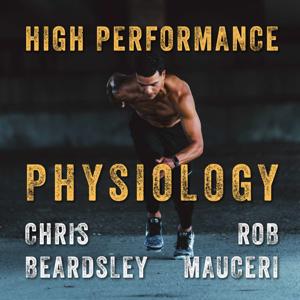


Chris and Rob respond to the popular trend in strength and conditioning for coaches to program changes in the main exercises every couple of weeks rather than just sticking with the same exercise for meaningful periods of time.
Responding to a listener's question, Chris and Rob explain how to organize a training week that includes two strength training sessions (in accordance with the High Performance Physiology Method) in addition to either two sports practices or one sports practice plus a game or competition. They also comment on how to add cardio on top of those training sessions where desired.
In this episode, Chris and Rob first describe how clusters, repetitions in reserve (RIR), and velocity-based training (VBT) work from a physiological perspective. Secondly, they talk about how to make use of these techniques in practice during strength training programs.
Chris and Rob tackle the topic of warm-ups, starting with the basic exercise science concept of increasing muscle temperature before moving on to tackle the additional rationales proposed in the fitness industry, such as [1] potentiation, [2] changing psychological state to one that helps maximize adaptations, [3] practicing form or technique, and [4] making sure that the main set of the exercise is safe and comfortable to perform.
In this episode, Chris and Rob describe how to program for contact team sports (like rugby and American football) within the context of the High Performance Physiology method four-part workout structure (high-velocity, heavy strength training, plyometrics, and supramaximal eccentrics).
In this episode, Chris and Rob explain [1] what adaptations isometrics are best suited to stimulating, and [2] how to include isometrics in a standard strength training program for stimulating those adaptations. They also talk briefly about some common misunderstandings and misapplications of isometrics in the fitness industry.
In this episode, Chris and Rob analyze the strength training program used in the study: "Exploring the Upper Limits of Resistance Training Volume for Muscle Hypertrophy and Strength in Trained Athletes" by Räntilä and Ahtiainen, which was published in 2026. The reason for the review is that the subjects were national-level track and field athletes, so the training program reflects what many S&C coaches are currently programming for this population. The paper is currently open access and table 1 shows the training program that we talk about.
Finally, Chris and Rob tackle block periodization, explaining why it makes very little sense for athletes in any strength or power sport. This episode references material covered in previous conversations, especially the preceding two (31 dose-response of adaptations and 32 supercompensation) as well as frequent discussions about the rate of loss of adaptations during detraining and fatigue accumulation.
As a preparatory topic before covering block periodization, Chris and Rob explain the concept of supercompensation. Supercompensation is the observation that outcome measures (like strength, speed, power) can reduce during a high-volume training block and then rebound (supercompensate) during a subsequent deload or taper. But that does not happen because of a delayed adaptation. It happens because fatigue was accumulating during the high-volume training block and reducing the value of the outcome measure.
The dose-response of hypertrophy to workout volume is a famous phenomenon. In this episode, Chris and Rob talk about how all adaptations display dose-responses (even though they have not been as carefully studied). That affects how we program for speed, maximum strength, stretch-shortening cycle, and maximum eccentric strength.
From the publisher's feed

227,563 Listeners
374 Listeners

372 Listeners

20,174 Listeners
1,193 Listeners

8,346 Listeners

1,957 Listeners

4,081 Listeners

7,954 Listeners

527 Listeners

90 Listeners

29,185 Listeners
52 Listeners

76 Listeners
21 Listeners