
Sign up to save your podcasts
Or

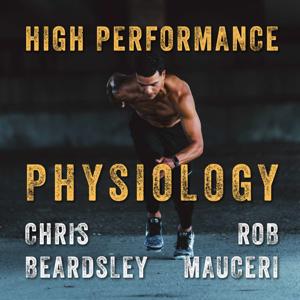


The dose-response of hypertrophy to workout volume is a famous phenomenon. In this episode, Chris and Rob talk about how all adaptations display dose-responses (even though they have not been as carefully studied). That affects how we program for speed, maximum strength, stretch-shortening cycle, and maximum eccentric strength.
Following on from the earlier episode about two-leg vertical jumping, Chris and Rob tackle single-leg vertical jumping and explain how it relates to power training (with power cleans and jump squats).
Chris was sick this week so this week's episode is a short one covering some practical suggestions on how we can still get productive training sessions while suffering from either a cold or flu.
Chris and Rob describe exactly how to combine bodybuilding with athletic preparation training for people who want to pursue multiple goals at the same time. They give three separate options depending on whether the two goals have equal weighting or whether one goal is currently more important.
In this very practical episode, Chris and Rob talk about how athletes can increase maximum strength without gaining weight (or without gaining too much muscle mass).
Following directly on from last week's podcast episode on potentiation, Chris and Rob talk about contrast training from a physiological perspective. They explain why in most cases, a more traditional approach to athletic strength training workouts (starting with high-velocity exercises, moving on to heavy strength training exercises, and finishing with plyometrics) is much better than doing contrast training methods that mix the various types of training up into complexes.
Potentiation is a temporary and reversible increase in exercise performance as a result of a previous bout of exercise (note that this is the exact opposite of the fatigue definition). In this episode, Chris and Rob explain the physiology behind potentiation and describe the most effective ways of using the various different potentiation mechanisms in strength training workouts.
Following on from the previous episode about muscle strain injuries, Chris and Rob talk about the physiology of tendon damage and how it likely leads to both tendinopathy and tendon ruptures. Afterwards, they describe how isometric training is probably the best training method for reducing the risk of such problems and Rob goes into detail about how he currently programs isometrics.
Chris and Rob talk about how muscle strain injuries happen, and what we can do in strength training programs to help reduce the risk of them happening.
Chris and Rob talk through what the literature says about the relationship between track sprinting performance and the muscle volumes of the hip extensors, hip flexors, knee extensors, knee flexors, and ankle plantar-flexors.
From the publisher's feed

227,416 Listeners
377 Listeners
372 Listeners

20,182 Listeners
1,196 Listeners

8,334 Listeners
1,951 Listeners

4,049 Listeners

7,929 Listeners
530 Listeners

91 Listeners

28,981 Listeners
52 Listeners

76 Listeners
18 Listeners