
Sign up to save your podcasts
Or

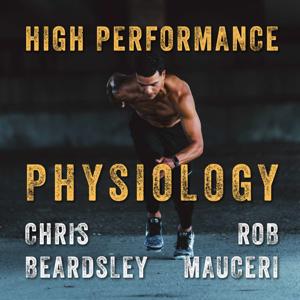


Chris and Rob continue describing how their proposed workout plan template (speed, maximum strength, stretch-shortening cycle, and eccentric strength) can work even when speed exercises are varied greatly over the week.
Chris and Rob talk about the popular strength and conditioning idea that there multiple strength qualities across the force-velocity spectrum, from maximum strength to strength-speed to power to speed-strength to maximum speed. They also introduce the High Performance Physiology method for building strength training workouts for athletes.
Endurance running performance is determined by three components: [1] maximal aerobic capacity, [2] lactate threshold, and [3] running economy. In this episode, Chris and Rob talk about how strength training can contribute to improvements in running economy.
Chris and Rob chat through what strength ratios between exercises can tell us (and what they cannot tell us) about writing athletic training programs.
Continuing from the previous two episodes about powerlifting, Chris and Rob tackle the problem of "work capacity" in this context. What does work capacity mean? What are the underlying physiological adaptations that contribute to changes in work capacity? How should we train to improve work capacity?
In this episode, Chris and Rob continue the powerlifting theme from the previous week. While the previous episode covered the main lifts, this episode is dedicated to accessory lifts to support gains in squat, bench press, and deadlift performance.
In this introductory episode, Chris and Rob explain the underlying adaptations that contribute to powerlifting performance in general terms, and then discuss basic concepts like sets and reps, progression models, potentiation prior to the lifts, and the basic purpose of the training programs from a physiological point of view.
How do strength training programs transfer to sporting movements? What is the role of different exercises? Chris and Rob unpack the physiology and then go on to provide both positive and negative examples from existing training programs.
Chris and Rob explain the definitions of rate of force development and explosiveness in sporting contexts before going on to talk about how to develop these qualities in strength training programs.
In this long-awaited episode, Chris and Rob talk about periodization. While periodization itself is somewhat overrated, there are some benefits associated with aspects of it that can be replicated in other ways.
From the publisher's feed

227,416 Listeners
377 Listeners

372 Listeners

20,182 Listeners
1,196 Listeners

8,334 Listeners

1,951 Listeners

4,049 Listeners

7,929 Listeners

530 Listeners

91 Listeners

28,981 Listeners
52 Listeners

76 Listeners
18 Listeners