
Sign up to save your podcasts
Or

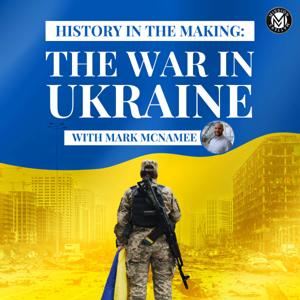
By Mark McNamee

5
1212 ratings


The podcast currently has 97 episodes available.
The most played episodes among Podcast App listeners.
Always a pleasure to have on the show my friend and great war correspondent, Giorgio Provinciali, who has see it all across the entire front the last 4 years. We talked about the comprehensive picture of what Ukraine is facing these days, the good and the bad. We discuss Ukraine's problems with ballistic missile defense, then move to the front where Ukraine is taking back the advantage in Donetsk around Lyman. And finally a word about a major breakthrough in Ukraine's ability to combat Russia's fiber optic drones. This podcast was recorded on August 26. About Giorgio Provinciali Giorgio Provinciali, War Correspondent, writes from the trenches of democracy in Ukraine. Engineer, journalist, war reporter. Medium writer since November 2023. Read more from Giorgio: https://medium.com/@giorgioprovinciali To connect and message with Mark on LinkedIn: www.linkedin.com/in/mark-mcnamee-58950910 To learn more, visit: https://ubn.network/ Listen to more episodes on Mission Matters: https://missionmatters.com/author/Mark-McNamee/ If you found this episode valuable, follow the podcast and share it with someone who wants to better understand the war in Ukraine.

For years, Vladimir Putin has managed to insulate much of Russian society from the direct costs of the war in Ukraine. Now that this deal is breaking down, what happens if Russia conducts a major mobilization on top of it all? I spoke with Professor Jeremy Morris, an expert on Russian society and everyday politics, about the growing pressures beneath the apparent stability of Putin’s Russia. Drawing on his recent Jacobin article, Russia’s Authoritarian Neoliberalism Reaches Its Limits, Morris argues that Ukraine’s attacks on Russian energy and economic infrastructure, growing war fatigue, labor shortages, and the increasing difficulty of recruiting soldiers through enormous financial incentives are beginning to erode the sense of normality that has helped sustain the war. Morris explains how economic pressure, inequality, and forced mobilization could interact to produce something much harder for the Kremlin to control. The discussion also goes deeper into the structure of Putin’s political system, including how ordinary Russians actually experience the war and where the limits of social endurance may ultimately lie. Further reading: Russia’s Authoritarian Neoliberalism Reaches Its Limits — Read the Jacobin article here: https://jacobin.com/2026/08/russia-ukraine-war-neoliberalism-putin?Everyday Politics in Russia: From Resentment to Resistance — View the book at Bloomsbury: https://www.bloomsbury.com/uk/everyday-politics-in-russia-9781350509344/ About Professor Jeremy Morris Jeremy Morris is Professor of Global Studies at Aarhus University and a specialist in Russian society, political anthropology, and the lived experience of post-Soviet transformation. His latest book is Everyday Politics in Russia: From Resentment to Resistance (Bloomsbury, 2025). To connect and message with Mark on LinkedIn: www.linkedin.com/in/mark-mcnamee-58950910 To learn more, visit: https://ubn.network/ Listen to more episodes on Mission Matters: https://missionmatters.com/author/Mark-McNamee/ If you found this episode valuable, follow the podcast and share it with someone who wants to better understand the war in Ukraine.
Vladimir Putin is likely approaching one of the most consequential decisions of the war and in fact of his entire reign: escalate further through another major mobilization, or accept some form of ceasefire. Or can he continue delaying that choice? In this episode, I spoke with Russian foreign policy expert Dr. Olena Snigyr about what Putin is likely to do in the coming months and what could actually force him to change course. They discuss why Putin has maintained his maximalist war aims after more than four years of fighting, whether the Russian political system now depends on continued war, what another mobilization would mean for Russian society, and the circumstances under which Putin might accept a ceasefire. They also examine the risks of nuclear escalation, how Russians are responding to increasingly frequent Ukrainian attacks deep inside the country, what could come after Putin, and a fundamental question for Ukraine and Europe: what would it actually take to make Moscow conclude that continuing the war is more dangerous than stopping it? About the Dr. Olena Snigyr Dr. Olena Snigyr is a political scientist and expert on Russian foreign policy, European security, and Russian strategic narratives. She is a Senior Fellow at the Delphi Global Research Center and a Jean Monnet Fellow at the European University Institute. Previously, she spent more than 15 years at Ukraine’s National Institute for Strategic Studies, including as Head of its Foreign Policy Department. To connect and message with Mark on LinkedIn: www.linkedin.com/in/mark-mcnamee-58950910 To learn more, visit: https://ubn.network/ Listen to more episodes on Mission Matters: https://missionmatters.com/author/Mark-McNamee/ If you found this episode valuable, follow the podcast and share it with someone who wants to better understand the war in Ukraine.
Today's guest is someone who has helped shape how thousands of people around the world understand this war on a daily basis. Francis Dearnley is Executive Editor at The Telegraph and one of the co-hosts of the award-winning podcast Ukraine: The Latest, which has become one of the most respected and widely followed sources of analysis on the conflict since Russia's full-scale invasion in 2022. One of the things I've always appreciated about Francis' work is that it combines rigorous journalism with a deep appreciation for history. As I also try to do with my podcast, rather than simply asking what happened today, he's constantly exploring the bigger questions and how these events fit within their historical context. So today, rather than focusing solely on the latest battlefield developments, I want to take a step back. We'll get Francis’ personal views on the war, what Ukraine has taught him after years of reporting from the country, and ultimately how history may judge this conflict. Link to Francis' podcast Ukraine: The Latest - https://www.youtube.com/playlist?list=PLO-F29HDAmtnKk7p0LMLqc5Xb4lpeqU5T About Francis Dearnley Francis Dearnley is a British journalist, writer and podcast host who has spent years closely following Ukraine and the war with Russia. He is the host of Ukraine: The Latest, the leading English-language podcasts covering the war, and brings a rare combination of on-the-ground reporting, historical context and deep knowledge of Ukrainian affairs. To connect and message with Mark on LinkedIn: www.linkedin.com/in/mark-mcnamee-58950910 To learn more, visit: https://ubn.network/ Listen to more episodes on Mission Matters: https://missionmatters.com/author/Mark-McNamee/ If you found this episode valuable, follow the podcast and share it with someone who wants to better understand the war in Ukraine.
If you've ever wondered why the US seems so divided, this conversation offers one of the most compelling explanations you'll hear. For many outside the US (and for many it in too), American politics can seem increasingly incomprehensible. Polarization is intensifying, compromise has become elusive, and debates over America's role in the world—from NATO to Ukraine—often appear deeply divided. In this episode, I spoke with award-winning journalist and historian Colin Woodard, author of American Nations: A History of the Eleven Rival Regional Cultures of North America. Woodard argues that the US is not one unified nation in the cultural sense, but a collection of distinct regional cultures, each founded by different groups of settlers with their own values, institutions, and competing visions of society. More than four centuries later, the sharp differences of these founding cultures persist and continue to shape elections, political identities, public policy, and even America's approach to the world. We explore the origins of Woodard's fascinating framework, how it builds upon David Hackett Fischer's classic Albion's Seed, why political compromise has become so much harder in recent decades, the rise of populism, competing visions of American identity, and whether U.S. democracy is facing its greatest test since the Civil War. Finally, we examine what these deep historical divisions reveal about America's support for Ukraine, its future as a global leader, and whether the American experiment can continue to hold together in the decades ahead. About Colin Woodard: Colin Woodard is an award-winning journalist, historian, and New York Times bestselling author. He is the Director of the Pell Center for International Relations and Public Policy at Salve Regina University in Newport, Rhode Island, where he leads research on American identity, democracy, and the historical forces shaping public life. He is the author of American Nations, American Character, Union, and The Republic of Pirates. You can find his book American Nations here: https://colinwoodard.com/books/american-nations/ To connect and message with Mark on LinkedIn: www.linkedin.com/in/mark-mcnamee-58950910 To learn more, visit: https://ubn.network/ Listen to more episodes on Mission Matters: https://missionmatters.com/author/Mark-McNamee/ If you found this episode valuable, follow the podcast and share it with someone who wants to better understand the war in Ukraine.
The podcast currently has 97 episodes available.
824 Listeners
144 Listeners

14 Listeners
367 Listeners

23 Listeners
156 Listeners

367 Listeners
1,871 Listeners
350 Listeners
478 Listeners
107 Listeners
267 Listeners

200 Listeners

75 Listeners

2 Listeners
4 Listeners
0 Listeners

4 Listeners
41 Listeners

4 Listeners

3 Listeners

2 Listeners
9 Listeners

0 Listeners
2 Listeners

0 Listeners
3 Listeners
0 Listeners

7 Listeners

4 Listeners
10 Listeners
0 Listeners

1,091 Listeners
0 Listeners
16 Listeners