
Sign up to save your podcasts
Or



Hosted on Acast. See acast.com/privacy for more information.
Hosted on Acast. See acast.com/privacy for more information.
Hosted on Acast. See acast.com/privacy for more information.
Hosted on Acast. See acast.com/privacy for more information.
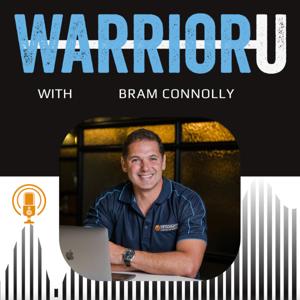
This week on The WarriorU Podcast Bram and Trent look back over 2020 - the year that was and discuss their observations and insights after assisting a number of high profile clients develop their current and emerging leaders in the operating environment of a pandemic.
They discuss key observations from the conduct of their Hindsight Leadership and Resilience courses. Business agility, both the client’s and Hindsight’s ability to “pivot” in order to function more effectively in the developing Covid-19 situation. The importance of outcome over output and the realisation that leaders needed to be more committed in order to lead their teams remotely. The also go into detail about getting the balance of communication right, as well as the importance of empathy and understanding what’s in your team’s “invisible backpack”. Bram and Trent finish by discussing their observations around the importance of leading through personal and organisational values.
Hosted on Acast. See acast.com/privacy for more information.
Bram Connolly and Trent Burnard continue their Leadership Analysis Series. During this series Bram and Trent forensically analyse leadership styles throughout history and attribute them with a score for different facets of leadership. By doing this, they hope to find knowledge, skills and attributes that modern leaders may, or may not want to emulate.
This week on the WarriorU Podcast, they analyse American President Jimmy Carter. Born on the 1st October 1924 in Plains, Georgia, Jimmy began life as a peanut farmer before his progressive politics lead him to becoming the Governor of Georgia from 1971-1975 and President of the USA from 1977-1981. His Presidential vision for America was to foster world peace and promote human rights abroad whilst achieving economic, political and social harmony and equality domestically in the midst of economic and social disruption.
Leadership Analysis
Inspiration and Motivation - Score: 3/10
- Carter used his image as a humble, honest, everyman to connect to the vast majority of Americans
- He refused to ‘play ball’ with the more underhand tactics of Congress and was seen as a leader of principle and integrity
- However he failed to inspire and motivate people to support his vision for America
- Towards the end of his Presidency he was seen as increasingly out-of-touch and his gentle touch to politics was seen more as a weakness than source of strength
Providing Purpose and Direction – 3/10
- Sought to internationally foster peace and promote human rights whilst domestically repairing the economic and political divide
- Was initially successful internationally with the Camp David Accords, Panama Treaties and SALT treaties, the Departments of Education and Energy and mending the political divide
- However, the Soviet invasion of Afghanistan and Iranian Hostage Crisis in 1979 and Carter’s lacklustre response saw him perceived as weak and turned people against his soft touch vision
- Domestically, Carter failed to revive the economy, inflation and interest rates along with fuel shortages and rationing and failed to mend the growing social and political divide
- These failures turned people towards the more conservative and strong-willed Reagan and saw Americans abandon their support for Carters vision for America
Effectiveness of Leadership Style – 3/10
- Carter utilised leading by example, delegation and collaborative styles of leadership throughout his Presidency
- His collaborative style initially saw success internationally, however allowed the Soviets and Iranians to take advantage of this to advance their interests
- Collaboration with Congress failed due to Carter refusing to ‘play ball’, and as such Congress blocked Carters progressive initiatives
- Used delegation to make presidential power more of a force for guidance rather than command, however this saw him unable to cohesively and effectively lead America
- His leading by example style did initially create a connection between him and the people, yet it also saw people perceive Carter as shifting blame onto the public and being too weak to lead...
Hosted on Acast. See acast.com/privacy for more information.
This week on the WarriorU Podcast, Bram Connolly and Trent Burnard continue their Leadership Analysis Series. During this series Bram and Trent will be forensically analysing leadership styles throughout history and attributing them with a score for different facets of leadership. By doing this, they hope to find knowledge, skills and attributes that modern leaders may, or may not want to emulate.
This week on the WarriorU Podcast, they dissect Mohammad Reza Pahlavi. Due to his status as the last Shah, or King, of Iran, he is often known simply as, The Shah. He was born on the 26th of October 1919 in Tehran. His rule started in 1941 until his overthrow in the Iranian Revolution on the 11th of February 1979. Throughout his reign, aimed to achieve two broad goals – consolidate his personal power and Westernize Iran.
Leadership Analysis
Inspiration and Motivation - Score: 4/10
Providing Purpose and Direction - Score: 5/10
Effectiveness of Leadership Style - Score: 4/10
Enduring Legacy - Score: 4/10
How it ended for them - Score: 0/10
Overall Leadership Summary - Score: 18/ 50
The Shah’s ability to pursue his goals of consolidating power, modernising and westernizing Iran was able to occur through the inspiration and motivation he was able to utilise through his centralization of power, coercion through SAVAK/Army, and pandering to social groups in order to pursue his vision for Iran, which was achieved successfully for much of...
Hosted on Acast. See acast.com/privacy for more information.
This week on the WarriorU Podcast, Bram Connolly and Trent Burnard continue their Leadership Analysis Series. During this series Bram and Trent will be forensically analysing leadership styles throughout history and attributing them with a score for different facets of leadership. By doing this, they hope to find knowledge, skills and attributes that modern leaders may, or may not want to emulate.
Mustafa Kemal Ataturk was born in 1881 to a Turkish family in Salonica in the Ottoman Empire, now Thessaloniki in Greece. His father was a military officer, and he sent Mustafa to. secular school and later on Mustafa joined the Salonica Military School in 1893. In 1899 he joined the Ottoman military academy, graduating in 1905.
Ataturk died in 1938 at the age of 57 of liver failure. His life ended as Turkey’s founding president and its greatest leader of the 20th century. His legacy will be remembered in how he crafted the political and social fabric of modern Turkey. Despite some political opposition to his leadership and his ideology, internationally and domestically he is regarded as a highly effective and visionary leader that demonstrated strong personal courage and deep empathy for his people and was able to successfully implement his vision for a modern Turkey – seeing him regarded as one of the 20th century’s most revered and effective leaders
Leadership Analysis:
Inspiration and Motivation - Score: 10 / 10
Providing Purpose and Direction - Score: 9 / 10
Effectiveness of Leadership Style - Score: 10 / 10
Enduring Legacy - Score: 8 / 10
How it ended for them - Score: 10 / 10
Overall Leadership Summary - Score: 47 / 50
www.warrioru.com.au
www.hindsightleadership.com
Hosted on Acast. See acast.com/privacy for more information.
This week on the WarriorU Podcast, Bram Connolly and Trent Burnard continue their Leadership Analysis Series. During this series Bram and Trent will be forensically analysing leadership styles throughout history and attributing them with a score for different facets of leadership. By doing this, they hope to find knowledge, skills and attributes that modern leaders may, or may not want to emulate.
This week on the WarriorU Podcast, Bram and Trent are going to delve deep into the leadership style of
General Sir John Monash as a leader. Monash was born in Melbourne Australia in 1865. He was a German Jew who spoke German as his native language. As an academic, through the 1890s and early 1900s, he worked as a Civil Engineer whilst also being active in the local militia. He became an Australian military commander of the First World War and is recognised by the allies as our most innovative, empathetic, meticulous and successful General, not only from Australia but from the War.
Leadership Analysis
Inspiration and Motivation - Score: 10/10
Providing Purpose and Direction - Score: 7/10
Effectiveness of Leadership Style - Score: 10/10
Enduring Legacy - Score: 9/10
How it ended for them - Score: 10/10
Overall Leadership Summary - Score: 46/ 50
Hosted on Acast. See acast.com/privacy for more information.
This week on the WarriorU Podcast, Bram Connolly and Trent Burnard continue their Leadership Analysis Series. During this series Bram and Trent will be forensically analysing leadership styles throughout history and attributing them with a score for different facets of leadership. By doing this, they hope to find knowledge, skills and attributes that modern leaders may, or may not want to emulate.
This week they dissect Sir Winston Churchill as a leader. Churchill was born in 1874 and was a direct descendant from the Dukes of Marlborough.
He started his career as a journalist and military man. He joined parliament in the 1900s and was the Prime Minister of the United Kingdom from 1940 to 1945, when he led the country to victory in the Second World War. He was a leader who could bring disparate groups of people under one banner and make them carry out a mission and vision for the nation.
We start off our conversation with a snippet from Churchill’s ‘Blood, Toil, Sweat and Tears’ speech.
Leadership Analysis
Inspiration and Motivation - Score: 10/10
Providing Purpose and Direction - Score: 8/10
Effectiveness of Leadership Style - Score: 8 /10
Enduring Legacy - Score: 9/10
How it ended for them - Score: 10/10
Overall Leadership Summary - Score: 45/ 50
Sir Winston Churchill was in touch with the common person who saw him be a figure of inspiration for his determination, commitment, patriotism and integrity, especially during the war.
His inspiriting motivation led him to higher political positions. Effectively pursued his mission of protecting Britain and providing for the nations people and was flexible in doing so. His leadership style ranged from independent to collaborative, to more of a delegator towards the end of his political leadership.
Churchill achieved remarkable visions that he was able to sell to the people, such as defeating Germany, when people couldn’t see any hope. He faced his strongest challenges from a leadership style, during unpopular times and missions. His enduring legacy as the greatest Britain in all of history, and one of the inspiring and effective world leaders.
Tweetable Quotes:
“Imagine what this world would look like without Sir Winston Churchill.” – Lieutenant Colonel Trent Burnard
Resources Mentioned:
Listen to the full ‘Blood, Toil, Sweat and Tears’...
Hosted on Acast. See acast.com/privacy for more information.
From the publisher's feed
The world isn't slowing down. Leaders today operate in a VUCA environment—Volatile, Uncertain, Complex, and Ambiguous—where the old playbooks don’t…
In Hindsight unpacks the psychology, strategy, and real-world lessons that help leaders think sharper, decide faster, and adapt smarter.
Drawing from business psychology, international relations, and leadership work with global organisations, this podcast is about cutting through the noise and giving you the tools to lead with confidence.
Because leadership isn’t about having the right answers—it’s about asking the right questions.
Hosted on Acast. See acast.com/privacy for more information.

19 Listeners

83 Listeners

42 Listeners

302 Listeners

319 Listeners

25 Listeners
32 Listeners

21 Listeners

23 Listeners

403 Listeners

49 Listeners

280 Listeners

151 Listeners
11 Listeners

20 Listeners