
Sign up to save your podcasts
Or



Based on Podcast App listening data
How do you define what things are living and dead? You might look at a sprinting cheetah and say it's clearly alive, whereas a chunk of rock is not -- but where do we draw the line? What might we expect extraterrestrials to look like, and would we even have the capacity to recognize them? And what does any of this have to do with Frankenstein, ancient Greek philosophers, or the possibility of finding a cell phone on Mars? Join Eagleman with guest Sara Walker, theoretical physicist at Arizona State University and author of the book “Life as No One Knows It”.
Do brains time travel? What is a prediction error? What does any of this have to do with the 2008 crash of the economy, how we keep internal price tags, or a rational approach to drug addiction in society? Join Eagleman to learn how your 3-pound universe spends its whole existence nailing down choices.
When you make a decision about what food to order, what's happening in your brain? How do you clinch long-term decisions, like hitting the gym instead of doomscrolling? And what does any of this have to do with the ancient Greeks, alien hand syndrome, and constraining a president who wants to launch a nuclear bomb? Join Eagleman this week and next to discover how your brain weighs alternatives and nails down decisions.
From the brain’s point of view, what is humor? When something is funny, why do we breathe in and out rapidly? Do other animals laugh? Why do most jokes come in threes? What do mystery novelists, magicians, and comedians have in common? Could AI be truly funny? Join Eagleman this week to appreciate the tens of reasons and millions of years behind the tickling of your neural pathways.
What does neuroscience have to do with investment, and what does that have to do with Isaac Newton, the Dutch East India company, Kodak, the way zebras herd, our emotions, and almost 200 cognitive biases? Join Eagleman with guest Mark Matson, whose new book The American Dream dives into the cognitive illusions we face when trying to make investments.
You know that moment in the horror movie where the monster is coming closer, but the movie star doesn't see it? Why does that drive you crazy, and what does that teach us about brains? What is theory of mind, and why is it so important for everyone from poker players to conmen to stage magicians to novelists? Join us this week to dive into a fundamental skill of human brains -- and the question of whether current AI has any ability to simulate other people's minds.
Is your notion of yourself built on narrative that may or may not be accurate? If someone told you an entirely false story about yourself, could you come to believe it? What does that have to do with six people who spent over a decade in prison together for a crime they didn't commit? Join Eagleman for part 2 of some mind-blowing conclusions about your account of your own life.
Why did lions look so strange in medieval European art? What does this have to do with Native American folklore, eyewitness memory of a car accident, or what a person remembers 3 years after witnessing the 9/11 attack on the World Trade Center? And what does any of this have to do with flashbulb memories, misinformation, and the telephone game that you played as a child? Join Eagleman for part 1 of an astonishing journey into what we believe about our memories.
What does the Baader-Meinhof Group, a West German terrorist group from the 1970s, have to do with the front of your brain, attention, salience, and synchronicity? And why might you soon hear about the Baader-Meinhof Group again, not for political reasons, but for reasons to do with your own neural networks? Join Eagleman for a dive into how we take in the world around us -- and how we get fooled about the frequencies of events.
Why are the majority of stock trades decided by algorithms at timescales we can scarcely conceive of? What is it like to have the speed and power of a computer, and to be dealing with slow humans? Why are movies compelling, given that they are just a series of photographs flashed rapidly? And what happens if we someday discover planets with creatures who operate on totally different time scales? Join Eagleman this week for a deep dive into speed: the speed at which we operate, the speed at which our machines operate, and what this all means for the future as the divergence grows larger.
From the publisher's feed
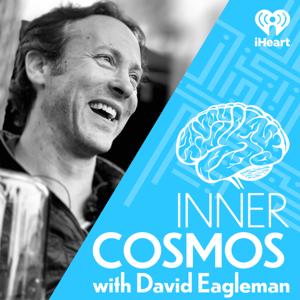
Neuroscientist and author David Eagleman discusses how our brain interprets the world and what that means for us. Through storytelling, research, interviews, and experiments, David Eagleman tackles…
Ranked by our users in the last 21 days

21,780 Listeners

78,291 Listeners

31,916 Listeners

43,352 Listeners

14,356 Listeners
5,658 Listeners

26,240 Listeners

939 Listeners

6,429 Listeners

4,659 Listeners
924 Listeners

11,943 Listeners

244 Listeners

4,172 Listeners

2,360 Listeners

8 Listeners

8 Listeners

352 Listeners

63 Listeners

250 Listeners

2,011 Listeners

142 Listeners

237 Listeners

1,551 Listeners

839 Listeners

63 Listeners

277 Listeners

159 Listeners

1,036 Listeners

18 Listeners

192 Listeners

1,622 Listeners

59 Listeners

34 Listeners

26 Listeners