
Sign up to save your podcasts
Or



Based on Podcast App listening data
We're the single species who composes symphonies, erects skyscrapers, builds computers, and regularly gets off the planet. But how did human intelligence evolve from our ancestors in the animal kingdom? And now that our species is scintillatingly shrewd, what does a knowledge of our road mean as we work to build intelligence artificially? Join Eagleman this week with Max Bennett, an especially smart human who illuminates a path through the 600 million year story of brain power in his book "A Brief History of Intelligence".
Why are conspiracy theories a natural output of the brain? What do they have to do with puzzle-solving, cognitive dissonance, ingroups/outgroups, and storytelling? If you hear an unlikely explanation for something, what are effective and ineffective ways to assess it? Join Eagleman to understand from the point of view of the brain why conspiracy theories have always been so pervasive in human societies.
Did magicians discover tricks of the mind centuries before neuroscientists? Why can’t you see what they’re doing right in front of you? How do magicians steer your attention or appear to read your mind? Dive into the trapdoors of the human brain which allow the mind to get fooled. Join Eagleman with several guests: magician Robert Strong and cognitive neuroscientists Stephen Macknik and Susana Martinez-Conde.
If you could get a kiss from your favorite celebrity, how long would you want to wait before receiving it? And why do things seem less meaningful or joyful over time than they were at the beginning? What does any of this have to do with Netflix releasing all the episodes of a new show at once, or why companies come out with new and improved products every year, or why French revolutionaries wanted to make a week five days long instead of seven? Join Eagleman and cognitive neuroscientist Tali Sharot to find out why everything dulls with time and what we can do to recover the shine.
Why do we have so much circuitry in the brain devoted to faces? Why does your electrical plug seem to look like a little face? Did aliens plant a signal for us on Mars, or are we looking at a quirk of our own brains? What is face blindness and what is a super recognizer? What does any of this have to do with looking at a magazine upside down, or why computer algorithms sometimes think a jack-o'-lantern is a person? Join Eagleman for a deep dive into something so fundamental as to be typically invisible.
The brain easily forms ingroups and outgroups – and shows different responses when viewing one or the other. At the extreme, the brain stops seeing outgroup members as people, but more like objects. But are there ways to rehumanize? And in this context, what do heroes look like? In this episode, Eagleman talks with two men -- Maoz Inon and Aziz Abu Sarah -- one Israeli and one Palestinian. The two men, full of pain and sorrow, are fighting. But they are fighting side by side. They are fighting to repair the future. Learn what peacebuilders are, how they function, and what this has to do with the neuroscience of dehumanization, ingroups, outgroups, and the possibilities -- both political and neural -- for rehumanization.
Why do you sometimes feel that you trust this person but not that one -- for reasons you can't quite put your finger on? What signals does the brain vacuum up in your daily life, and what fraction of those does your conscious mind have access to? When does intuition steer us wrong? And what is the future of intuition, as we build new technologies to take the myriad signals racing around in the dark of our brains and bodies and bring them to light? Join Eagleman and his guest, cognitive neuroscientist Joel Pearson, to unpack when to trust and when to ignore the signals of intuition.
Why do we believe our own truths so strongly? What is steel-manning, and why is it so important? What does any of this have to do with F. Scott Fitzgerald, John Keats, or the future of our society? This week's episode deals with polarization and what we might do about it. Join Eagleman and his guest Isaac Saul, who works to represent different points of view in his newsletter Tangle -- all in the name of the intellectual humility that can blossom from grappling with conflicting ideas.
How do brains picture things internally, and how might you and I imagine differently? How have recent discoveries completely changed the debate and the way we understand internal experience? What does this have to do with Disney's Fantasia, or Pixar's aphantasia? Strap in for some very wild surprises today about our internal experiences, with guest Ed Catmull, founder of Pixar Studios.
From a neuroscience point of view, what is creativity? How does it shine light on the current lawsuits over large language models and whether they produce anything fundamentally new... or are simply remixing the old? How do the arts expose something important about what's happening in the human brain? What do we know about the cultural evolution of ideas? And what does any of this have to do with how cell phones got their names, and why koala bears don’t write novels? Join Eagleman and his guest, composer Anthony Brandt, as they uncover the surprises about creativity.
From the publisher's feed
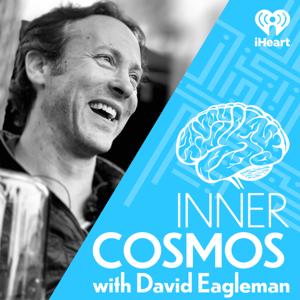
Neuroscientist and author David Eagleman discusses how our brain interprets the world and what that means for us. Through storytelling, research, interviews, and experiments, David Eagleman tackles…
Ranked by our users in the last 21 days

21,780 Listeners

78,291 Listeners

31,916 Listeners

43,352 Listeners

14,356 Listeners
5,658 Listeners

26,240 Listeners

939 Listeners

6,429 Listeners

4,659 Listeners
924 Listeners

11,943 Listeners

244 Listeners

4,172 Listeners
2,360 Listeners
8 Listeners

8 Listeners

352 Listeners

63 Listeners

250 Listeners
2,011 Listeners

142 Listeners

237 Listeners

1,551 Listeners

839 Listeners

63 Listeners

277 Listeners

159 Listeners

1,036 Listeners

18 Listeners

192 Listeners

1,622 Listeners

59 Listeners

34 Listeners

26 Listeners