
Sign up to save your podcasts
Or



Based on Podcast App listening data
Why are brains superstitious? Would you wear a nice sweater that belonged to a murderer? What does this have to do with lucky socks, ghosts, our interpretation of coincidences, why kids often need their special blankets, and what any of this has to do with the brain? Join this week with guest Bruce Hood to learn why it's so natural for brains to take incomplete data and infer causes.
How have humans through the ages tried to crack the mysteries of the brain, and why are our theories always yoked to the most recent technologies? What does the history of brain science have to do with bumps on the skull, electricity, Frankenstein, animatronics, telegraphs, telephone exchanges, computers, and LLMs? What's the next metaphor we'll use to try to capture the brain’s magic? Join this week with guest Matthew Cobb.
Most people claim to be in favor of free speech, but they often mean speech from their own side (and not whatever those crazy people on the other side want to say). But from the point of view of the brain, why does free speech need to be rigorously defended? What does this have to do with internal models, printing presses, college campuses, John Stuart Mill, online indecency, cultures of honor, Robinson Crusoe, cancel culture, the importance of literature, and why free speech makes everyone safer?
Are there new colors you could see? And why are they impossible to imagine before you've seen them? Can you lose your color vision? And what does any of this have to do with linguistic color terms, why the military likes colorblind people for a particular task, and why Eagleman suggests that the cultural history of Thailand was influenced by one single, unknown neurodivergent?
Why do birds and bees choose different flowers? Why do mammals' eyes seem to be optimized for moving around at night, and what does that have to do with hairless humans getting angry? What does any of this have to do with road signs, camouflage, mantis shrimp, the sun, the dress that broke the internet, and women who can see more colors than you can?
Would you eat a burger grown from a human muscle cell? Would you rather use your own cell or someone else's? What does the future of lab-grown meat illuminate about neuroscience, our calculations of morality, and whether your grandchildren will have a different answer? What does any of this have to do with endangered species, the sacred versus the profane, brain plasticity, moral positioning, social belonging, stepping on the boundary between mental categories, flesh copyrights, and the future of personhood?
Why do some people jump into entirely new categories of possibility? And what does this have to do with self-driving ships, solar panels in space, shooting mosquitoes with lasers, skateboarding tricks, silent drones, and our future as a species? Join Eagleman with guest Pablos Holman, a venture capitalist, author, and connoisseur of invention.
What is code, and can it be thought of like a magic spell? Are we building a world so complex that we will lose the ability to understand its operations -- and has that already happened? What does any of this have to do with SimCity, or knowledge that already exists but no one has put together, or how coding will evolve in the near future? Join Eagleman with scientist Sam Arbesman, who has just written a book asking the question: what is code, really?
What is intelligence? If we look hard, can we find it in unexpected places: not just in brains but in all kinds of structures? How should we recognize it? And what does any of this have to do with a bipedal dog born without front legs, or making small new organisms out of single cells, or how Wikipedia might be like an axolotl, or why we are so blind to the vast variety of minds that might surround us? Join Eagleman with guest Michael Levin, professor at Tufts, about how we might discover intelligence all around us in ways we don't typically intuit.
Can we explain consciousness as emerging from classical neuroscience, or do we require deeper principles? Could quantum physics have something to do with it? Is it possible that consciousness predates biology, and biology evolved to take advantage of it? What are the right ways to build new theories in neuroscience when we don’t know the answers? Join Eagleman with Nobel laureate Roger Penrose and anesthesiologist Stuart Hameroff to explore the controversial idea that there could be, even possibly, any connection between quantum theory and our awareness of the world.
From the publisher's feed
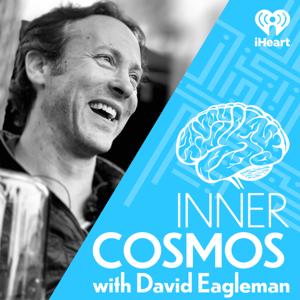
Neuroscientist and author David Eagleman discusses how our brain interprets the world and what that means for us. Through storytelling, research, interviews, and experiments, David Eagleman tackles…
Ranked by our users in the last 21 days

21,780 Listeners

78,291 Listeners

31,916 Listeners

43,352 Listeners

14,356 Listeners
5,658 Listeners

26,240 Listeners

939 Listeners

6,429 Listeners
4,659 Listeners
924 Listeners
11,943 Listeners
244 Listeners

4,172 Listeners

2,360 Listeners
8 Listeners
8 Listeners

352 Listeners

63 Listeners
250 Listeners

2,011 Listeners

142 Listeners

237 Listeners
1,551 Listeners

839 Listeners
63 Listeners

277 Listeners

159 Listeners

1,036 Listeners
18 Listeners

192 Listeners

1,622 Listeners

59 Listeners
34 Listeners
26 Listeners