
Sign up to save your podcasts
Or



Based on Podcast App listening data
What does The Matrix tell us about the brain and time perception? And what does that have to do with champion bicyclists, hidden data, elementary particles, secret murderers, or time machines? Today’s episode is about slow motion: what’s going on in the brain, and why we are so mesmerized by it. Whether watching a sword battle, basketball dunk, or sprinters, we're pulled to slow motion like moths to flame... but have you ever wondered from a neuroscience perspective what that’s all about? Me too, and hence today’s 100th weekiversary episode.
Your brain occasionally cooks up falsehoods that you believe entirely, but why does this confabulation happen, and how frequently? What does this tell us about memory, truth-telling, and your life as a story that drifts? And what does this have to do with a paralyzed Supreme Court judge, a blind person who insists she can see, whether Nelson Mandela did or did not die in the 1980s, or whether Curious George had a tail?
How many people are having relationships with artificial neural networks? Should we think of AI lovers as traps, mirrors, or sandboxes? Is there a clear line between relationship bots and therapist bots? And what does this have to do with Eliza Doolittle, a doll cabinet in your head, loneliness epidemics, or suicide mitigation? Join Eagleman with guest researcher Bethanie Maples to discover where we are and where we're going.
You're defined in part by the genome you arrive with -- so what does it mean when you can edit it? What does this have to do with viruses, copy-pasting, and whether we will modify the story of our own species? Join Eagleman with guest Trevor Martin, CEO of Mammoth Biosciences, for this week's episode about the remarkable situation we find ourselves in, now that we know how to read and write our biological inheritance.
Now that we’re careening into our AI future, what are the most important things for our students to learn? Do we keep teaching as we always have, do we drop our heads on the desk, or are there clever ways to steer and optimize education? What would Sal Khan, founder of Khan Academy, say about all this? Find out in this week's episode.
How can we rethink schools to meet the future? What does this have to do with the invention of the printing press, the prevalence of desk calculators, or the spread of Google? And how is this connected to the writer Goethe, a digital replica of the philosopher Aristotle, or the two lasting bequests that we should give our children? Join Eagleman this week for surprises about what AI means for the next generation.
Do you perceive red the same way I do? What is wrong with the textbook model of vision? Why do brains have so many internal feedback loops? And what does any of this have to do with Plato’s cave, Ernest Hemingway, or artificial neural networks that perceive dogs everywhere? Join Eagleman with guest Anil Seth, author of “Being You”, to explore the scientific problem of consciousness.
Meet David Eagleman - neuroscientist, author, and more. He is best known for his work on sensory substitution, time perception, brain plasticity, synesthesia, and neurolaw and is currently a neuroscientist at Stanford University. I thoroughly enjoyed picking his brain and I hope you enJOY too!
How will creative people make a living in a world with AI? Is there a different way to think about the economy of the future -- and how might it involve mystifying and elevating humans? What does the term “data dignity" mean? Join Eagleman with guest Jaron Lanier -- computer scientist, artist, futurist -- as they discuss AI's boundless creative output and how we might thoughtfully navigate into the future.
How are secrets in the brain like Abraham Lincoln’s political cabinet? Will AI in the near future hide things from you? And what does any of this have to do with political hierarchies, the formula for Coca-Cola, or deceptive chimpanzees? Join Eagleman to understand what neuroscience tells us about secrets: what they are, why they weigh on us, and how they sometimes grow into tangled webs we never meant to weave.
From the publisher's feed
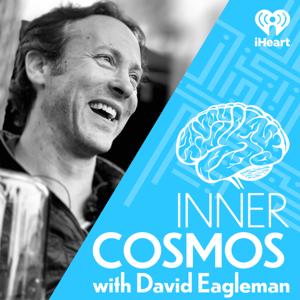
Neuroscientist and author David Eagleman discusses how our brain interprets the world and what that means for us. Through storytelling, research, interviews, and experiments, David Eagleman tackles…
Ranked by our users in the last 21 days

21,780 Listeners

78,291 Listeners

31,916 Listeners

43,352 Listeners

14,356 Listeners
5,658 Listeners

26,240 Listeners

939 Listeners

6,429 Listeners

4,659 Listeners
924 Listeners

11,943 Listeners

244 Listeners

4,172 Listeners

2,360 Listeners
8 Listeners

8 Listeners

352 Listeners

63 Listeners

250 Listeners

2,011 Listeners

142 Listeners

237 Listeners

1,551 Listeners

839 Listeners

63 Listeners

277 Listeners

159 Listeners

1,036 Listeners

18 Listeners

192 Listeners

1,622 Listeners

59 Listeners

34 Listeners

26 Listeners