
Sign up to save your podcasts
Or



Show notes: https://www.leanblog.org/407
My guest for Episode #407 is Joy Mason, a Strategist, Author, Speaker, and Entrepreneur based in Indianapolis. He is President and Senior Business Strategist at her company, Optimist Business Solutions, that she started after 18 years at Eli Lilly.
She is the author of the book The Optimist Workbook: 5 Steps to Sustainable Solutions for Women In Business and also Purpose: A Shift from Driving It to Embracing It.
Topics and questions in today's episode include:
The podcast is sponsored by Stiles Associates, now in their 30th year of business. They are the go-to Lean recruiting firm serving the manufacturing, private equity and healthcare industries. Learn more.
This podcast is part of the #LeanCommunicators network.
Veterinarian & Entrepreneur, Ivan Zakharenkov, DVM
My guest for Episode #406 is Dr. Ivan Zakharenkov, he's a doctor of veterinary medicine and he's Chief Executive Officer at the company Veterinary Integration Solutions. He goes by Dr. Zak for short and he's based in Brantford, Ontario, Canada.
I'm joined, as my co-host, by Chip Ponsford, DVM — he was also co-host of Episode #254 with a veterinarian as our guest then, as well. Chip also has a blog called Lean Vets and a book titled Lean Veterinary Practice Management.
Today, we all talk about the important issue of burnout — Ivan wrote a whitepaper on the subject and you can download that as a PDF: “Lean Thinking in Veterinary Organizations to Improve Employee Experience.” He also wrote an MBA dissertation of the same name. In that research, he considered a correlation between human and animal healthcare and proposed that lean thinking can help reduce burnout.
This is a topic that we've explored twice on the podcast with Dr. Paul DeChant, looking at it in the realm of “human healthcare.” I agree that Lean can be part of the solution, in these settings and elsewhere!!
Topics and questions include:
I interviewed Adam a year ago... and his concept (The Wheel of Sustainability) is now a book!
Check out the original episode and enter to win here:
https://www.leanblog.org/2020/03/podcast-362-adam-lawrence-on-kaizen-events-the-wheel-of-sustainability/
CEO at DeondraWardelle.com, Co-host of "KataCon7"
For show notes and discount codes for KataCon7 and for Deondra's workshop, go to http://leanblog.org/405 or scroll down.
My guest for Episode #405 is Deondra Wardelle, CEO of her own company and one of the hosts of next week's virtual KataCon7 event. She is, among other things, a Visionary, Coach, Strategist, Speaker, Consultant, Kata Geek, Leader of the #RootCauseRacism Movement. Her mission is developing a world of problem-solvers.
You can register for 10% off of KataCon7 by using code LF10 (thanks to Lean Frontiers for that code). Deondra is also doing a Strategic Vision Board Workshop on Saturday and you can register with a 20% discount by using code LEANBLOG.
In today's episode, Deondra shares how and why she became a “Kata Geek” and how that built upon her continuous improvement foundations from her time in manufacturing. We'll talk about the similarities with Lean across industries (“it's always going back to the people”) and what “Respect for People” means to her. Deondra shares stories about how Kata helped her become a better manager — less of a micromanager. We also discuss communities including Lean Communicators and Women in Lean.
All of that — and more — in this episode… released early because of the timing with these two events — KataCon7 and Deondra's workshop.
The podcast is sponsored by Stiles Associates, now in their 30th year of business. They are the go-to Lean recruiting firm serving the manufacturing, private equity and healthcare industries. Learn more.
Senior Director, Enterprise Continuous Improvement at Cleveland Clinic
Show notes: https://www.leanblog.org/404
My guest for Episode #404 is Nate Hurle, a Senior Director of Enterprise Continuous Improvement at Cleveland Clinic. He was previously a guest on Episode 282. He was also recently a virtual keynote speaker for the Society for Health Systems annual conference.
Today, Nate shares stories and reflections from the past year — the pandemic year — and how Cleveland Clinic quickly stood up drive-thru testing, how they built a 1000-bed hospital (that thankfully wasn't needed), and how they've been ramping up Covid vaccination.
What happened when Nate got a surprise phone call about the need for testing to be up and running “in a few days.” Why was the approach of “get it up and running… then make it better” a useful one and how were mockups and other methods used to put safety first, given the cars and people on foot.
How did they utilize effective standardized work and training methods, huddles, and continuous improvement methods? Why was the question of “What's the most important problem to solve?” such a useful one?
How are they balancing the need for higher throughput with having a patient experience that's not too rushed? How did Cleveland Clinic get so much done in such a short period of time, and what were the lessons learned that could be applied in more normal times? Why is Cleveland Clinic now looking to continuously improve (again) their Cleveland Clinic Improvement Model?
We also chat a bit about their adoption of “Process Behavior Charts” (as I have written about) and we'll talk about that more in a future episode.
Thanks for listening! Please subscribe (or follow), rate, and review!
Show notes: https://leanblog.org/403
My guest for Episode #403 is Arnout Orelio, author of the book Lean Thinking for Emerging Healthcare Leaders: How to Develop Yourself and Implement Process Improvements.
Arnout is from the Netherlands, but we have crossed paths a number of times when he and many of his Dutch colleagues have come to the U.S. for events like the Lean Healthcare Transformation Summit, produced by Catalysis. His book, written in English, has a lot of great lessons for leaders and Lean practitioners in American healthcare and beyond. He has also written two books in Dutch.
Arnout and I have strikingly similar professional backgrounds and paths, which we discuss in the episode. We are both engineers who progressed from the automotive industry into healthcare. We talk about how he shifted into healthcare (in 2005, same year as me) and how this experience has reinforced that:
“Leadership is not a person, it’s a process. Everyone can be a leader if you want to change something.”
We talk about the differences in the Dutch healthcare system, at a high level, and the similarities in how Lean can be applied. We also discuss topics near and dear to my heart:
Here are his website and his publisher's websites, so please take a look.
The podcast is sponsored by Stiles Associates, now in their 30th year of business. They are the go-to Lean recruiting firm serving the manufacturing, private equity and healthcare industries. Learn more.
This podcast is part of the #LeanCommunicators network.
Founder & President, Jay Hodge & Associates
Show notes: https://www.leanblog.org/402
My guest for Episode #402 is Jay Hodge, the founder and CEO of Jay Hodge & Associates. He has over 25 years of operational leadership experience in companies such as Toyota, General Motors, Caterpillar, and Tenet Healthcare. Jay is also the author of The Lean Treasure Chest.
We talk about Jay's career — going from teaching the Toyota Production System at General Motors to then actually going and working at Toyota. What did Jay first learn about “efficient operations” and leadership in the United States Marine Corps?
What did Jay learn about culture and servant leadership? What was the most difficult thing about leaving Toyota and going to other environments, including healthcare? How do we teach somebody to manage and to lead instead of just promoting them?
The podcast is sponsored by Stiles Associates, now in their 30th year of business. They are the go-to Lean recruiting firm serving the manufacturing, private equity and healthcare industries. Learn more.
This podcast is part of the #LeanCommunicators network.
Co-author of the book Personal Kanban
Show notes: http://www.leanblog.org/401
My guest for Episode #401 is my friend Jim Benson, who you might know as the co-author of the book Personal Kanban (and we talked about that in Episode 155, back in 2012). He was also a guest on Episode #4 of "My Favorite Mistake" with me.
We recorded this using the LinkedIn Live platform. Jim and I have talked a lot (and collaborated) over the years, so we intentionally went into this conversation without much of a plan.
The main theme is "humane management," a phrase of Jim's that I really like. We talk about workplaces, psychological safety (listen to my episode with Amy Edmondson on that), learned helplessness, respect, autonomy, systems thinking, and more.
We also jokingly brainstorm titles for a hypothetical podcast that we would do together. He is going to join me and Jamie Flinchbaugh for the next episode of the "Lean Whiskey" podcast, by the way. Is "Mark and Jim's Vomitorium of Management Ideas" a good name? Probably not.
Jim's company, Modus Institute, has a new "Lean Agile Visual Management Certification and Accreditation Series," so please check it out.
The podcast is sponsored by Stiles Associates, now in their 30th year of business. They are the go-to Lean recruiting firm serving the manufacturing, private equity and healthcare industries. Learn more.
This podcast is part of the #LeanCommunicators network.
From the publisher's feed
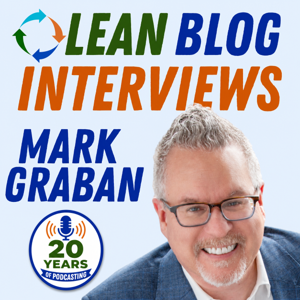
Lean Blog Interviews: Real-World Lean Leadership Conversations features thoughtful, in-depth discussions with leaders, authors, executives, and practitioners who are applying Lean thinking in the real world.
Hosted by Mark Graban—author of Lean Hospitals, Measures of Success, and The Mistakes That Make Us—the podcast explores Lean as a management system, a leadership philosophy, and a people-centered approach to continuous improvement.
Episodes span healthcare, manufacturing, startups, technology, and professional services. Guests share candid stories about what actually works—and what doesn’t—when organizations try to improve.
This is not a podcast about chasing tools, jargon, or “Lean theater.” Instead, you’ll hear honest conversations about leadership behaviors, culture, psychological safety, learning from mistakes, and building systems that help people do their best work.
If you believe improvement starts with respect for people—and that better systems beat blaming individuals—this podcast is for you.
Find show notes and all episodes at LeanCast.org.
Learn more about Mark Graban at MarkGraban.com.

32,058 Listeners
452 Listeners
1,461 Listeners

198 Listeners
15 Listeners

27 Listeners

8,564 Listeners
9,063 Listeners

20 Listeners
377 Listeners
2,438 Listeners

9 Listeners
2,204 Listeners

40 Listeners
19 Listeners

152 Listeners
1,620 Listeners
28 Listeners