
Sign up to save your podcasts
Or



My guest for Episode #275 is Katie Anderson, following up on her last appearance here in Episode #233. Now, she has been back home in California and shares some more recent reflections on her time there, what she learned, and what she continues to learn. In this episode, we talk about how Lean isn't inherently Japanese in all ways, Ashikaga (the "5S City"), a key mentor of hers (Isao Yoshino), and more.
Remastered January 2022
Episode page: https://www.leanblog.org/274
My guest for Episode #274 of the podcast is Jay Arthur, author of Lean Six Sigma for Hospitals: Improving Patient Safety, Patient Flow and the Bottom Line, Second Edition.
Jay is owner and founder of his company KnowWare International, based on Denver. Before founding that company in 1995, Jay was in a number of quality roles at US West / Qwest from 1973 to 1995. He has a BS in Systems Engineering from the University of Arizona.
To me, “Lean Sigma” is often a controversial topic… not because anything is wrong with Six Sigma. Six Sigma methods can be very compatible with a Lean culture. But, “Lean Sigma” books and trainers (including Jay), paint a picture that says Lean is only about speed or efficiency and that Six Sigma is the method to improve quality.
He says pretty directly in his book that Lean helps fix all of the types of waste… except for the waste of defects. He says Six Sigma is used to address defects. That's silly.
I challenge Jay a bit about this in the podcast, and I'd like to remind the listeners that Lean and the Toyota Production System are about flow AND quality. Lean and quality go hand in hand. Lean methods, like error proofing, and mindsets, like not blaming people, can very directly improve quality.
So, I disagree with him on that point, but there are many good points in his book about not overcomplicating Lean or Six Sigma — that the goal is results (and I'd add “developing people”). I'm also glad that the phrase “Patient Safety” is in the subtitle of his book, as it is in mine.
You can read more about Jay and his bio here.
Joining me for Episode #273 of the podcast is David Veech, author of the new book Leadersights: Creating Great Leaders Who Create Great Workplaces. David is a senior lecturer in the Department of Management Sciences at Ohio State University and their Fisher College of Business, teaching in the MBOE program (see his full bio). Veech was previously a lecturer in the College of Engineering at the University of Kentucky. He joined the University of Kentucky after retiring from the US Army in 2001. He taught in the Defense Acquisition University from 1998 to 2001 and was assistant professor of military science at Stetson University from 1988 to 1991. In today's episode, we talk about his book, how his background and career in the Army influenced his views on Lean and leadership, "self-efficacy," and more.
My guest for Episode #272 is Steve Thompson, Director of Patient Driven Supply Network initiatives for Cardinal Health, a global, integrated healthcare services and products company. He is also a Lean Six Sigma Master Black Belt, dating back to his time spent working in the automotive industry. In today's episode, we talk about his lessons learned from General Motors and Lear Corporation and how he's helping healthcare leaders apply these lessons to improve their supply chain operations. In the past year, I've had a marketing partnership with Cardinal Health, which has led to content like this webinar and article, but after meeting Scott last year and having a great chat, I'm doing this podcast outside of that formal partnership. I'm pleased to have him on the podcast.
Joining me for Episode #271 is Isaac Mitchell (@IssacMitchell), talking about Lean Design for healthcare, the Society for Health Systems, and more. Isaac is a full-time lean practitioner at East Tennessee Children's Hospital, a lecturer at the University of Tennessee's Department of Industrial and Systems Engineering, and an instructor for the Institute of Industrial and Systems Engineers. You can read his bio (PDF) and learn more about Isaac via his personal website. Scroll down to the show notes for links to a special Lean Hospitals book excerpt and more free downloads about Lean Design and Isaac's work at ETCH.
My guests for Episode #270 of the podcast are two physicians: Paul DeChant, MD and Diane Shannon, MD. They are co-authors of the recently-released book Preventing Physician Burnout: Curing the Chaos and Returning Joy to the Practice of Medicine. Paul was previously a guest for Episode #230. In this episode, we talk about the symptoms and causes of burnout for physicians and other healthcare professionals. We also talk about how Lean, in particular "Lean done right," can help prevent or even reverse burnout by eliminating some of the systemic causes, such as the never-ending chaos that exists in far too many organizations.
Joining me for Episode #269 are Brian MacNeice & James Bowen, co-authors of the recently released book Powerhouse: Insider Accounts into the World's Top High-performance Organizations. They are founders of the international Kotinos Partners consultancy. In this episode, we talk about the book and take a deeper dive into two of the organizations they profiled: Toyota and Mayo Clinic. I think it's always interesting to see what people outside of our "Lean community" see when they study Toyota. They describe how "continuous improvement is at the heart of Toyota's high-performance model." And, as somebody committed to healthcare improvement, I'm always curious to learn lessons from organizations like Mayo Clinic. The authors write about a key driver of the Mayo Clinic's success being its "commitment to collaborative medicine."
My guest for Episode #268 is a long-time friend of mine in the Lean community and Lean Enterprise Institute circles, Tom Ehrenfeld (@tomehrenfeld). Tom is a writer and editor living in Cambridge, MA. A former writer/editor with Inc. Magazine and Harvard Business Review, he is the author of The Startup Garden: How Growing A Business Grows You. He works as a consulting editor for LEI and with many other Lean authors. He's a regular contributor to LEI's "The Lean Post." Eight of his edited books have won the Shingo Research Award. Today, we talk about some of the books he's played a role with, we'll talk about the evolution of the understanding of Lean, and his thoughts on shifting from his experience covering startups to thinking about "The Lean Startup" methodology in more recent years.
Joining me for Episode #267 is Stephen M. Shortell PhD, MPH, MBA. He is Blue Cross of California Distinguished Professorship, HPM and is a Professor of Organizational Behavior at the University of California Berkeley School of Public Health. He is the director of the Center for Healthcare Organizational and Innovation Research (CHOIR). Today, we are talking about Lean healthcare and a new initiative that's part of CHOIR called CLEAR: the Center for Lean Engagement & Research in Healthcare. You can read a release about CLEAR, which highlights funding coming from the Lean Enterprise Institute, the ThedaCare Center for Healthcare Value, and Rona Consulting Group. In this episode, we talk about the Center, their planned research, and some reasons why there is variation in what organizations would describe as "Lean" - variation in methods and approach as well as variation in results.
From the publisher's feed
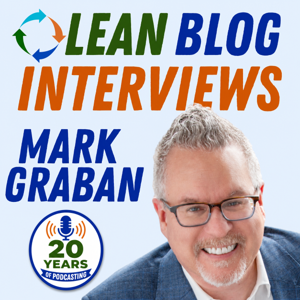
Lean Blog Interviews: Real-World Lean Leadership Conversations features thoughtful, in-depth discussions with leaders, authors, executives, and practitioners who are applying Lean thinking in the real world.
Hosted by Mark Graban—author of Lean Hospitals, Measures of Success, and The Mistakes That Make Us—the podcast explores Lean as a management system, a leadership philosophy, and a people-centered approach to continuous improvement.
Episodes span healthcare, manufacturing, startups, technology, and professional services. Guests share candid stories about what actually works—and what doesn’t—when organizations try to improve.
This is not a podcast about chasing tools, jargon, or “Lean theater.” Instead, you’ll hear honest conversations about leadership behaviors, culture, psychological safety, learning from mistakes, and building systems that help people do their best work.
If you believe improvement starts with respect for people—and that better systems beat blaming individuals—this podcast is for you.
Find show notes and all episodes at LeanCast.org.
Learn more about Mark Graban at MarkGraban.com.

32,058 Listeners
452 Listeners
1,461 Listeners

198 Listeners
15 Listeners

27 Listeners

8,564 Listeners
9,063 Listeners

20 Listeners
377 Listeners
2,438 Listeners

9 Listeners
2,204 Listeners

40 Listeners
19 Listeners

152 Listeners
1,620 Listeners
28 Listeners